Applying to US universities if your Ghanaian family can pay
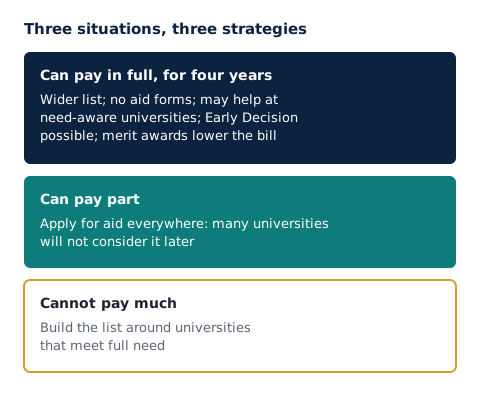
If your family can pay the full cost for four years, your list can be wider, your odds at need-aware universities may be better, and Early Decision becomes a real option. Be certain about the money first: a private US university often costs over $90,000 a year. If you can pay only part, still apply for aid, because many universities will not consider it later. Merit awards can lower the bill either way.
How should a family that can pay approach US applications?
With a wider list, a careful look at the money, and a few advantages most Ghanaian applicants do not have. A family that can pay the full cost for four years can consider any university, not only those that fund international students. At need-aware universities, not asking for aid can help. And Early Decision becomes a real option.
But be certain about the money first. A year at a private US university often costs over $90,000, and the cost usually rises each year. A plan that works for one year but not four is not a plan.
Can we really pay for four years?
Work it out before you build the list. Take the cost of attendance for international students at the universities you are considering, multiply by four, and add an allowance for rises, flights and the costs before arrival. Then ask whether the family can pay that, in dollars, without selling essential assets or relying on uncertain help.
Remember the exchange rate. A cost fixed in dollars can rise sharply in cedis if the cedi weakens, as it has in some recent years. Families paying in full carry that risk every year. Our guide to the cost of studying in the USA breaks down the full cost.
How do universities know whether we need aid?
From what you tell them on the application. The Common App and most university forms ask whether you intend to apply for financial aid. If you answer no, you do not file the CSS Profile or the university's aid forms, and the admissions office treats you as a full-paying applicant.
That answer matters, so decide it as a family before your child starts the forms, not on the night of the deadline. Our guide to the Common App from Ghana shows where the question sits.
Does not needing aid help admission?
At need-aware universities, it can. Columbia, Penn and Stanford all say they weigh an international applicant's aid request in admission, because their aid budget for internationals is limited. A student who applies without asking for aid removes that factor from the decision.
At need-blind universities, such as Harvard, MIT and Amherst, it makes no difference: they ignore the aid request either way. So the advantage is real, but only at need-aware universities, and only if the family can genuinely pay. Our guide to need-blind and need-aware explains the terms.
What if we can pay only part?
Apply for aid. You do not have to need everything to ask for something. A university calculates your need from your family's figures and fills only the gap. Columbia and Penn both say an international student admitted without asking for aid cannot ask for it later, so a family that might need help in years two or three should ask at the start.
Partial-pay families also benefit from a list that mixes universities that meet full need with those that give merit awards. Our guide to whether asking for aid hurts helps you decide university by university.
Should we use Early Decision?
It is much more practical for a family that can pay in full. Early Decision is binding: if admitted, you attend. For a family relying on aid, that is a risk, because you cannot compare offers. For a family paying in full, the risk is small, and some universities admit a larger share of their class early.
Use it only for a clear first choice, and read the agreement with your child and their counsellor before signing. Our guide to Early Decision with financial aid explains the commitment.
Can we still win scholarships?
Yes, merit scholarships. Many universities award them for achievement, whatever the family's income. The University of Rochester, for example, considers all applicants for merit awards regardless of citizenship, and Vanderbilt's full-tuition Cornelius Vanderbilt Scholarship is awarded on merit. A merit award can cut the bill substantially, even for a family that could pay without it.
Merit deadlines are often early, around 1 November or 1 December. Our guide to US merit scholarships lists them.
Which universities open up?
Almost any. With the money settled, you can weigh universities on teaching, subjects, location and fit, including state universities and specialist programmes that give international students little need-based aid. Choose universities where your child will thrive, not only the most famous.
A wider list still needs balance: a few reaches, several where your child is a strong match, and one or two where admission is very likely. Our guide to building a college list shows how to balance one.
What do we need to show for the visa?
Proof that the family can pay the first year. After admission, the university asks for a certification of finances with bank documents, then issues the I-20. At the visa interview, the officer may ask how the family will pay for the whole degree, so have a clear, documented answer. Our guide to the certification of finances explains the documents.
Is paying in full worth it?
That is a family decision, and a fair question to ask out loud. Weigh the total over four years against what the same money could do at home, against a funded place elsewhere, or against a university that offers a large merit award. A student admitted to a funded university and a full-paying one can compare the two on cost as well as fit.
Paying in full can be the right choice, for the right university and subject. It should be a choice you make with the numbers in front of you, not one you drift into because the list was built before the budget. Our guide to comparing aid offers shows how to set offers side by side.
What should we do first?
Agree, as a family, the most you can pay each year for four years, in dollars, with a margin for the exchange rate. That one number decides whether you apply for aid, whether Early Decision makes sense, and how wide your list can be.
If you would like help building a list around what your family can pay, you can book a free call with us.
Questions people ask
Can I study in the USA without a scholarship from Ghana?
Yes, if your family can show and pay the full cost. You apply in the same way, without aid forms, and after admission you prove your funds for the I-20 and the visa. Be sure the family can pay for all four years, not just the first.
Does not needing aid help my chances?
At need-aware universities, it can. Columbia, Penn and Stanford say an international applicant's aid request is weighed in admission, so a student who does not ask for aid removes that factor. At need-blind universities, it makes no difference.
What if my family can pay part of the cost?
Apply for aid. You do not have to need everything to ask for something. Several universities, including Columbia and Penn, say an international student who does not ask for aid when applying cannot ask later.
Can a family that pays still get a scholarship?
Yes, merit scholarships. Many universities award them on achievement, not need. The University of Rochester, for example, considers all applicants for merit awards, regardless of citizenship.