Does asking for financial aid hurt a Ghanaian applicant?
At a few universities, no; at most, it can. Harvard, Yale, Princeton, MIT, Dartmouth, Brown, Amherst and Bowdoin ignore an international student's aid request when they admit. Most other universities, including Columbia, Penn and Stanford, weigh it. But if your family needs aid, ask for it anyway: an admission you cannot afford is worth nothing, and some universities will not let you ask later.
Does asking for aid hurt my chances?
At a few universities, no. At most, it can. Eight universities ignore an international student's aid request when they decide whom to admit: Harvard, Yale, Princeton, MIT, Dartmouth, Brown, Amherst and Bowdoin. Most others, including Columbia, Penn and Stanford, weigh it.
But that is not the question that matters most. The question is whether your family can pay without aid. If it cannot, ask for aid everywhere, because an offer you cannot afford to take is worth nothing.
Where does asking cost nothing?
At need-blind universities. There, the admissions committee does not take your aid request into account. Each of the eight named above also meets the full need of the students it admits, so asking costs you nothing and the aid is complete.
For a Ghanaian student who needs full funding, these are the universities where ticking "yes" is free. They are also among the hardest in the world to get into. Our guide to need-blind and need-aware explains the terms in full.
Where can asking cost me?
At need-aware universities, which is most of them for international students. They have a limited aid budget for internationals, so they weigh your request alongside the rest of your application.
| University | What it says |
|---|---|
| Columbia | Lists aid-applicant status among the criteria it considers for international applicants |
| Penn | Need-aware for international applicants because its international aid budget is limited |
| Stanford | An international applicant's aid request is a factor in admission |
Nobody outside the university knows exactly how much the request weighs, and none publishes it. It matters most when your application is borderline. A student the committee clearly wants is often admitted with aid; one it is unsure about may lose out to a similar applicant who does not need it.
Should I leave the aid box unticked?
Only if your family can pay the full cost for four years without strain. That is often more than $90,000 a year at a private university. For almost every Ghanaian family, that means the answer is no.
There is a second reason. Several need-aware universities, including Columbia and Penn, say an international student admitted without asking for aid cannot ask for it later. If you leave the box unticked and are admitted, you hold a place with no aid, at a price your family cannot meet.
Can I ask for less to look like a safer bet?
No. You do not choose how much aid you receive. The university works out your need from your family's figures on the aid forms. You cannot request a smaller amount, and there is no box for it.
Changing the figures to look less needy does not work either. Any figure you make up is a false statement, and documents usually show the truth. If the university calculates a lower need from false figures, your family is left with a bill it cannot pay. If the falsehood is found, you can lose the place.
What if my family can pay part of the cost?
Ask for aid anyway, and let the university work out how much. A family that can pay some of the cost has a smaller need, and the university fills only that. You do not have to need everything to ask for something.
Before you decide, check two things:
- What your family can pay each year, for four years. Not this year alone. A family that can manage $20,000 in the first year but not after needs aid from the start.
- What each university's net price calculator suggests, where it suits international families. Our guide to the net price calculator shows how.
If the family can genuinely pay the full cost without hardship, applying without aid is a reasonable choice at a need-aware university. If there is any doubt, ask. You cannot go back and ask later at many of them.
How do I decide, university by university?
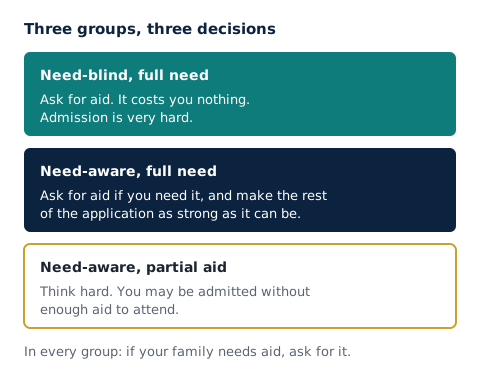
Sort your list into three groups, and treat each differently:
- Need-blind, full-need. Ask for aid. It costs you nothing.
- Need-aware, full-need. Ask for aid if you need it, and make the rest of your application as strong as it can be. These universities fund you fully if they admit you.
- Need-aware, partial aid. Think hard about whether these belong on your list. You may be admitted with too little aid to attend.
Put most of your list in the first two groups. Our guide to universities that meet full need names the universities in each.
How can I strengthen an application to a need-aware university?
By making the committee sure it wants you, so the aid request matters less. The request weighs most on borderline applications, so move yours away from the borderline:
- Fit the university's list well. Apply where your record sits in or above the middle of admitted students, not only where it would be a reach.
- Write supplements for that university alone. Specific reasons to be there, from your own interests, show a committee you would come.
- Show depth. One or two activities with clear results beat a long list.
- Get recommendations from teachers who know you well.
None of this guarantees admission. It gives your application the best chance of carrying an aid request.
Does applying early change the picture?
Sometimes. Some need-aware universities admit a larger share of applicants in their early round, but an early round can also be binding. Early Decision commits you to attend if admitted with enough aid. Read our guide to Early Decision with financial aid before you use it to improve your chances.
What should I do first?
Mark every university on your list as need-blind or need-aware for international applicants, and whether it meets full need. If your family needs aid, plan to ask for it at every one of them.
If you would like a second opinion on how your list balances the two kinds, you can book a call with us.
Questions people ask
Will asking for financial aid reduce my chances of admission?
At need-blind universities, no. At need-aware universities, it can, because their aid budget for international students is limited. The effect is usually greatest for applications on the borderline.
Can I apply without aid and ask for it after I am admitted?
Usually not. Columbia and Penn, for example, say an international student admitted without asking for aid cannot ask for it later. Ask when you apply if you will need it.
Can I ask for a smaller amount of aid to improve my chances?
No. You do not choose the amount. The university calculates your need from your family's figures. Changing the figures to look less needy is a false statement and can cost you the place.
Should I apply only to need-blind universities?
No. They admit very few international students. Need-aware universities that meet full need fund the internationals they admit, so they belong on your list too.