Certification of finances for Ghanaian students
It is the form that proves your family can pay whatever your aid does not cover for the first year. The university needs it before it issues your I-20, the document your student visa depends on. Most universities ask for it after admission, a few with the application. You show the year's cost minus your aid, with a signed form and a recent bank letter or statement. With a full scholarship, the amount can be small.
What is a certification of finances?
It is the form that proves your family can pay whatever your aid does not cover for the first year. The university needs it before it can issue your I-20, the document your student visa depends on. No certification, no I-20, no visa.
Different universities give it different names: certification of finances, certificate of finances, financial certification or declaration of finances. They all do the same job. You complete a form, a sponsor signs it, and bank documents back it up.
When do we submit it?
Usually after admission, when you accept your offer and ask for your I-20. A few universities ask for it earlier. Johns Hopkins, for example, asks international applicants to document their funding as part of the admissions application.
Check each university's international admissions page early, and note whether it wants the form:
- With the application, so it is part of your file from the start.
- After admission, usually in April or May, through the new student portal.
- Only if you are not applying for aid, at some universities.
Universities that meet full need usually ask for it after admission, once your aid is known.
How much money do we need to show?
The first year's cost of attendance, minus any aid the university has awarded. The university tells you the cost of attendance, and your offer letter shows the aid. The difference is the amount your documents must cover.
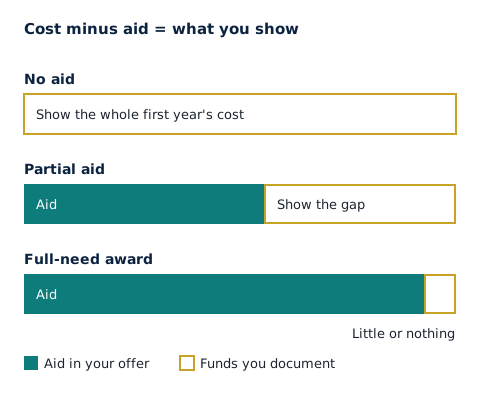
Three cases show how much this varies:
| Your offer | What you must show |
|---|---|
| No aid | The whole first year's cost, often more than $90,000 at a private university |
| Partial aid | The gap between the cost and the aid |
| Full-need award with a small family contribution | That family contribution, which can be a few thousand dollars or nothing |
If your aid covers everything, the aid letter itself usually serves as the evidence. You may still need to show a small amount for personal costs.
Do we have to show money for all four years?
Usually only for the first year. The I-20 shows one year's estimated costs and how they will be paid, and the certification supports that one year.
But the question of later years does not disappear. At the visa interview, a consular officer can ask how the family will pay for the whole degree. A four-year aid award, renewable each year, is the clearest answer. If your offer is partial, be ready to explain how the family will cover the gap in years two, three and four, not only in the first.
If your family's finances change after you submit, before the I-20 is issued, tell the university. A changed sponsor or a smaller balance needs new documents, and it is far better to fix them now than at the interview.
What documents do we need?
Three things, at most universities:
- The completed form, signed by the student and the sponsor.
- A bank letter or statement for each account you rely on, usually dated within the last six months. It should be on the bank's letterhead or carry its stamp, and show the account holder's name and the balance.
- A sponsor statement, if anyone other than the student is paying: the sponsor's name, address, relationship to the student and signature.
Some forms also ask for a bank official's signature on the form itself. Read the instructions for each university's version, because the details differ.
How do we get the bank documents in Ghana?
Ask your bank for an official balance letter or a certified statement, in English, on letterhead and stamped. Tell the bank it is for a US university and a student visa. Most banks in Ghana produce these letters regularly.
Three details save delays:
- Currency. Ask whether the university wants the balance in cedis, dollars or both. Where it does not say, cedis with a stated dollar equivalent at a named rate and date is clear.
- Account holder. The name on the account must match the sponsor on the form.
- Timing. Request the letter close to when you submit, so it is within the university's time limit.
Who can be our sponsor?
Parents, other relatives or another sponsor, such as a family friend or an organisation. Each sponsor signs the form and provides their own bank documents. More than one sponsor can share the amount, as long as the total covers it.
An outside scholarship counts too. If a foundation, a company or a government body is paying part of your costs, its award letter can serve as evidence for that part. The letter should name you, the amount, the period it covers and how the money will be paid. Send it with the form, alongside any family documents for the rest.
Choose sponsors whose funds are real and documented. The same evidence may come up again at the visa interview, where the consular officer can ask how the family will pay. Our guide to the cost of studying in the USA lists the costs that come before the first term.
What happens after we submit it?
The university checks the form and documents, then issues your I-20. You then pay the SEVIS fee, complete the visa application and book an interview at the US Embassy in Accra. If anything is missing, the university writes to you, and the I-20 waits until it is fixed.
Submit as early as the university allows. Visa appointments can fill in the summer, and a late I-20 pushes everything back.
What should we do first?
For each university on your list, find out when it wants the certification and in what form. Once offers arrive, subtract the aid from the cost of attendance for the one you choose. Then ask your bank for the letter.
If you would like help preparing the certification and the documents behind it, that is part of the Scholarship and Aid Sprint.
Questions people ask
What is a certification of finances?
A form that shows a US university your family can pay for the first year, after any aid. It is backed by bank documents and a sponsor's signature. The university uses it to issue your I-20.
When do I submit the certification of finances?
Usually after admission, when you accept the offer and request your I-20. A few universities ask for it with the application. Check each university's international admissions page.
How much money do we need to show?
The first year's cost of attendance minus any aid the university has awarded. With a full-need or full-ride award, it may be only a few thousand dollars, or nothing. Without aid, it is the whole year's cost.
Can a relative sponsor me?
Yes. Universities accept funds from parents, other relatives or a sponsor. The sponsor signs the form and provides their own bank documents, and states their relationship to you.
How recent must the bank statement be?
Recent, usually within the last six months, on the bank's letterhead or with its stamp, showing the account holder's name and the balance. Check each university's exact rule.