Building a college list for full aid from Ghana
Build a list of about eight to twelve universities, and make most of them ones that meet full need for international students. Split it into layers: a few need-blind universities, several need-aware ones that still meet full need, and a few where your record stands out and aid for internationals is strong. Add one or two funded options outside the US. Drop any university that cannot show it would fund you.
How should I build a college list if I need full aid?
Start from the money, not from the names. Build a list of about eight to twelve universities, and make most of them universities that meet full need for international students. Then balance it in layers, so you are not relying on the hardest universities alone.
A list is the single biggest decision in your application. A strong student with the wrong list can end the year with no funded offer. A careful list gives the same student several real chances.
What layers should my list have?
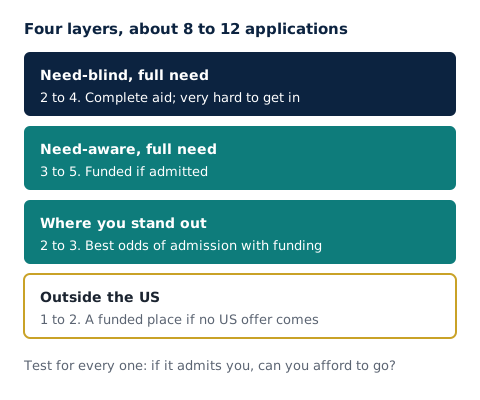
Four, each with a different job:
| Layer | What it is | How many | Why |
|---|---|---|---|
| Need-blind, full need | Asking for aid does not affect admission; full need met | 2 to 4 | Complete aid, but admission is very hard |
| Need-aware, full need | Aid request is weighed; full need met if admitted | 3 to 5 | Funded if admitted; more of them to try |
| Where you stand out | Your record near the top of their applicants; strong aid or merit for internationals | 2 to 3 | Your best odds of admission with funding |
| Outside the US | A funded option elsewhere, such as Canada or a Mastercard Foundation partner | 1 to 2 | A funded place if no US offer comes |
The ranges are a starting point, not a rule. A student with an exceptional record might weight the first two layers more. A student whose record is strong but not exceptional should weight the third.
Why not just apply to the most famous universities?
Because they admit so few international students that a list of only them is the riskiest list of all. MIT admitted 136 of 6,926 international applicants for its class of 2029. Duke expects to enrol around 20 to 25 international students a year whose full need it meets.
Those universities belong on your list. They should not be all of it. Each layer below them adds chances the top layer cannot give.
How do I find universities for each layer?
From their own aid pages, not from rankings. For the first two layers, our guide to universities that meet full need names the best-known ones. For the third layer, look for universities where:
- Your grades and achievements sit in or above the middle of their admitted students, as their published profiles show.
- Their international aid page says they fund international students, with need-based aid, merit awards or both.
- Their Common Data Set shows real numbers of international students receiving aid.
Our guide to finding universities that fund you shows how to run those three checks on any university.
Does what I want to study change my list?
Yes, in two ways. First, check that each university offers your subject. Engineering, nursing and some sciences are not taught everywhere, and many liberal arts colleges have no engineering school at all.
Second, check how flexible each university is if you change your mind. At many US universities, you do not choose your major until the end of your second year, and moving between subjects is easy. At others, you apply to a specific school, such as engineering, and switching later is harder.
So for each university, write down two things: whether it teaches what you want, and how you enter it. If you are unsure what to study, favour universities where you can explore before you choose. A funded place at a university that lets you change direction is worth more than one that locks you in.
How many universities should I apply to?
About eight to twelve, for most students who need full aid. Fewer leaves too much to chance. Many more usually means rushed supplements and more application fees, and twenty weak applications give worse odds than ten strong ones.
Think of the count as a budget of time. Each university needs its own supplements, sometimes an interview, and its own aid forms. Ten well-made applications take most of an autumn.
What should I write down for each university?
One line per university, with the facts that decide whether it stays:
- Aid policy: meets full need for internationals, or not.
- Admission policy: need-blind or need-aware for internationals.
- Your fit: where your record sits against its admitted students.
- Deadlines: admission, aid forms and any scholarship date.
- Aid forms: CSS Profile, the university's own form, or a free form.
- Testing: required, optional or not considered.
- Net price estimate, where its calculator suits international families.
A simple spreadsheet works well. When the columns are full, weak choices become obvious.
When should my list be final?
By the end of August before your final year. That gives you September to plan your essays, agree the school's part and book any tests, with every deadline already known.
You can still adjust the list in the autumn, especially if a test score or mock result changes the picture. But most of the research should be done before term starts. Our month-by-month plan shows where the list fits.
Should I use Early Decision on my list?
Only after careful thought. Early Decision is binding, so it suits a student who has one clear first choice that meets full need. Read our guide to Early Decision with financial aid before you build it into your list.
What should I do first?
Write down every university you are considering. Next to each one, write whether it meets full need for international students. Cross off any that do not, unless you have a clear reason to keep it. Then sort the rest into the four layers.
If you would like a second opinion on your list before you start writing, you can book a call with us.
Questions people ask
How many universities should a Ghanaian student apply to?
Around eight to twelve is a sensible range for a student who needs full aid. Fewer leaves too much to chance. Many more means rushed essays and more fees. Quality of each application matters more than the count.
Should my whole list be Ivy League universities?
No. They admit very few international students, and a list made only of them is the riskiest list of all. Mix them with need-aware universities that meet full need and ones where your record stands out.
Should I include universities outside the US?
Yes, one or two funded options, such as a Mastercard Foundation partner or a Canadian full award. They keep a funded place possible if no US offer comes through.
When should my list be final?
By the end of August before your final year, so you know every deadline, essay and aid form before term starts. You can still adjust it in the autumn, but most of the work should be done.