US merit scholarships open to Ghanaian students
Yes, many US universities give merit scholarships to international students, including Emory, Vanderbilt, Richmond, Rochester and Tulane. Most go to the strongest applicants at each university, many require you to apply by an early date such as 1 December, and some need a separate application. Most are partial, so aim for universities where your record is near the top, and check what each award leaves you to pay.
Can a Ghanaian student win a US merit scholarship?
Yes. Many US universities consider international applicants for merit scholarships, including Emory, Vanderbilt, the University of Richmond, the University of Rochester and Tulane. Merit awards depend on your record, not your family's income.
But merit money is competitive and usually partial. It goes to the strongest applicants at each university, often only to those who apply by an early date. Treat it as a second layer of your funding plan, beside the universities that meet full need.
Which universities give merit aid to international students?
Many, across a wide range of selectivity. These five show the variety:
| University | Award | How you are considered |
|---|---|---|
| Emory | Scholar Programs, including the Woodruff Scholarship | A separate Scholar Programs application, before December |
| Vanderbilt | Cornelius Vanderbilt Scholarship, full tuition | A separate scholarship application, with need-based aid added where your need is greater |
| University of Richmond | Richmond Scholars Program | Automatic if you apply by 1 December |
| University of Rochester | Merit scholarships, from a few thousand dollars to full tuition | Automatic for all applicants, regardless of citizenship |
| Tulane | Dean's Honor Scholarship and other merit awards | Automatic if you apply by the early deadlines |
The Ivy League and many of the most selective universities give no merit scholarships at all. Their aid is need-based only. Our guide to need-based and merit aid explains the difference.
Terms change from year to year. Read each university's own scholarship page for your year of entry before you rely on this table.
How are merit scholarships decided?
On the same application that decides admission, read more closely. Most universities look for four things:
- Academic strength. Your SHS grades, mocks and predicted WASSCE results, and any test scores you send.
- Depth in your activities. One or two things done seriously, with results, count for more than ten done lightly.
- Leadership with effect. What changed because of you, for other people.
- Fit with the scholarship's purpose. Named scholarships often describe the kind of student they want. Read the description.
Some programs add a separate essay, a recommendation or an interview, often by video for international finalists.
When do I have to apply?
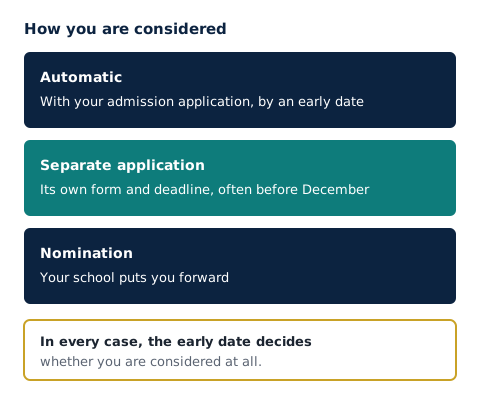
Earlier than you might think. Many universities consider you for merit only if your application is complete by an early date: often 1 or 15 November, or 1 December. Named programs with a separate application can close earlier still.
If you miss that date, you may still be admitted later in the regular round, but with no merit award. So build your calendar around each university's merit deadline, not its last admission deadline. Our page on US application deadlines lists the main dates for this cycle.
Should I apply Early Decision to get merit aid?
Usually not, if merit aid is what you are counting on. Early Decision is binding: if you are admitted, you agree to attend and withdraw your other applications. You cannot compare that university's merit award with offers from anywhere else.
Early Action is different. It is not binding, it often meets the merit deadline, and you keep every other option open. For a student who needs to compare awards, Early Action, or any early non-binding round, is usually the safer route.
There is one exception worth knowing. Some universities release you from an Early Decision agreement if the aid they offer is not enough for your family to attend. That protection rests on need-based aid, not merit. Read our guide to Early Decision with financial aid before you sign anything.
Where do I have the best chance?
At universities where your record is near the top of their applicant pool. Merit committees reward the students they most want to attract. The same student can win nothing at a university where they are typical, and a large award where they stand out.
To find those universities, compare your grades and achievements with the profile of each university's admitted students, which most publish. Then look for three signs that a university is serious about merit aid for international students:
- It says so on its scholarship page, naming international students.
- It publishes the size and number of its awards.
- It explains how merit and need-based aid combine.
If a scholarship page is silent on international students, email the admissions office and ask directly whether international applicants are considered for merit awards, and by what date. A clear answer in writing is worth more than any list online, this one included.
What does a merit award usually leave to pay?
Most of the cost, unless it is a full-tuition award. Even full tuition leaves housing, food, insurance and travel, often $20,000 or more a year. A partial award of $20,000 at a university costing $90,000 leaves $70,000.
So for each award, subtract it from the university's cost of attendance for international students, and ask whether your family can pay the rest for four years. The university will want proof of that before it issues the I-20 for your visa. Our guide to full ride and full tuition shows the arithmetic.
Can I keep a merit scholarship for four years?
Usually, if you meet its conditions. Most merit awards renew each year while you keep a minimum grade point average and study full time. Vanderbilt's full-tuition award, for example, renews while you keep at least a 3.0.
Read the renewal terms before you accept, and ask what happens if you fall short once. Some universities allow a probation semester. Others end the award at once.
What should I do first?
For each university on your list, find three things on its scholarship page: whether it gives merit aid to international students, how you are considered, and the date that decides it. Put those dates in your calendar now.
If you would like help building a list that combines merit and need-based aid, and getting every scholarship application in on time, that is what the Scholarship and Aid Sprint is for.
Questions people ask
Can Ghanaian students get merit scholarships in the USA?
Yes. Many universities consider international applicants for merit awards, including Emory, Vanderbilt, Richmond, Rochester and Tulane. Most awards are partial and go to the strongest applicants at each university.
Do I need a separate application for US merit scholarships?
Sometimes. Some universities consider every applicant automatically, while others, such as Emory's Scholar Programs, have their own application or an early deadline. Read each university's scholarship page.
When are merit scholarship deadlines?
Often earlier than the regular deadline. Several universities consider only students who apply by an early date, often 1 or 15 November or 1 December. Missing it can rule you out even if you are admitted later.
Do merit scholarships cover the full cost?
Rarely. Most are a fixed sum, and a few cover full tuition. Housing, food, insurance and travel usually remain. Some universities add need-based aid on top; others do not.