Need-blind and need-aware, explained for Ghanaians
A need-blind university ignores your aid request when it decides whether to admit you. A need-aware university can weigh it. For international students only a small group is need-blind, including Harvard, MIT, Dartmouth and Brown, so asking for aid there costs you nothing. Need-aware universities that meet full need, such as Penn, Columbia and Duke, are still worth applying to, because they meet the full need of the internationals they admit.
What do need-blind and need-aware mean?
A need-blind university ignores your aid request when it decides whether to admit you. A need-aware university can take your aid request into account.
If you need a full scholarship, this matters. At a need-blind university, ticking "yes" to financial aid costs you nothing in admission. At a need-aware one, the admissions committee weighs your request alongside your grades, essays and recommendations.
Most American pages on this topic were written for American families, and many selective universities are need-blind for them. For international applicants it is the other way round. Need-blind is the exception.
Is need-blind the same as meeting full need?
No. Need-blind is about admission. Meeting full need is about money: the university pays the gap between its cost and what it calculates your family can contribute.
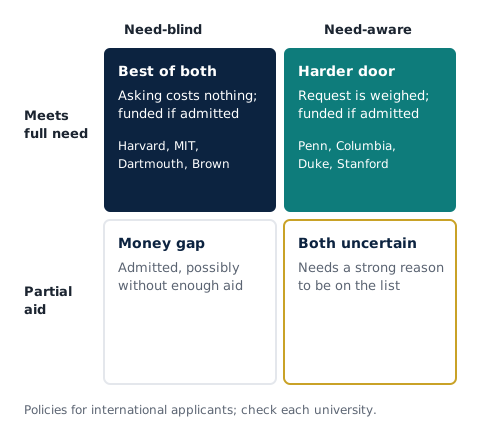
A university can make one promise without the other. Penn, Columbia, Duke and Stanford are need-aware for international students, yet each meets the full need of the internationals it admits. A need-blind university that does not meet full need could admit you without enough money to come.
Which universities are need-blind for international students?
Eight, by Brown's count: Harvard, Yale, Princeton, Dartmouth, MIT, Amherst, Bowdoin and Brown itself. Brown named the group in January 2024, when it announced it would become need-blind for international applicants. Each of the eight also meets the full demonstrated need of the students it admits.
Dartmouth's 2022 announcement said its policy covers all international applicants, Early Decision candidates included. Policies can change, so confirm each one on the university's international aid page for the cycle you apply in.
The need-aware universities that still meet full need are named in our guide to US universities that meet full need.
How much does asking for aid hurt at a need-aware university?
Nobody outside the university knows exactly, and no university publishes the figure. It matters most when the rest of your application is borderline.
A student the committee clearly wants is often admitted with aid. A student the committee is unsure about may lose out to a similar applicant who does not need aid.
What the universities do say is that they weigh the request, and that their aid budget for international students is limited:
- Columbia lists your status as an aid applicant among the criteria it considers for international applicants.
- Penn says it is need-aware for international applicants because its international aid budget is limited.
- Stanford says an international applicant's aid request is a factor in its admission decision.
- Duke says it is need-aware for international applicants, and expects to enrol around 20 to 25 a year whose full need it meets.
That has two consequences for you:
- Getting in with aid is harder than the published admission rate suggests. That rate includes applicants who pay the full cost.
- Your application has to be strong enough to carry the request. Your essays, recommendations and record all count for more.
Should I leave the aid box unticked to improve my chances?
Only if your family can pay the full cost for four years. Columbia and Penn both say an international student admitted without asking for aid cannot ask for it later.
Changing your family's figures to shrink the request does not work either. You do not choose your need: the university works it out from your family's figures. Report a higher income than you have, and you get an aid offer your family cannot meet. Any wrong figure on the form is a false statement.
How can I tell whether a university is need-blind for me?
Read its international aid page and find out who the policy covers. Many universities call themselves need-blind in large type, then say lower down that this applies to US citizens and permanent residents. For you, that line is the one that matters.
Wording to look for:
- "Need-blind for all applicants, regardless of citizenship" or "including international students": need-blind for you.
- "Need-blind for US citizens, permanent residents and...", with international students missing from the list: need-aware for you.
- "Need-aware" or "need-sensitive" for international applicants: the university weighs your request.
- "Meets 100% of demonstrated need for all admitted students": full need, whichever admission policy applies.
Check the date on the page too. Brown changed its policy for the class that entered in 2025, and Dartmouth for the class that entered in 2022. A page or blog post from a few years ago can be wrong in either direction.
If the page does not say, email the admissions office. Ask whether it admits international applicants need-blind for the cycle you are applying in. Admissions offices get this question from international applicants often.
How should this change my university list?
Spread your list across both kinds, and put most of it at universities that meet full need. Need-blind, full-need universities are reaches for almost everyone, because they admit so few. Need-aware, full-need universities weigh your request, but fund you if they admit you.
Our guide to US universities that meet full need names them and shows how to build your list in layers. Our guide to Early Decision with financial aid covers how the early round changes the picture.
What should I do first?
Mark every university on your list twice: need-blind or need-aware for international applicants, and meets full need or not. A university that is need-aware and does not meet full need needs a strong reason to stay.
You can do this sorting yourself from each university's international aid page. If you would like a second opinion on how your list balances, you can book a call with us.
Questions people ask
What does need-blind mean for international students?
It means the university ignores your aid request when it decides whether to admit you. Only a small group of US universities is need-blind for international applicants. They include Harvard, Yale, Princeton, MIT, Dartmouth, Brown, Amherst and Bowdoin.
Does applying for aid hurt my chances at a need-aware university?
It can. Columbia, Penn and Stanford all say they consider an international applicant's aid request when they decide whether to admit. The effect is usually greatest when the rest of your application is borderline.
Should I apply without aid to improve my chances?
Only if your family can pay the full cost for four years. Columbia and Penn say an international student admitted without asking for aid cannot ask for it later. You could end up with a place you cannot afford to take.
Is need-aware the same as not meeting full need?
No. Need-aware is about getting in. Meeting full need is about money once you are in. Penn, Columbia, Duke and Stanford are need-aware for international students, and each still meets the full need of those it admits.