Comparing US financial aid offers from Ghana
Put every offer on one sheet, with the same lines for each: cost of attendance, grants, work, loans and family contribution. Compare what your family pays each year after grants, then multiply by four. Check the renewal rules and how outside scholarships are treated. Then weigh what the numbers do not show, such as your course, the teaching and support for international students, before you choose.
How do I compare financial aid offers?
Put every offer on one sheet, with the same lines for each, and compare what your family pays each year after grants. Then multiply by four, add any loans as future costs, and check how each offer is renewed. Only then weigh the things money does not show.
Each university formats its letter differently, which makes offers look harder to compare than they are. One sheet with the same lines removes the confusion.
How do I set out the comparison?
As a table, one column per university. An illustration, with round figures:
| University A | University B | |
|---|---|---|
| Cost of attendance | $90,000 | $85,000 |
| Grants and scholarships | $86,000 | $72,000 |
| Work | $3,000 | $3,000 |
| Loans | $0 | $5,000 |
| Family pays this year | $1,000 | $5,000 |
| Loan to repay later | $0 | $5,000 |
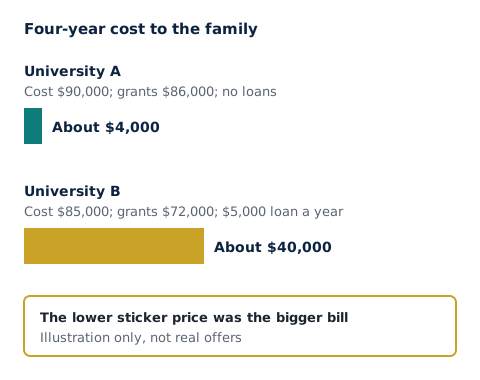
| Over four years, family and loans | About $4,000 | About $40,000 |
University A costs more on paper but far less to the family. University B's package looks generous until you see the loan and the larger family contribution. Our guide to reading an award letter explains each line.
What should I check beyond the first year?
Three things that change the four-year picture:
- Renewal. Need-based aid is recalculated each year from your family's updated forms. Merit awards may need a minimum grade point average. Ask how each university renews.
- Loans. A loan in every year's package adds up. MIT, for example, says its aid never includes loans; others include one each year.
- Outside scholarships. If you hold one, ask how each university treats it. Princeton says outside awards reduce its grant; others first reduce your work or loan.
Ask each aid office in writing, and keep the answers with the offers.
What about the exchange rate?
It affects what your family's contribution costs in cedis. A contribution of $3,000 can cost far more in cedis a year later if the cedi weakens. Families with a contribution to pay should plan for that, not just for today's rate.
The aid itself is in dollars, and need-based aid is recalculated each year from your family's figures. If the cedi falls sharply and your family's dollar income with it, your calculated contribution may fall at the next renewal. Ask each aid office how it handles large currency changes.
So when you compare offers, add a line for the family contribution in cedis at today's rate, and a second at a weaker rate, such as 20% weaker. If an offer is affordable only at today's rate, treat it as riskier than its dollar figure suggests.
What should I weigh besides money?
Once the costs are clear, the things that decide whether you will thrive:
- Your course. Does each university teach what you want, and how easily can you change if you change your mind?
- Teaching and size. Small classes and close teaching, or a large university with more specialist options?
- Support for international students. An international office, an African students' association, help with jobs and summers.
- Location and climate. A small town or a city, and how far from an international airport.
- Outcomes. Where graduates go, from each university's own published figures.
If two offers are close in cost, these should decide. If they are far apart, cost should usually win for a Ghanaian family.
How do I compare a US offer with one from elsewhere?
On the same sheet, in the same currency. A Canadian full award, a Mastercard Foundation place or a Ghana government bilateral award can be set beside US offers if you convert everything to one currency at one rate and include the same kinds of cost: tuition, housing, food, insurance, travel and visa fees.
Some differences do not show in the numbers. A preparation year, a shorter or longer degree, or a commitment to return home all affect the choice. Add a line for each, and talk them through as a family. Our guide to scholarships for Ghanaian students describes those routes.
What if an offer is incomplete when the deadline nears?
Ask the university for more time, in writing, and explain why. If an aid offer is still waiting on a document, or another university's offer has not arrived, many admissions offices will consider a short extension to the reply date. Ask early, not on 30 April.
Never accept two offers to buy time. Accepting a place commits you to it, and holding two places blocks a student on a waiting list. If you must decide before every offer is in, choose the best offer you have.
How do we decide as a family?
Together, with the sheet on the table. Sit down with your parents or guardians and walk through each column: what the family pays each year, any loans, the renewal rules and the things money does not show.
Let everyone say what matters to them, then decide on the evidence. A decision the family understands is easier to live with in the hard months of a first year abroad.
Can I ask a university to improve its offer?
Sometimes. If an offer rests on a mistake, or your family's situation has changed, you can ask the aid office to review it. Some universities also consider a competing offer from a similar university. Universities that meet full need usually change an offer only when the family's figures were wrong or have changed. Our guide to appealing an aid offer explains how.
What should I do first?
Make the comparison table today, one column for each offer, and fill in every line from the letters. Send any questions to the aid offices in writing, well before 1 May.
If you would like help comparing your offers and asking the right questions, that is part of the Scholarship and Aid Sprint.
Questions people ask
How do I compare financial aid offers?
Write each offer on one sheet with the same lines: cost, grants, work, loans and family contribution. Compare the family's yearly cost after grants, multiply by four, and note any loans you would repay.
Should I always choose the cheapest offer?
Not always, but cost should come first for most Ghanaian families. If two offers are close in cost, the right university for your course and your way of learning matters more than a small difference in money.
Can I ask one university to match another's offer?
Some universities will review an offer if you share a competing one, but universities that meet full need usually change an offer only if your family's figures were wrong or have changed. Ask politely, with documents.
When do I have to decide?
Usually by 1 May for regular admission. Ask any questions before then, in writing, so your decision rests on answers rather than guesses.