Can a Ghanaian student win a scholarship with B grades?
Yes, but not usually at the most selective universities, which mostly admit students at the very top of their schools. With mostly B grades, your realistic funded routes are universities where your record is above their typical applicant and that give aid to international students, some merit awards, and options in Ghana. A strong final WASSCE, a clear upward trend and real achievements outside class can all help.
Can I win a scholarship with mostly B grades?
Yes, but the honest answer depends on where you apply. The most selective universities that meet full need for international students mostly admit students at the very top of their schools, so with mostly B grades they are long shots. Universities where your record stands out, and that fund international students, are far more realistic.
A B is not a failure. It means your list needs to be chosen carefully, and your application needs to show what your grades alone do not.
Which funded routes are realistic?
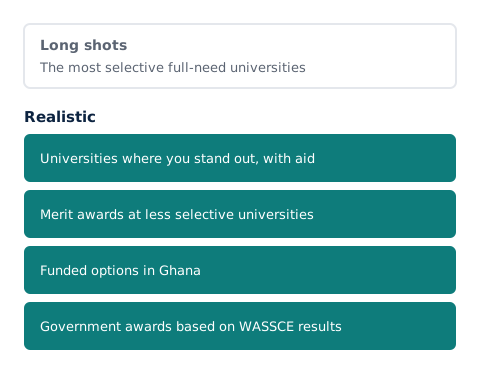
Four, roughly in order of fit:
| Route | Why it can work with B grades |
|---|---|
| Universities where you are above their typical applicant | Your record stands out there, and some give generous aid or merit to internationals |
| Merit awards at less selective universities | Merit goes to each university's strongest applicants, so a strong student there can win one |
| Funded options in Ghana | Local tertiary scholarships and university aid, including places for students in need |
| Government bilateral awards | Selected mainly on WASSCE results, so a strong final WASSCE matters most |
The University of Rochester, for example, considers all applicants for merit scholarships, regardless of citizenship. Berea College gives every international student it enrols aid covering the full first-year cost, though admission is competitive. Check each university's terms.
Which routes are long shots?
The most selective universities, including most that are need-blind for international students. They admit a very small share of international applicants, mostly students at the very top of their schools. One or two on your list, if you love them, is fine. A list built only from them is likely to end with no funded offer.
Our guide to your chances of a full scholarship explains how few places there are.
How do I find universities where I stand out?
Compare your grades with each university's published profile of admitted students, and look for ones where you are in or above the middle. Then check three things:
- It gives aid to international students, need-based, merit or both.
- It publishes how many internationals receive aid, often in its Common Data Set.
- It has a net price calculator that suits international families, or an aid office willing to estimate.
Our guide to US merit scholarships lists universities that give merit aid to international students.
What can I still improve?
More than you might think, if you start now:
- Your final WASSCE. A strong result shows an upward trend and matters most for bilateral awards and Ghanaian universities.
- Your mocks. Universities may see them, and they show where you are heading.
- Your activities. Real responsibility and results outside class can outweigh a grade or two.
- Your essays. A clear, honest personal statement helps readers see the student behind the grades.
- Context. If something affected your grades, such as illness or family responsibilities, explain it briefly. Our guide to writing about hardship shows how.
Does a B mean the same thing everywhere?
No. Readers judge grades in the context of your school. A B in a demanding subject at a school known for strict marking can mean more than an A elsewhere, and a B2 or B3 on the WASSCE is a solid credit. Your school profile and counsellor's letter should explain how your school grades and where you stand in your year.
So before you decide your grades are "only Bs", ask your counsellor or headteacher how they compare with your classmates'. Our guide to explaining Ghanaian grades shows how to give readers that context.
What about a US community college, then transfer?
It is rarely a funded route for an international student. Community colleges cost less than four-year universities, but they usually give international students little or no aid, and the family still pays living costs and the visa expenses. Transfer aid for international students at four-year universities is also often limited.
Look into it only if your family can pay the community college costs, and check the transfer and aid policies of the universities you would aim for before you start.
How do we talk about this as a family?
Honestly, and without shame. A student with mostly B grades has worked hard and has real options. Agree together that the aim is a funded place where the student will thrive, not a famous name. That makes it easier to choose the realistic routes, and easier to celebrate the offer when it comes. Our guide to how many universities to apply to helps you size the list.
What about funded options in Ghana?
Take them seriously. The Ghana Scholarships Authority's local tertiary scholarships keep places for brilliant but needy students, and some Ghanaian universities offer their own aid. A funded degree at home, done well, can open the door to funded graduate study abroad later, where your university results matter more than your SHS grades.
Is a gap year worth it to improve my chances?
Sometimes, if you use it well. A year spent resitting a WASSCE subject, working, volunteering or building a project can strengthen a second application, and many universities welcome students who have taken a purposeful year. A year with nothing to show rarely helps. Our guide to a gap year after WASSCE explains how to plan one.
What should I do first?
Look up the admitted-student profile of every university on your list, and mark where your grades fall. Replace long shots with universities where you stand out, and add one funded option in Ghana.
If you would like an honest second opinion on your list, you can book a call with us.
Questions people ask
Can I get a scholarship abroad with B grades?
Yes, at the right universities. The most selective universities that meet full need mostly admit students at the very top, so they are long shots. Universities where your record is above average and that fund international students are more realistic.
Which universities should a student with B grades apply to?
Ones where your grades are at or above the middle of their admitted students and that give need-based or merit aid to international students. Check each university's published profile and international aid page.
Can a good WASSCE result make up for weaker SHS grades?
It can help. A strong WASSCE, sent as soon as results are out, shows an upward trend, and some funded routes, such as government bilateral awards, rely heavily on WASSCE results.
Should I give up on studying abroad with B grades?
No, but be realistic about where to apply. Build a list where you stand a genuine chance, include funded options in Ghana, and strengthen what you still can.