Writing about hardship in a US application
Write about hardship only if it shaped you, and keep the focus on what you did, not only on what happened. Use the Common App's optional challenges and circumstances question, up to 250 words, for context that affected your studies. Use the personal statement only if the hardship is central to who you are, and then spend most of it on your response. Never exaggerate, and never write it to win sympathy.
Should I write about hardship in my application?
Only if it shaped you, and only if you can write about what you did in response. Hardship is not a requirement, and readers do not rank applications by how hard a student's life has been. They want to understand you.
If a hardship affected your studies, you have a place to explain it outside the main essay. If it is central to who you are, it may belong in the personal statement. Either way, keep the focus on you: your choices, your effort, your thinking.
Where does each kind of hardship go?
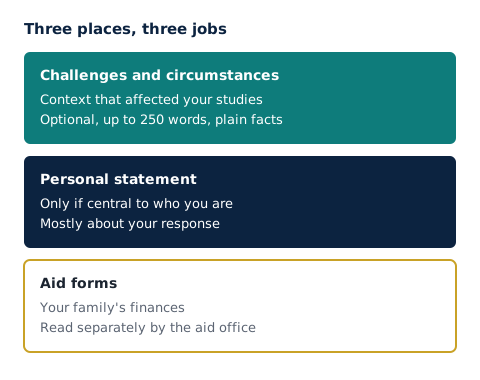
In one of three places, each with a different job:
| Place | What it is for | Length |
|---|---|---|
| Challenges and circumstances question | Context that affected your education: family obligations, health, housing, community disruption | Up to 250 words, optional |
| Personal statement | A hardship central to who you are, told through your response to it | Up to 650 words |
| Aid forms | Your family's financial situation | The forms' own fields and explanation sections |
The Common App introduced the challenges and circumstances question for 2025-26, replacing its earlier community disruption question. It lets you explain circumstances without spending your main essay on them.
How do I use the challenges and circumstances question?
For plain context, in plain words. Say what happened, when, and how it affected your schooling. For example: caring for a sick parent during SHS 2, working in the family business most evenings, or losing a term to a move.
Write it like a short report, not an essay. Two or three short paragraphs are enough. You do not need a lesson or a conclusion here. The reader is simply learning what your record does not show.
When does hardship belong in the personal statement?
When it is central to who you are and you can show your response. The Common App's second prompt asks about a challenge, setback or failure and what you learned, and many students answer it well. But an essay can also touch hardship through another prompt, such as one about a background or an accomplishment.
A strong hardship essay usually spends:
- A small part on what happened: enough for the reader to follow.
- Most of it on what you did: the choices, the effort, the responsibilities you took on.
- A closing part on what it changed in how you think or act now.
Our guide to personal statement ideas helps you test whether a hardship topic is the right one.
How do I write about it with dignity?
Plainly, without exaggeration, and with care for the people in it. Three habits help:
- State facts simply. "My father lost his job in 2024" needs no adjectives. Readers feel the weight without being told.
- Protect your family's privacy. You can say a parent was ill without naming the illness, or that money was tight without listing debts.
- Avoid writing for sympathy. Readers are not looking for the saddest story. They are looking for evidence of who you are.
Never exaggerate or invent hardship. Counsellors, teachers and interviewers may refer to your circumstances, and anything that does not match will damage your whole application.
Should my counsellor mention it too?
Often, yes, and that can be stronger than saying it yourself. A counsellor or headteacher who writes "she cared for her two younger brothers every evening through SHS 2 while keeping her grades" gives the reader a trusted second voice.
Agree with your counsellor what each of you will cover, so the reader does not meet the same story three times. A sensible split is: the facts in the challenges question, the counsellor's view of how you coped in their letter, and your own reflection, if any, in the essay. Our guide to asking for recommendations explains how to brief them.
Can hardship come up in supplement essays?
Sometimes, but rarely as the main subject. University supplements usually ask why you want that university, what you would contribute or what you want to study. A hardship can appear there as part of your reason: wanting to study medicine after caring for a sick relative, for example.
Keep it brief and tied to the question. A supplement that turns into a second hardship essay misses what the university asked, and readers notice.
What about financial hardship?
Mostly, leave it to the aid forms. Your family's income, assets and circumstances are read by the aid office, separately from your essays. You do not need to prove your need in the personal statement.
Mention money in the essay only if it shaped your life in a way the essay is really about: working in the family shop every evening, for example, or paying your own school fees. Then write about what you did, not about the amounts. Our guide to how universities decide what you pay explains how the aid office reads your situation.
What if my hardship is still happening?
Write about it with care, and with your counsellor's help. A situation that is ongoing can be harder to write about, because there is no ending yet. Use the challenges and circumstances question for the facts, and ask your counsellor whether to mention it in their letter.
If the situation affects your ability to meet a deadline, write to the admissions office. Many universities can make reasonable allowances if they know early.
What should I do first?
Write down, in plain notes, any circumstances that affected your studies. Decide which belong in the challenges question and whether any is central enough for the personal statement. Then draft the challenges answer first, in under 250 words.
If you would like help deciding where your story belongs and how to tell it, you can book a call with us.
Questions people ask
Should I write my college essay about hardship?
Only if it genuinely shaped you and you can write about what you did in response. Hardship is not required, and an essay about something ordinary, written well, can be just as strong.
What is the Common App challenges and circumstances question?
An optional question, up to 250 words, for describing circumstances that affected your education, such as family obligations, health, housing, or community disruption. It sits outside the personal statement, so the essay can be about something else.
How much detail should I give about hard events?
Enough for the reader to understand, and no more. A sentence or two on what happened is usually enough. Spend the rest on how you responded and what you learned.
Should I mention financial hardship in my essay?
Usually not in detail. Your family's finances go on the aid forms, which are read separately. Mention money in the essay only if it shaped your life in a way the essay is really about, such as working to support your family.