A gap year after WASSCE: does it help a scholarship bid?
A gap year can help, if you use it well and apply during it. Many US universities accept applications from students who have finished school, as first-year applicants, provided they have not started a degree. Use the year to apply with your final WASSCE results in hand, a stronger list and a project, job or service you can describe. A year with nothing to show rarely helps.
Does a gap year after WASSCE help?
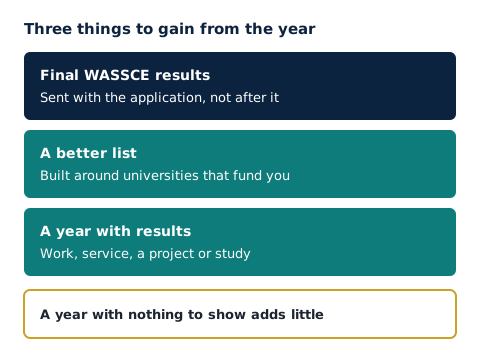
It can, if you use it well and apply during it. Many US universities accept applications from students who have finished school but not started a degree, as first-year applicants. A gap year lets you apply with your final WASSCE results in hand, a better-researched list and a year of real experience to describe.
A gap year with nothing to show rarely helps. The year itself is not the advantage; what you do with it is.
When does a gap year make sense?
In three common situations:
- You applied and got no funded offer. A second application, with a better list and stronger results, can succeed where the first did not.
- You did not apply in your final year, because of time, money or uncertainty, and want to apply properly now.
- Your WASSCE results are stronger than your SHS record, and you want universities to see them before deciding.
If you already hold a funded offer you are happy with, take it. A gap year is a strategy for a problem, not a default.
How do I apply during a gap year?
As a first-year applicant, on the usual timetable. You apply in the autumn of your gap year, through the Common App or each university's portal, for entry the following August or September. Your school still sends your transcript and recommendations, so stay in touch with your counsellor or headteacher.
- August
WASSCE results arrive. Plan the year and your list.
- September to October
Write essays, ask for recommendations, sit any tests.
- November to January
Submit applications and aid forms.
- January to June
Work, volunteer or build your project; offers arrive from March.
- August
Start university.
Our guide to reapplying after a rejection covers a second application in detail.
What should I do with the year?
Something you can describe with results. Good uses of a gap year include:
- Work, especially in something related to your interests, or in a family business where you take real responsibility.
- Service, such as teaching younger students or volunteering in your community, with something to show for it.
- A project: a small business, an app, a community initiative or research.
- Study: improving a weak subject, learning a skill or, if needed, resitting a WASSCE subject. WAEC runs a WASSCE for private candidates.
Write down what you do each month. Your activities list and essays will need specifics. Ask a supervisor, employer or community leader who sees your work whether they would write a short letter about it; some universities accept an optional extra recommendation, and it can bring the year to life.
How do I explain the gap year in my application?
Plainly, through what you did. List the work, service, project or study in your activities, with hours and results, as for any activity. If the year needs context, such as a first application that did not succeed, add a short note in the additional information section.
There is no need to apologise for the year. Readers want to know how you spent it and what you learned. A specific, honest account of a year of work in the family shop, or of teaching younger students mathematics, tells them a great deal about you.
Is there an age limit?
Not usually for US universities, which admit first-year students of a range of ages. But some funded routes do set age limits. Ghana government bilateral awards have asked for candidates aged 23 or under, and Japan's MEXT and the Ashinaga Africa Initiative set their own limits and results windows. Check each route's current call before you plan a year that might take you past its limit.
How do I keep my school involved?
Stay in touch with your counsellor or headteacher through the year. They still send your transcript and school report, and a teacher may still write your recommendation. Visit or write to them in August, explain your plan, and agree dates for the autumn. A school that knows your plan supports it far better than one that hears from you a week before a deadline.
What about money during the year?
Plan for the application costs again: fees, any tests and the aid forms, unless you secure waivers. If you work during the year, set some earnings aside for these and for the costs before travel if you are admitted. Our guide to applying without application fees shows how to reduce them.
Is a gap year the same as a deferral?
No. A deferral means you have accepted a place and the university agrees to hold it for a year, usually for a stated reason. A gap year means you take the year and then apply. With a deferral, ask whether your aid will carry over or be recalculated, and what you may and may not do during the year.
What funded routes fit a gap year?
Several, because their timing suits students who have finished school:
- US universities that meet full need, applied to in the autumn.
- The Ashinaga Africa Initiative, which accepts students with secondary results from recent years and includes its own preparation year.
- Ghana government bilateral awards, which often ask for recent WASSCE results.
- Ghanaian universities and their scholarships, as a safety net.
Our guide to funded places outside the USA lists the routes and their timing.
What should I do first?
Decide whether a gap year solves a real problem for you. If it does, write a plan for the year: what you will do, which universities you will apply to, and your deadlines. Tell your school you will need their support again in the autumn.
If you would like help planning a gap year and a stronger second application, you can book a call with us.
Questions people ask
Can I apply to US universities after finishing WASSCE?
Yes. Students who have finished secondary school but not started university usually apply as first-year applicants. You apply in the autumn of your gap year for entry the following August or September.
Does a gap year hurt my chances?
Not if you use it purposefully. Many universities welcome applicants who have worked, volunteered or built something. A year with nothing to show can raise questions, so plan it.
Should I start a degree in Ghana during the gap year?
Think carefully. At many US universities, starting a degree elsewhere can make you a transfer applicant, with fewer places and less aid for internationals. Check each university's rules before you enrol.
What is the difference between a gap year and a deferral?
A deferral means you have accepted a place and the university agrees to hold it for a year. A gap year means you take a year and then apply. Aid on a deferred place may need to be renewed.