Explaining Ghanaian grades to US universities
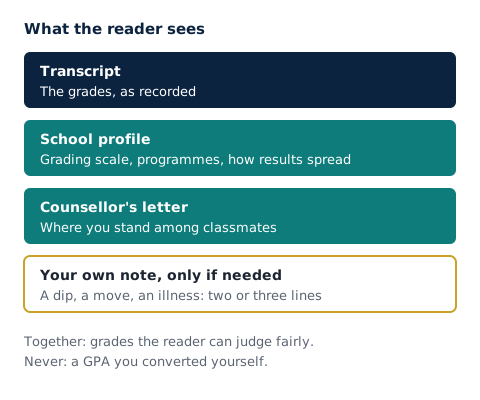
Let your school explain them, through a school profile and the counsellor's letter, rather than converting them yourself. The profile tells a US reader how your school grades, what your programme covers and how your results compare with your classmates'. Add your own short note only for something the school cannot explain, such as a dip in one term. Many US readers already know the WASSCE; context is what they lack.
How do I explain Ghanaian grades to a US university?
Let your school do most of the explaining, through a school profile and the counsellor's letter. Do not convert your grades into an American GPA yourself. A US reader needs context: how your school grades, what your programme covers and how your results compare with your classmates'.
Many admissions officers at selective universities already know the WASSCE and its A1 to F9 scale. What they rarely know is your school. That is the gap to fill.
What does a US reader need to know?
Four things, and each comes from a different place:
| What the reader needs | Where it comes from |
|---|---|
| How your school grades, and what counts as strong | The school profile |
| What your programme covers, and how demanding it is | The school profile and your transcript |
| How you compare with your classmates | The counsellor's letter, or a class position on the transcript |
| Anything unusual in your record | The counsellor's letter, or your own short note |
How your grades go on the Common App itself, and where the WASSCE goes, is covered in our guide to WASSCE grades on the Common App.
What is a school profile, and does my school have one?
A short document, usually one to four pages, that explains a school to US universities. The College Board describes what a good one includes: the school's programmes, its grading scale, how grades are distributed, and where its graduates go. Penn, among others, asks counsellors to send one with every application.
Many Ghanaian schools do not have a profile. If yours does not, ask your headteacher whether one can be written. A single page is enough, covering:
- The school: its size, whether it is a boarding school, and its programmes.
- The grading scale used on the transcript, and what a strong result looks like at this school.
- Class positions, if the school records them.
- Recent WASSCE results, such as the share of students with credits in all subjects, if the school publishes them.
- Where recent graduates went, in Ghana and abroad.
One profile serves every student in the school who applies abroad, so it is worth the headteacher's time.
How do I show what my programme covers?
Through the subjects on your transcript, with a line in the school profile. A US reader may not know that General Science at SHS usually means physics and chemistry with biology or elective mathematics, or what General Arts or Business include.
So the profile should name each programme and its elective subjects. If you took a demanding combination, such as elective mathematics with three sciences, the reader should be able to see that at a glance.
What about the WASSCE aggregate?
Explain it, or leave it out; never let it stand unexplained. The aggregate adds the grade points of your best six subjects, three core and three electives, with A1 counting as 1 and F9 as 9. So a lower aggregate is better, and 6 is the best possible. Ghanaian universities use it for admission cut-offs, which is why it feels so important at home. US readers mostly look at the individual grades instead.
That runs opposite to most US scales, where higher is better. A reader who sees "aggregate 8" without explanation might misread it. If you mention your aggregate, add a short line saying what it means. Your individual subject grades usually tell the story more clearly.
How do I show where I stand among classmates?
Through a class position, if your school records one, or through the counsellor's letter. Many Ghanaian schools publish positions on terminal reports, such as "3rd out of 120". That is valuable context for a US reader.
If your school does not rank, the counsellor's letter can say it in words: "among the strongest students in her year in mathematics". Ask the person writing it to be specific, and offer them your terminal reports to work from. Our guide to asking for recommendations covers how.
Will I be compared with students from other countries?
Not grade for grade. Selective US universities read each application in the context of the student's school and country. A reader does not set your A1 in Core Mathematics beside an American student's A grade and decide which is higher. They ask how well you did with what your school offered.
That is why context matters so much. If your school offers three science electives and you took all three, the reader should see that. If your school sends few students abroad and you are the first in years, the counsellor can say so. If you came top of a large year group, the reader should know how large.
Readers who see many Ghanaian applications build up a sense of each school over the years. A clear profile helps the next student from your school as much as it helps you.
When should I explain a dip in my grades?
When there was a real reason the reader would want to know. Illness, a family death, a move between schools, or a term disrupted by events outside your control all count. Explain in two or three plain sentences in the additional information section, or ask your counsellor to mention it.
Do not explain every lower grade. One weaker subject among strong ones needs no comment. A clear downward or upward trend, or one bad term, is worth a sentence. An upward trend after a hard start is something readers often respect.
What should I do first?
Ask your headteacher whether the school has a profile for US universities. If not, offer the checklist above and ask whether one can be ready by October. Then check that your transcript shows your programme, every grade and the grading scale.
If you would like help preparing the school profile or the note about your record, you can book a call with us.
Questions people ask
Do US universities understand Ghanaian grades?
Many do, especially the selective universities that admit Ghanaian students regularly. They know the WASSCE and its A1 to F9 scale. What they often lack is context about your particular school, which the school profile provides.
Should I convert my grades to a US GPA?
No. Report your grades as your school and WAEC record them. A home-made conversion can mislead a reader and may not match the university's own reading of your record.
What is a school profile?
A short document from your school that explains it to a US reader: its programmes, its grading scale, how results are distributed and where its graduates go. It travels with your transcript.
Should I explain a bad term?
Yes, if there was a real reason, such as illness, a family loss or a change of school. Explain it briefly and factually in the additional information section, or ask your counsellor to mention it.