What are my chances of a full scholarship from Ghana?
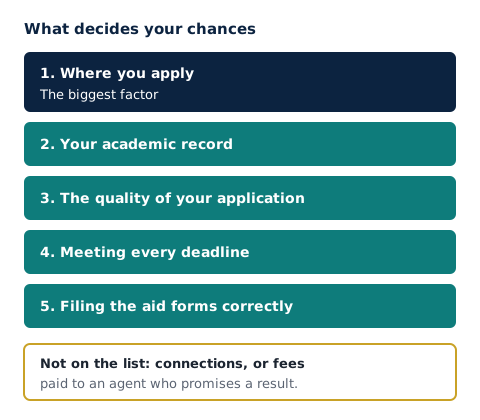
Low at any single university, and much better across a well-built list. The most generous universities admit a very small share of international applicants: MIT admitted about 2% for its class of 2029. Your chances depend on five things you can influence: where you apply, your record, the quality of your application, meeting every deadline and filing the aid forms correctly. No one can promise you a scholarship.
What are my chances of a full scholarship?
Low at any single university, and much better across a well-built list. The universities that fund international students fully are among the hardest in the world to get into. But you do not need every one of them to say yes. You need one.
That is the honest starting point. We will not tell you the odds are good at any one university, because they are not. We will tell you what decides them and what you can change.
How few full scholarships are there?
Very few, compared with the number of students who want one. The published figures make the point:
| University or program | What it publishes |
|---|---|
| MIT | Admitted 136 of 6,926 international applicants for its class of 2029, about 2% |
| Duke | Expects to enrol around 20 to 25 international students a year whose full need it meets |
| Stanford | About one in three of its international students receive aid |
| Lester B. Pearson Scholarship, Toronto | About 37 Scholars a year, from around the world |
These numbers are not a reason to give up. They are a reason to apply to enough of the right universities, with an application strong enough to compete, and to keep funded options outside the US.
What decides my chances?
Five things, and you can influence all of them:
- Where you apply. The biggest factor. A strong student who applies only to universities that give little aid to internationals has almost no chance of full funding, however good the application.
- Your academic record. Your SHS grades, mocks, predicted WASSCE results and any tests. Universities that fund fully usually admit students at or near the top of their school.
- The quality of your application. Essays in your own voice, activities with real results, and recommendations from teachers who know you.
- Meeting every deadline. Admission, aid and scholarship dates, some of them early.
- Filing the aid forms correctly. A full-need offer rests on accurate family figures. Wrong figures can mean the wrong offer.
Notice what is not on the list: who you know, or how much you paid someone. No agent, contact or fee changes how a university reads your application.
Does being from Ghana help or hurt my chances?
Neither, in itself. Universities read your application in the context of your school and your country. A reader who knows the WASSCE system judges your grades against what is possible at your school, not against an American school's.
What matters is how clearly your application explains that context. If your school has no college counsellor, no advanced courses or a grading scale readers may not know, make sure the school profile or a short note says so. If you took on responsibilities at home, such as work, caring for siblings or a family business, say so in the activities list. A reader can only credit what they can see.
Which universities give me the best chance?
Those that meet full need for international students, and those where your record is near the top of their applicants. The first group gives full funding if they admit you. The second gives you better odds of admission and of a large merit award.
A list built only from the most famous names is the riskiest list of all. Mix three kinds:
- Need-blind, full-need universities, such as Harvard, MIT and Amherst. Asking for aid does not count against you, but admission is very hard.
- Need-aware, full-need universities, such as Penn, Columbia and Duke. Your aid request counts in the decision, but they fund you if admitted.
- Universities where you stand out, with substantial aid or merit awards for internationals.
Our guide to universities that meet full need names them, and our guide to finding universities that fund you shows how to check each one.
How can I improve my chances?
Work on the things that are still open to change, in order of their effect:
- Fix your list first. Replace any university that gives international students little aid with one that meets full need or where you stand out.
- Protect your grades. Your mocks and WASSCE results still count after you apply. A strong final year confirms the offer.
- Go deeper in one or two activities. Results you can describe, for other people, count for more than a long list.
- Write in your own voice. An honest essay about your own life beats a polished one that could be anyone's.
- Get the aid forms right. Gather a full year of family documents and fill in every form from the same figures.
How many universities should I apply to?
Enough for real chances, few enough that every application is strong. Many students who need full aid apply to around eight to twelve universities, mostly ones that meet full need. They add one or two funded options outside the US, such as Canada's full awards or the Mastercard Foundation partners.
The right number for you depends on how much time you have, the fees and how strong your record is against each university's applicants. Ten well-researched applications beat twenty rushed ones.
What if I do not get a full scholarship this year?
You have options, and a year without one is not the end. You can:
- Take a funded place outside the US, at a Mastercard Foundation partner, through a Ghana government bilateral award or at a Canadian university with a full award.
- Start a degree in Ghana, and consider transferring later. Check each university's transfer aid policy first.
- Reapply next year with a stronger list and application. Our guide to reapplying after a rejection explains how.
Decide on your backup before results arrive, so the decision is yours and not the deadline's.
What should I do first?
Take your current list and mark each university: meets full need for international students, or not. If fewer than half do, rebuild the list before you write another essay.
If you would like an honest second opinion on your list and your chances, you can book a call with us.
Questions people ask
How hard is it to get a full scholarship to a US university?
Very hard at any one university. The universities that fund international students fully admit only a small share of them. MIT, for example, admitted about 2% of international applicants for its class of 2029. Applying to a well-chosen list raises your overall chances.
What grades do I need for a full scholarship?
There is no single cut-off. Universities that fund international students fully usually admit students at or near the top of their school, with strong grades in demanding subjects. Grades alone are not enough; the rest of the application matters too.
How many universities should I apply to?
Enough to give you real chances, not so many that each application is rushed. Many students who need full aid apply to around eight to twelve, mostly universities that meet full need, plus funded options outside the US.
Can anyone guarantee me a full scholarship?
No. Only the university decides. Anyone who promises a scholarship for a fee is selling something they do not control. Treat that promise as a warning sign.