How many US universities should a Ghanaian apply to?
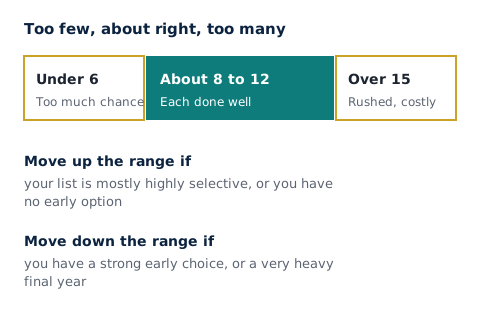
For most Ghanaian students who need full aid, about eight to twelve. That is enough to give you real chances at universities that fund international students, and few enough that every application gets your best work. Apply to more if your list leans on the most selective universities; fewer if you have a strong early option. Never add a university that could not fund you just to make the number bigger.
How many universities should I apply to?
About eight to twelve, if you need full aid. That is enough to give you real chances, and few enough that each application gets your best work. Every one should be a university that could fund you if it admits you.
The number matters less than the list. Ten universities that fund international students beat twenty chosen by name. But the number still matters, because too few leaves you exposed and too many leaves you exhausted.
Why not apply to as many as possible?
Because each application costs time, money and quality. A university on the Common App is not one click: it usually needs its own supplement essays, sometimes an interview, and its own aid forms. Each one also adds an application fee and a CSS Profile fee, unless you get waivers.
Past a certain point, more applications make every application weaker. A reader can tell when a "why this college" essay was written in twenty minutes. So the extra universities do not add the chances they seem to.
Why not apply to just a few?
Because funded places for international students are scarce. MIT admitted 136 of 6,926 international applicants for its class of 2029. Even a strong student cannot count on any one university.
A short list works only when it includes universities where you stand a genuine chance, and ideally a strong early option. Five applications to the most famous names is a gamble, not a plan.
What should raise or lower my number?
Four things:
| Factor | Apply to more if | Apply to fewer if |
|---|---|---|
| How selective your list is | Most of it is need-blind or highly selective | Several universities are ones where you stand out |
| Your time | You have the summer and autumn free to write | Your final SHS year is very heavy |
| Fees | You have waivers or no-fee colleges | Each fee is a real burden, with no waivers |
| Early options | You have no early round, or only a reach | You have a strong Early Action or Early Decision choice |
Use the table to move within the range, not outside it. A student who needs full aid rarely does well with fewer than six or more than fifteen.
What do different lists look like?
Three illustrations, not real students:
- A student with an exceptional record, applying mostly to need-blind and need-aware full-need universities. Around eleven or twelve, because even an exceptional record is no guarantee at that level.
- A student with a strong record and a clear early choice, applying Early Action to a full-need university where they fit well. Around eight, with more added only if the early result is a no.
- A student with a good record and a heavy final year, applying mainly where they stand out and aid for internationals is strong. Around nine, including one funded option outside the US.
In each case, every university on the list could fund the student if it admitted them.
How do early results change the number?
They can shrink it or grow it. If you apply in an early round and are admitted with enough aid, you may withdraw your other applications, or, with Early Decision, you must. If you are deferred or rejected early, you may want to add one or two universities for the regular round.
So plan your list in two parts: the early applications, and the regular applications you will send if the early ones do not settle things. Write the regular supplements before the early results arrive in December, so you are not starting from nothing over the holidays.
Should I also apply to universities in Ghana?
Yes, as a safety net, and it does not count against your US number. Ghanaian universities admit students after WASSCE results, on a different timetable from US universities. Applying to one or two keeps a place open at home if no funded offer comes from abroad.
That is not a sign of doubt. It is a plan. A student who starts a degree in Ghana can still reapply abroad, or look at transfer options later, with a year of university results behind them. A student with no place anywhere loses that year.
Check each Ghanaian university's admission dates and requirements, and whether it offers the course you want. Plan the forms so they do not collide with your US deadlines in November and January. And remember the government's local tertiary scholarships, which our guide to Ghana government scholarships explains.
How do I know if my list is the right size?
Run three checks:
- Can I write every supplement properly? Count the essays across your list and set them against the weeks you have.
- Can my family afford the fees? Add the application, CSS Profile and test fees, after any waivers.
- Would I go to every university on it? If not, cut the ones you would not attend.
Keep the answers in one spreadsheet: one row per university, with its supplements, deadlines, fees and aid forms. When the columns are filled in, the true size of the job is plain to see, and so is the university that does not belong. Share it with a parent, so the family sees the same picture you do.
If all three pass and most of your list meets full need for international students, your number is probably right. Our guide to building a college list for full aid shows how to fill it.
What should I do first?
Count the universities on your list today. Then count the supplement essays they need. If the essays outnumber the weeks you have, shorten the list, starting with any university that would not fund you.
If you would like a second opinion on the size and balance of your list, you can book a call with us.
Questions people ask
How many universities should I apply to as an international student?
About eight to twelve, if you need full aid. Each should be a university that could fund you. The right number for you depends on your time, your fees and how selective your list is.
Is applying to twenty universities a good idea?
Rarely. Twenty applications usually means rushed supplement essays and high fees. Ten strong applications usually give better chances than twenty weak ones.
Is five universities enough?
Usually not, for a student who needs full aid. Funded places for international students are scarce, so five applications leaves too much to chance unless one of them is a strong early option.
Do non-US options count towards the number?
Yes. One or two funded options outside the US, such as a Mastercard Foundation partner or a Canadian full award, belong on the list and count towards your total.