How strong is my application? A self-check for Ghanaian students
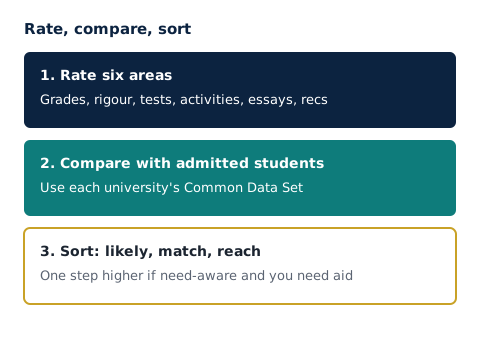
Rate yourself honestly in six areas: grades, the rigour of your subjects, tests, activities, essays and recommendations. Grades and rigour matter most at most universities. Then compare yourself with each university's admitted students: where you are near the middle or above, it is a match; where you are below, a reach. No self-check predicts admission, but it tells you how to balance your list.
How strong is my application?
You can find out roughly by rating yourself honestly in six areas, then comparing the result with each university's admitted students. The six areas are grades, the rigour of your subjects, tests, activities, essays and recommendations. Grades and rigour usually matter most.
No self-check can predict an admission decision. Selective universities turn down many students with excellent records, and every reader brings judgement. But an honest self-check tells you which universities are reaches, which are matches, and how to balance your list.
What are the six areas?
Rate yourself in each, using these descriptions as a guide:
| Area | Strong | Solid | Developing |
|---|---|---|---|
| Grades | Mostly A1s, steady or rising | Mostly A1 to B3 | Many C grades or a falling trend |
| Rigour | The most demanding programme and electives your school offers | A demanding programme | A lighter programme than the degree needs |
| Tests | Strong SAT, if submitted, and a clear English score where asked | Scores near a university's middle range | No scores, at universities that want them |
| Activities | Deep, long-term commitment with real responsibility or impact | Steady involvement, some responsibility | Brief or many short memberships |
| Essays | Specific, personal, clearly your voice | Clear but general in places | Not yet drafted or retells the CV |
| Recommendations | Teachers who know you well and will write in detail | Teachers who know your work | Not yet asked |
Be strict with yourself. If you are unsure between two levels, choose the lower one.
Which areas matter most?
At most universities, grades and rigour come first. They show how you handle sustained academic work, which is what a university most needs to know. Essays, recommendations and activities matter most at selective universities, where nearly every applicant has strong grades and the readers must choose between them.
Each university reports how much weight it gives each factor in section C7 of its Common Data Set, a standard report many US universities publish. Search for a university's name and "Common Data Set" to find it.
How do I compare myself with a university?
Look for its middle range. Many universities publish the middle 50% of test scores and other figures for admitted students, often in their Common Data Set. Where you are near or above the middle, the university is a match. Where you are below, it is a reach.
For universities that admit very few students, it is always a reach, however strong you are. MIT, for example, admitted 136 of 6,926 international applicants for its class of 2029. Our guide to your chances of a full scholarship explains why.
How does needing aid change the picture?
At need-aware universities, your request for aid is part of the decision, so a university is harder for you than its overall admission rate suggests. At need-blind universities, it is not. So a university that is a match on grades can still be a reach for a student who needs full aid.
Sort need-aware universities one step higher than your self-check alone suggests. Our guide to whether asking for aid hurts explains the difference.
How do I explain context?
US readers judge you against what was available to you. If your school offers few electives, no SAT preparation or few clubs, your counsellor's school profile and recommendation should explain that. A strong record within limited opportunities reads differently from the same record at a school with every advantage.
So when rating rigour and activities, ask: did I take the most demanding options my school offered? Did I make the most of what was available? Our guide to explaining Ghanaian grades covers the school profile.
How do I improve a weak area?
It depends on how much time you have:
- Grades: the most valuable thing to protect. A rising trend in SHS 3 helps, and mock and WASSCE results are sent later.
- Tests: a second SAT attempt, if your list values scores and you have time.
- Activities: you cannot build years of depth in one term. Describe what you have done more clearly instead.
- Essays: the area you can improve most, right up to the deadline.
- Recommendations: brief your teachers well, with a short note on what you did in their class.
Should I trust online chance calculators?
Use them with care. Most are built on data from US students, and few know how to read WASSCE grades, a Ghanaian school or a need-aware aid request. They can give a Ghanaian student a number that looks precise but is not.
A calculator's result is one rough input, at best. Your own comparison with a university's published figures, adjusted for aid, is usually more useful, and it teaches you how admissions work.
What if most of my ratings are 'developing'?
Then change the list, not the dream. A student with developing grades can still find funded places, but rarely at the most selective universities. Look at generous colleges where your record is near the middle, merit awards for strong students elsewhere, and funded options outside the US.
If you are in SHS 1 or 2, you have time to move several areas up a level. Our guide to planning from SHS 1 shows where to start. If you are in SHS 3, focus on your essays and a realistic list. Our guide to scholarships with B grades covers the options.
How do I turn the self-check into a list?
Sort every university into likely, match or reach, after allowing for aid. A balanced list for a student who needs full aid has a few of each, all from universities that fund internationals. Our guide to building a college list for full aid shows the balance, and our guide to how many universities to apply to helps with the number.
What should I do first?
Fill in the table above for yourself, honestly. Then take three universities on your list, find their Common Data Set, and sort each into likely, match or reach.
If you would like an experienced second opinion on your application and list, you can book a free call with us.
Questions people ask
How do I know if my application is strong enough?
Compare each part of it with the students a university admits, using its published figures where they exist. You cannot predict a decision, but you can tell whether a university is a reach, a match or likely for you, and build a balanced list.
What matters most in a US application?
At most universities, grades and the rigour of your courses come first. Each university reports how much weight it gives each factor in section C7 of its Common Data Set.
Are my WASSCE grades good enough for top US universities?
Strong WASSCE grades, mostly A1s and B2s in demanding subjects, keep you in consideration at selective universities. They are necessary, not sufficient: essays, activities and recommendations decide between many strong students.
Can a strong essay make up for weak grades?
Rarely, at selective universities. A strong essay can lift a solid application and explain context, but it cannot replace the academic record. Match your list to your grades first.