Planning for a US university from SHS 1
Use SHS 1 to build strong grades and pick electives that fit the degree you want, SHS 2 to go deeper in one or two activities and start researching universities and money, and the first term of SHS 3 to apply. Every grade from SHS 1 appears on your transcript. Parents can help most by starting the money conversation and gathering financial documents early.
How should I plan for a US university from SHS 1?
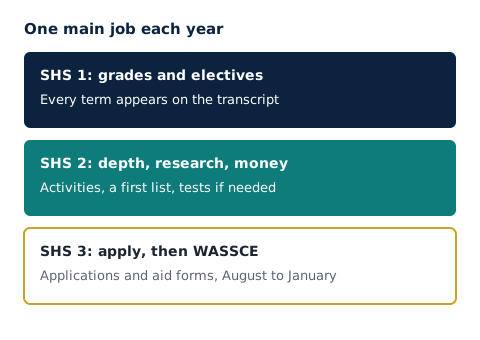
One year at a time, with a different focus each year. SHS 1 is for strong grades and the right electives. SHS 2 is for going deeper in what you care about and starting to research universities and money. The first term of SHS 3 is when you apply, before you sit the WASSCE.
Most Ghanaian students start thinking about US universities in SHS 3, which leaves a few months for everything. Starting earlier does not mean more work each week. It means the work is spread out, and the big decisions are made calmly.
What should I do in each year?
- SHS 1Strong grades from the first term. Electives that fit the degree you might want. Try a few activities and keep the ones you enjoy.
- SHS 2Go deeper in one or two activities. Start researching universities and what they fund. Decide on the SAT. Families begin the money conversation.
- SHS 2 holidaysWrite first ideas for the personal statement. Build a first list. Gather financial documents.
- SHS 3, first termApply between August and January, with the aid forms. Keep grades steady for the mocks.
- SHS 3, after applyingDecisions in March and April. WASSCE. Results in August, then travel.
EducationUSA advises starting the search at least 12 to 18 months before you hope to enrol, which for a Ghanaian student means SHS 2 at the latest.
Why do SHS 1 grades matter?
Because US universities see all of them. Your transcript shows every term of SHS, and admissions officers read it for consistency and trend. A student who starts strong and stays strong shows they can handle hard work over time.
A weak SHS 1 is not fatal: a clear upward trend tells its own story. But it is easier to protect good grades than to recover from poor ones. Our guide to transcripts from a Ghanaian SHS explains what universities see.
Which electives should I choose?
The ones that fit the degree you might study. Engineering and computer science usually expect elective mathematics and physics. Medicine-related courses need biology and chemistry. If you are unsure, choose a programme that keeps options open, such as general science with elective maths.
Changing programme later in SHS is hard, so this is one of the few early decisions that is difficult to undo. Ask your teachers, and check what a few US universities expect for the subjects that interest you.
What activities should I do?
One or two you genuinely care about, done deeply. Depth looks like:
- Responsibility that grows, such as moving from member to organiser.
- Something you started: a study group, a small business, a project in your community.
- Work at home or in a family business, which counts as much as a club.
- A subject followed beyond class, through reading, competitions or a project.
Our guide to the Common App activities list shows how these appear on the application.
When should I deal with tests?
In SHS 2, decide whether you need the SAT. Many US universities are test-optional, but some require scores, and a strong score can help a Ghanaian student whose school is unfamiliar to US readers. If you take it, sit it in SHS 2 or early SHS 3, leaving room for a second attempt.
Plan for an English test too, if any university on your list needs one. Our guide to whether you need the SAT helps you decide.
What should I do in the holidays?
Something that adds to what you care about. A summer programme can help, but it does not have to be expensive or abroad. Teaching younger children, working in a family shop, building something, or a free online course in your subject all show initiative. Our guide to summer programmes for Ghanaian students lists funded options and how to judge the rest.
Who will write my recommendations?
Usually two teachers and a counsellor or head, in SHS 3. They write best about students they know well, so build those relationships from SHS 1 and 2: take part in class, ask questions, and get to know one or two teachers in subjects you enjoy. Our guide to asking for recommendations covers the request itself.
What should parents do, and when?
Three things, starting in SHS 2:
- Start the money conversation. Decide what the family can pay each year, in dollars. That number shapes the whole list. Our guide to talking about paying helps.
- Gather financial documents. Payslips, bank statements, any tax records and a note of property. The aid forms in SHS 3 need them.
- Get the passport early. It takes time, and tests and applications ask for it.
Parents do not need to manage the applications. Making time, space and the financial information available is the most useful help.
What happens in SHS 3?
Applications, alongside a demanding school year. Between August and January you finish the essays, submit applications and file the aid forms. Most Ghanaian students apply before sitting the WASSCE, with their grades so far, and send mock and WASSCE results later. Our guide to applying before your WASSCE results explains how.
A student who has used SHS 1 and 2 well arrives in SHS 3 with a list, an essay idea and documents ready. The term is busy, not frantic.
What if I am already in SHS 2 or 3?
Start where you are. In SHS 2 you have time for almost everything above. In SHS 3, focus on a funded list, the essays and the aid forms, and do not try to add new activities. Our guide to whether it is too late to apply covers late starters.
What should I do first?
Write down two or three degrees you might study and check that your electives fit them. Choose one activity to take more seriously this year. Parents: agree when, as a family, you will have the money conversation.
If you would like a plan for your child's SHS years, with the applications handled together in SHS 3, you can book a free call with us.
Questions people ask
When should I start preparing for a US university in SHS?
As early as SHS 1, gently. US universities see your grades from all three years, so SHS 1 counts. Serious research usually starts in SHS 2, and applications go in during the first term of SHS 3.
Do my SHS 1 grades matter for US universities?
Yes. Your transcript shows every year, and admissions officers look for consistent or improving results. A weak start can be overcome with a strong upward trend, but a strong start is easier.
What activities should I do in SHS for US universities?
One or two that you care about, done deeply over time, rather than many done briefly. Leadership, a project you started, responsibility at home or in a family business all count.
When should I take the SAT?
If you take it, usually in SHS 2 or early SHS 3, leaving time for a second attempt before applications. Many universities are test-optional, so check your list before deciding.