Getting into the Ivy League from Ghana
It is possible but rare, so treat every Ivy as a reach. The good news is the money: all eight meet the full demonstrated need of the international students they admit, and five (Harvard, Yale, Princeton, Dartmouth and Brown) are need-blind for internationals. The hard part is admission. Apply to the Ivies that fit you, alongside other full-need universities where your odds are better.
Can a Ghanaian student get into the Ivy League?
Yes, but rarely, so every Ivy is a reach for every applicant. Ghanaian students are admitted each year, and the Ivies fund the international students they admit generously. But they admit a very small share of applicants from every country, and many excellent students are turned down.
So aim high, and plan wisely. Apply to the Ivies that suit you, and build the rest of your list from universities that fund internationals and where your odds are better.
How do the Ivies fund international students?
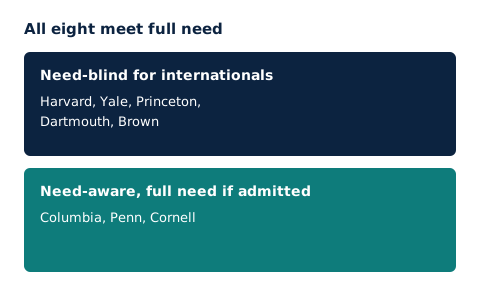
Generously, on need, not merit. All eight meet the full demonstrated need of the international students they admit, and none gives scholarships for academic merit or athletics. Five are need-blind for internationals, so asking for aid does not affect your chances there:
| University | Admission for internationals | Aid |
|---|---|---|
| Harvard | Need-blind | Meets full need |
| Yale | Need-blind | Meets full need, with grants |
| Princeton | Need-blind | Meets full need, with grants |
| Dartmouth | Need-blind | Meets full need |
| Brown | Need-blind | Meets full need |
| Columbia | Need-aware | Meets full need of those admitted |
| Penn | Need-aware | Meets full need of those admitted |
| Cornell | Need-aware | Meets full need of those admitted |
For a Ghanaian family with a modest income, a full-need offer can cover the whole cost, including travel allowances at some. Yale, for example, says its aid for international students allows for the difference between the US economy and the student's home economy. Our guide to need-blind and need-aware explains the terms.
What do the Ivies look for?
Excellence in context, and a person they want on campus. Admitted students almost always have top grades in the most demanding subjects their school offers. Beyond that, readers look for depth: a real intellectual interest followed beyond class, sustained commitment outside it, and a voice in the essays that makes them want to meet you.
For a Ghanaian student, context matters. Readers judge you against what your school offered. Top WASSCE grades from a school with few electives, plus initiative in your community, can read as strongly as a long list of opportunities elsewhere.
Which Ivy suits me?
They differ more than their shared name suggests:
- Size and style: Dartmouth and Princeton focus closely on undergraduates; Columbia, Penn and Cornell are large research universities with many schools.
- Curriculum: Brown has an open curriculum with few requirements; Columbia has a demanding core curriculum.
- Location: New York City for Columbia; small towns for Dartmouth and Cornell.
- Subjects: Cornell and Penn admit to specific schools within the university, such as engineering or business.
Read each one's website and choose those whose teaching and setting fit you. Our guide to the why this college essay helps you research them from Ghana.
Should I apply early?
Think carefully. Some Ivies offer binding Early Decision, and others a restrictive early action that limits where else you can apply early. Each has its own rules. Early Decision is binding: if admitted, you must attend, and you cannot compare aid offers.
At a full-need university, the aid offer should be the same in either round. But a family should still be confident in the university's aid estimate before applying binding. Our guide to Early Decision with financial aid explains the trade-offs.
What about the SAT?
Policies have changed in recent years, and several Ivies now require test scores again. Check each university's current testing policy for your year of entry before deciding. Our guide to whether you need the SAT covers how to decide and where to sit it in Ghana.
Will I have an interview?
Possibly. Several Ivies offer interviews with alumni, which may take place in person in Ghana or online. Not every applicant is offered one, and not having one does not count against you. If you are invited, accept, prepare a few clear examples, and treat it as a conversation. Our guide to college interview questions covers what to expect.
Does it matter which SHS I attend?
Less than many families think. Readers judge you against what your school offered, using your counsellor's school profile. Students from well-known schools and from schools the Ivies have never heard of are both admitted. What matters is what you did with the opportunities you had. A strong counsellor letter that explains your school helps a reader from abroad place your record. Our guide to explaining Ghanaian grades shows how.
What are my real chances?
Low, for everyone, and impossible to predict for any one student. The most selective universities admit only a small share of international applicants. Our guide to your chances of a full scholarship gives the published figures.
That is a reason to plan, not to give up. A student who applies to two Ivies alongside six full-need universities where they are a strong match has a real chance of a funded offer. One who applies only to Ivies is gambling. A rejection from an Ivy says very little about you; with so few places, chance plays a part in every decision.
How do the Ivies fit a balanced list?
As reaches. A typical balanced list for a strong Ghanaian student who needs full aid might include one or two Ivies, other need-blind universities such as MIT, Amherst and Bowdoin, full-need universities such as Stanford, Duke and Williams, and several generous colleges where the student's record stands out. Our guide to building a college list for full aid shows the balance.
What should I do first?
Read the international aid page for each Ivy you are considering, and note whether it is need-blind for internationals. Choose the one or two that suit you best. Then list six full-need universities where your record is near or above the middle, and make sure they get as much of your effort.
If you would like help building an ambitious list that still gives you a real chance of a funded place, you can book a free call with us.
Questions people ask
Can a Ghanaian student get into Harvard?
Yes, Ghanaian students are admitted to Harvard and the other Ivies, but very few applicants from any country are. Treat Harvard as a reach, and build the rest of your list from universities where your record is near or above the middle.
Do Ivy League universities give full scholarships to Ghanaians?
They give need-based aid, not scholarships for merit. All eight meet the full demonstrated need of admitted international students. For a family with a modest income, that can cover the whole cost.
Which Ivy League universities are need-blind for internationals?
Harvard, Yale, Princeton, Dartmouth and Brown. Columbia, Penn and Cornell are need-aware for internationals, but meet the full need of those they admit.
What grades do I need for the Ivy League from Ghana?
There is no cut-off, but admitted students almost always have top grades in the most demanding subjects their school offers. Strong grades keep you in consideration; essays, activities and recommendations decide.