The cheapest US universities for Ghanaian students
For a Ghanaian student who needs aid, the cheapest US university is usually not the one with the lowest fees. It is the one that will fund you: a university that meets full need can cost your family far less than a cheap state university that gives internationals no aid. Berea College covers the full first-year cost for every international it enrols. Community colleges have low fees but little aid. Compare what your family would pay, not the price list.
What is the cheapest US university for a Ghanaian student?
The one that will fund you, which is rarely the one with the lowest fees. Most lists of "cheapest universities" rank by the published price. But a Ghanaian family pays the published price minus the aid, and aid for international students varies enormously between universities.
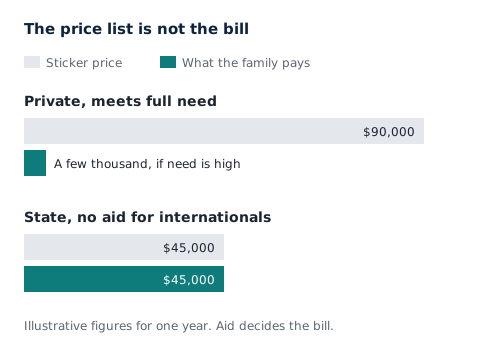
A private university with a published cost of $90,000 a year that meets your full need might ask your family for a few thousand dollars. A state university with a published cost of $45,000 that gives internationals no aid will ask for all $45,000. For a family that needs help, the first is far cheaper.
What is the difference between sticker price and net price?
The sticker price is the published cost of attendance: tuition, housing, food, fees, books and personal costs for one year. The net price is what your family pays after grants and scholarships. Loans and work-study do not lower the net price; they only change how you pay it.
For international students, the gap between the two is the whole story. Some universities give no aid to internationals, so their net price equals their sticker price. Others meet full need, so their net price depends on your family's finances. Our guide to how universities decide what you pay explains the calculation.
Which universities can cost a Ghanaian family least?
Four groups, depending on your family's finances:
| Option | What your family pays | Who it suits |
|---|---|---|
| Full-need universities | Whatever the university calculates you can afford; can be very little | Strong students who need substantial aid |
| Berea College | No tuition; first-year cost covered; a small deposit and personal costs | Students with high need who fit a small work college |
| Merit scholarships | The cost minus the award; often still large | Strong students whose family can pay part |
| Community colleges | Low fees, but full living costs and little aid | Families who can pay modest amounts, planning to transfer |
None of these is cheap for everyone, and none guarantees admission or an award. The point is to find where your family's figures produce the lowest bill.
Why are full-need universities often cheapest?
Because they set your price from your family's finances. A university that meets the full demonstrated need of international students calculates what your family can contribute, usually from the CSS Profile, and covers the rest with grants. For a family with a modest income, that can mean paying very little.
The catch is admission. These universities are selective, and many are need-aware for internationals. So they belong on your list, but not as the whole list. Our guide to universities that meet full need lists them with sources.
What does Berea College offer?
Berea College in Kentucky charges no tuition to any student. It says it provides full funding to every international student it enrols, with aid covering tuition, housing, food and fees in the first year. Every student works on campus through its work programme, and the job pays toward personal expenses.
Berea asks admitted international students for a deposit and suggests they save toward personal costs each year, and it says further aid is available to students who cannot pay the deposit. Read its international costs page for the current figures. Admission for international students is competitive, so treat Berea as one option on your list, never a safety. Our guide to overlooked generous colleges covers it alongside others.
Are community colleges a good route?
They can be, for the right family. Community colleges are two-year public colleges with low tuition, and many accept international students. Some students study there for two years, then transfer to a four-year university to finish a degree, a route EducationUSA describes as the 2+2 pathway.
But the savings are smaller than they look. You still pay housing, food, insurance and travel, and community colleges give internationals little aid. Transfer aid for internationals at four-year universities is often more limited than aid for first-year applicants, so check before relying on it. This route suits a family that can pay a modest amount each year, not one that needs almost everything covered.
What about state universities?
They are rarely cheapest for a Ghanaian who needs aid. Public universities charge out-of-state or international rates, and most of their need-based aid goes to students from their own state. Some offer merit awards to internationals, which can bring the cost down for strong students.
For a family that can pay in full or in large part, a state university with a merit award can be good value. Our guide to applying if your family can pay covers that case.
How do I compare the real cost?
Three steps for each university on your list:
- Check its international aid policy. Does it meet full need for internationals, give merit awards, or give no aid at all?
- Estimate your net price. Use its net price calculator if it works for international families, or email the aid office with your family's figures. Our guide to net price calculators shows how.
- Add the costs aid does not cover. Flights, the visa, the SEVIS fee, winter clothing and summers. Our guide to costs a scholarship will not cover lists them.
Multiply by four years and compare the totals in cedis as well as dollars.
What does the cheapest route cost overall?
More than tuition alone. Even a fully funded student usually pays for flights, the visa application and SEVIS fee, and some personal costs, and the family should keep a reserve for emergencies. A student at a community college pays far more of the living costs. Our guide to the cost of studying in the USA gives the full picture.
What should I do first?
Write down the most your family can pay each year in dollars. Then, for each university on your list, find out whether it funds internationals and estimate your net price. Cross off any where the net price is above your number, and replace them with universities that fund students like you.
If you would like help finding the universities where your family would pay least, our Scholarship and Aid Sprint does exactly that.
Questions people ask
What is the cheapest US university for international students?
It depends on your family's finances. For a student who needs aid, a university that meets full need, or Berea College, which covers the full first-year cost of every international student it enrols, can cost far less than one with low published fees and no aid.
Is there a free university in the USA for international students?
Berea College in Kentucky charges no tuition and says it covers the full first-year cost of every international student it enrols, with an on-campus job for personal expenses. Many full-need universities can also cost a low-income family very little, though none is free for everyone.
Are community colleges a cheap way to study in the USA?
Their fees are low, but they give international students little aid, and you still pay for housing, food and insurance. Some students study two years there and transfer. Check the transfer agreements and the aid at the university you hope to transfer to before you choose this route.
Are state universities cheaper for Ghanaian students?
Their published fees are often lower than private universities', but international students usually pay the highest rate and receive little need-based aid. For a family that needs aid, a generous private university is often cheaper.