Using a net price calculator from Ghana
Yes, you can use many of them, but check first whether each one is built for international families. A net price calculator estimates what your family would pay at one university, from your income, assets and household. Some, such as Harvard's, ask for your country. Others, such as Yale's and Amherst's, say they are not designed for international students. Convert your cedi figures to dollars at one rate, and treat the result as an estimate.
Can we use a net price calculator from Ghana?
Yes, many of them, but check each one first. A net price calculator estimates what your family would pay for a year at one university, after grants. Some are built to handle international families. Others say plainly that they are not, and their results will mislead you.
Used well, a calculator is the quickest way to see whether a university is affordable before you spend time on its application. Used carelessly, it can give you false hope or false fear.
What is a net price calculator?
A tool on a US university's website. You answer questions about your family's income, assets and household, and it estimates what you would pay after grants. US law has required colleges that offer federal student aid to post one since 2011.
The result is usually called the net price: the cost of attendance minus the grants the calculator expects you to receive. It does not include loans or work, so it is close to what your family would actually pay.
Which calculators work for international families?
It varies, and the calculator usually says so on its first page. Three examples show the range:
| University | What it says |
|---|---|
| Harvard | Asks for citizenship and country of residence, so it is set up to take an international family's details |
| Yale | Says its calculators are designed for families whose parents live and work in the US, and will not give an accurate estimate for international students |
| Amherst | Says its calculators are not intended for international students |
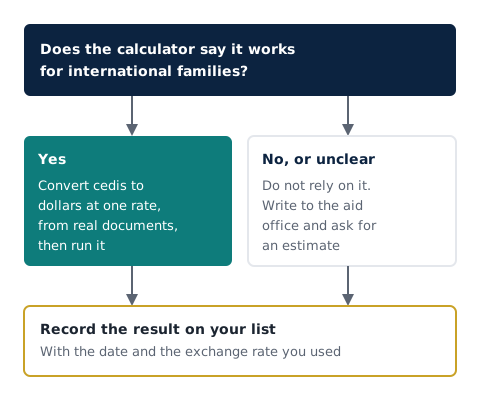
When a calculator says it is not for international families, do not rely on its figure. Write to the aid office instead, and ask how it estimates costs for an international family like yours. Some offices will give you a rough figure if you describe your family's income and assets.
Many universities also use a shared calculator, such as MyinTuition, for a quick estimate from a few questions. Check whether it covers international applicants before you trust it.
What do we need before we start?
About half an hour per calculator, with a parent, and five things to hand:
- Last year's income for each parent, from payslips, an employer's letter or business records.
- Savings balances: bank, mobile money, susu and any investments.
- Property and land, with a rough current value and any loan against it.
- Household details: who lives on the family's income, and anyone else in university.
- The exchange rate you will use, with its date.
A parent should sit with the student for this. Most of the questions are about the family's money, and a guess on any of them weakens the result. These are the same figures you will need for the CSS Profile, so the work is not wasted.
How do I enter Ghanaian figures?
In dollars, unless the calculator asks for another currency. Follow three rules so your results can be compared:
- Use one exchange rate for everything. Take a published rate from the Bank of Ghana or your bank, on one date, and write it down.
- Use real figures from documents, not memory: a year of payslips, business records, bank and mobile money statements.
- Use the same figures for every calculator. Different inputs give different answers, and the comparison becomes meaningless.
Where a calculator asks about the family home, retirement savings or a business, answer what it asks. Some universities count those assets and some do not, which is one reason results differ.
How accurate is the estimate?
It depends on your family's finances and on the calculator. Estimates tend to be closest for families with one or two salaries, savings in the bank and no business or land. They are less reliable when the family has:
- A business or farm, which calculators handle only roughly.
- Land or property beyond the family home.
- Irregular income, from trading or contract work.
- Relatives it supports, which the calculator may not ask about.
In those cases, the real offer can differ a lot from the estimate, in either direction. The aid office uses your full forms and documents, and can apply judgement the calculator cannot. Our guide to how universities decide what you pay explains what they look at.
How should I use the results?
To shape your list, not to decide it alone. Run each suitable calculator early, in the summer before your final year, and record the result beside each university.
Then sort your list:
- Estimate within what your family can pay: keep it.
- Estimate somewhat above: keep it, but find out why. A business or property question may explain the gap.
- Estimate far above: a warning sign. Unless you have reason to think the calculator misjudged your family, the university may not be affordable.
Remember that at a need-aware university, the estimate tells you what you would pay if admitted with aid. It says nothing about your chances of being admitted. Our guide to need-blind and need-aware explains the difference.
Do I need to run it every year?
Run it once before you apply, and again if your family's finances change before you file the aid forms. After you are admitted, the calculator no longer matters: your actual offer replaces it, and the university recalculates your aid each year from your updated forms.
Save a copy or screenshot of each result with the date and exchange rate. If an offer later comes in far above the estimate, you can show the aid office the inputs you used and ask what changed.
What should I do first?
Pick three universities on your list. Open each one's net price calculator and read whether it suits international families. Run the ones that do, with your cedi figures converted at one rate, and write down each result.
If you would like help gathering the figures and reading what the results mean for your list, that is part of the Scholarship and Aid Sprint.
Questions people ask
What is a net price calculator?
A tool on a US university's website that estimates what your family would pay for a year, after grants, from a few questions about income, assets and household. US law has required colleges that offer federal aid to post one since 2011.
Can international students use net price calculators?
Some of them. Harvard's calculator asks for citizenship and country of residence. Yale and Amherst say theirs are not designed for international families. Read the note at the start of each calculator before you trust its result.
Should I enter my income in cedis or dollars?
In dollars, unless the calculator asks for another currency. Convert every figure at one published rate on one date, write the rate down, and use it for every calculator so the results are comparable.
How accurate is a net price calculator?
It is an estimate. It can be close when your family's finances are simple and the calculator suits international families. It is less reliable for families with a business, land, irregular income or relatives they support.