How US universities decide what a Ghanaian family pays
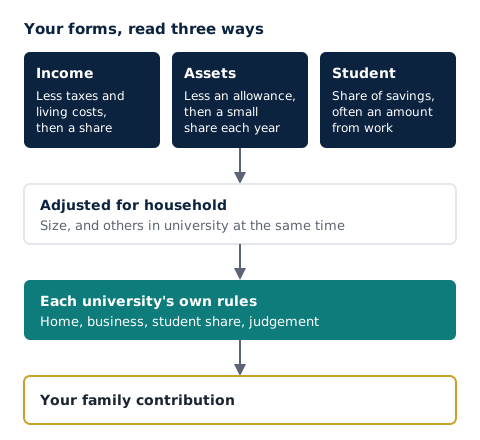
Each university reads your family's aid forms and works out what it believes you can pay each year. It counts a share of your income after allowances for basic living costs, a small share of your savings and property, and something from the student, then adjusts for household size and anyone else in university. Universities apply their own rules, so the same family can get different figures from different universities.
How does a university decide what my family pays?
It reads your family's aid forms and works out what it believes you can pay each year. That figure is your family contribution. The university then pays the rest, if it meets full need.
The forms are usually the CSS Profile, plus your documents. The method most universities start from is the College Board's Institutional Methodology, but each university adjusts it with its own rules. So the contribution is a calculation, not a guess, and you can understand most of it in advance.
What goes into the calculation?
Five things, and each one is assessed differently:
| What | How it is treated |
|---|---|
| Parents' income | Allowances for taxes and basic living costs come off first; a share of what remains is expected |
| Parents' assets | A small share each year of savings, property and business value, after an allowance |
| The student's money | A share of the student's own savings, and often an expected amount from summer work |
| Household | More people living on the income means a lower contribution |
| Others in university | A sibling at university at the same time can reduce what is expected for each |
The College Board describes the starting principle simply: a family's capacity to pay depends on its income and assets. Each line above turns part of one or the other into a contribution.
How is our income counted?
After allowances, not in full. The university first subtracts the taxes you pay and an allowance for your household's basic living costs. It then expects a share of what is left, and that share rises as income rises.
So a family with a modest income may be expected to contribute very little from it, because most of it goes on basic living. A family with a high income contributes more, and a larger share of each extra cedi.
You report income in cedis on the CSS Profile, and it is converted to dollars. That means the exchange rate matters: when the cedi weakens, the same cedi income is worth fewer dollars, and the calculated contribution in dollars usually falls with it. A university recalculates each year, so the rate in the year you file is the one that counts.
Count every source of income. That means salaries, business profits, rent, farm income and regular support from relatives. Leaving one out does not lower your figure for long: documents and later checks usually find it, and the gap can cost the student the offer.
How are our property and savings counted?
As a small share each year, after an allowance. Assets matter less than income in most calculations, but in Ghanaian families they often surprise people. Three kinds count:
- Savings and investments, including bank, mobile money and susu balances, and treasury bills.
- Land and property other than the family home: building plots, farm land, a second house, rental units.
- Business assets, for a family that owns a shop, a farm business or a company.
The family home is treated differently by different universities. Harvard says it does not count the equity in a family's primary home or its retirement savings. Other universities count home equity, sometimes capped at a multiple of income. Our guide to land and property on the CSS Profile explains how to report each kind.
What is the student expected to contribute?
Usually two things: a share of the student's own savings and, at many universities, an expected amount from summer or term-time work. The amount from work often appears in the package as a campus job.
For a student coming straight from SHS in Ghana, savings are usually small. Report what there is honestly. Some universities set a standard student contribution for everyone; others vary it.
Why do two universities give different figures?
Because each applies its own rules to the same forms. They differ in at least four places:
- The family home. Counted, capped or ignored.
- Business and farm assets. Valued and assessed differently.
- The student's contribution. A fixed figure at some universities, calculated at others.
- Professional judgement. How far the aid officer adjusts for circumstances the formula misses.
So a difference of several thousand dollars between two universities is normal, and does not mean either made a mistake. Compare what each expects your family to pay, and ask the higher one to explain its figure if it seems wrong.
How do universities handle circumstances the forms miss?
Through professional judgement. Aid officers can adjust the calculation for circumstances the formula does not capture, if you explain them and back them up. Common ones in Ghanaian families include:
- Supporting relatives, such as grandparents or a sibling's children.
- School fees for younger children, especially private school fees.
- Irregular income, from trading, farming or contract work that varies from year to year.
- Large medical or funeral costs in the past year.
Use the explanation section of the CSS Profile, or write to the aid office, and attach documents. Keep it short and factual. Brown, for example, lists the factors its own formula weighs on its aid website, and most aid offices publish a similar page.
How can we estimate our figure before we apply?
Use each university's net price calculator, then compare the results with what you expect from the factors above. Some calculators are not built for international families, so read what each one says about them first. Our guide to the net price calculator explains how to use one from Ghana.
What should we do first?
Gather a full year of income documents and a list of everything the family owns and owes, with values and evidence. Write down any circumstance the forms might miss. Those three things decide how accurate your figure will be.
If you would like help preparing the forms and explaining your family's circumstances clearly, that is part of the Scholarship and Aid Sprint.
Questions people ask
How does a US university calculate what my family pays?
From your aid forms, usually the CSS Profile. It takes your family's income, subtracts allowances for taxes and basic living costs, and expects a share of what remains. It adds a small share of your assets, and a contribution from the student, then adjusts for household size.
Does my family's house count?
It depends on the university. Harvard says it does not count the equity in a family's primary home or retirement savings. Other universities count home equity, sometimes capped. Land, a second house or rental property is usually counted.
Why did two universities give us different figures?
Because each applies its own rules to the same forms. They differ on how they treat home equity, business assets, the student's contribution and special circumstances. Differences of thousands of dollars are normal.
Do universities understand Ghanaian incomes and costs?
Aid officers work with international families every year, and many use professional judgement for circumstances the formula misses. Explain anything unusual, such as supporting relatives, in the space the forms give you, with documents.