How to write a personal statement for US universities
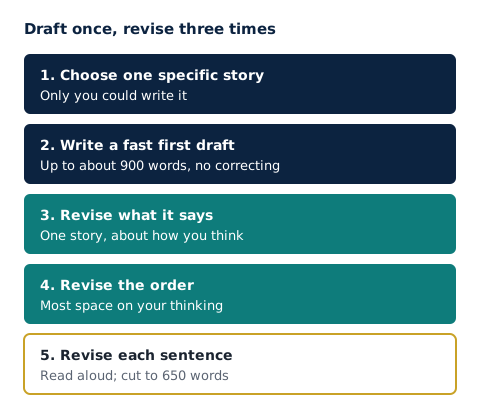
Choose one specific story from your life, write a fast first draft of up to about 900 words, then cut and revise it in three rounds: what it says, how it is ordered, and how each sentence reads. The Common App allows 650 words. It is not a school composition: write plainly, in your own voice, about how you think, and give yourself at least two months.
How do I write a personal statement?
In five steps: choose one specific story, write a fast first draft, then revise it in three separate rounds. Most students try to write a perfect essay in one sitting. Strong essays are almost always rewritten several times, and each round fixes a different thing.
The Common App personal statement can be up to 650 words. You choose one of seven prompts, and the same essay goes to every university you apply to through the Common App. For many admissions officers it is the only place they hear you speak.
How is it different from a school essay?
It is personal, plain and specific, where a school composition is often formal and general. Many Ghanaian students are trained to write for the WASSCE: a formal opening, a balanced argument, impressive vocabulary and a moral at the end. A US admissions reader wants almost the opposite.
| WASSCE composition | Common App personal statement | UCAS personal statement | |
|---|---|---|---|
| Purpose | Show command of English | Show who you are and how you think | Show why you suit the course |
| Topic | Set by the examiner | Chosen by you, from seven broad prompts | Three set questions about your subject |
| Tone | Formal | Plain and personal | Clear and academic |
| Length | Set by the paper | Up to 650 words | Up to 4,000 characters in total |
If you are also applying to the UK, write the two separately. Our guide to studying in the UK from Ghana covers the UCAS statement.
How do I choose the story?
Pick one specific part of your life that shows how you think: a moment, a routine, a problem you keep coming back to. It does not need to be dramatic or a big achievement; those are already in your activities list.
A good test: could another student at your school write this essay? If yes, find something more specific to you. Our guide to personal statement ideas has topics that work for Ghanaian students and three tests for any idea.
How should I structure it?
There is no required structure, but a simple shape works for most essays:
- Open in the middle of something. A moment, an image, a line of speech. No quotations from famous people, no dictionary definitions.
- Tell the story briefly. Enough for the reader to follow, no more.
- Show what you thought and did. This is the heart of the essay, and it should take the most space.
- Show how it changed you or what you do now. Not a moral, but where the thinking led.
- End by looking forward, or by returning to the opening. Not with a summary.
The balance matters most. Many first drafts spend 500 words on what happened and 100 on what the writer thought. Reverse that.
How do I write the first draft?
Fast, and too long. Give yourself one or two sittings and write up to about 900 words without stopping to correct. You are finding out what you have to say, not polishing it.
Write the way you would tell the story to a teacher you trust. If you use a Ghanaian word or refer to a place, explain it briefly: your reader may never have been to Ghana. Then put the draft away for a few days before you revise.
How do I revise it?
In three separate rounds, each with one job:
- What it says. Is there one clear story? Does the reader learn something true about you that nothing else in your application says? Cut anything that does not serve that.
- How it is ordered. Does it open in the right place? Is most of the space on your thinking? Does the ending land?
- How each sentence reads. Read it aloud. Cut repeated words, vague phrases and anything you would never say. Then cut to 650 words.
Do not fix commas in round one. A sentence you polish may be cut in round two.
What if writing is not my strongest skill?
Then plain writing is your friend. The essay is not marked for vocabulary, and short, clear sentences about real things read well to any admissions officer. Spend your effort on the story and the details, which no one else can supply, and on careful proofreading at the end. A science student who writes simply about a problem they solved often writes a stronger essay than a fluent writer with nothing specific to say.
Who should read it?
Two or three people at most: one who knows you well, one who does not, and perhaps a teacher who reads for clarity. Ask each one specific questions: what do you remember, what did you learn about me, where did you get lost?
Feedback should help you rewrite, not rewrite for you. Universities want to hear your voice, and the Common App asks you to confirm that your application is your own work. An essay written by someone else, or by a chatbot, tends to sound like no one in particular, which is the opposite of what the essay is for.
How long does it take?
About two months, working steadily. Most students need four to six drafts. Start early enough to finish before early deadlines in November:
- JuneCollect ideas. Test two or three against the questions in our ideas guide.
- JulyChoose one story. Write the fast first draft.
- AugustRevise for what it says and how it is ordered. Share with one reader.
- SeptemberRevise sentence by sentence. Share with a second reader. Cut to 650 words.
- OctoberFinal read aloud. Paste into the Common App and check the formatting.
Our guide to when to apply, month by month fits the essay into the rest of the season.
What about scholarship and supplement essays?
Write the personal statement first. Once you know your main story, you can choose different material for the supplements and scholarship essays, so each one adds something new. Our guides to supplemental essays and the scholarship essay cover those.
What should I do first?
Write down three moments from the last two years that you still think about. For each, write one sentence on what it shows about how you think. The one with the most specific answer is often the story.
If you would like someone to work through the drafts with you, from blank page to final essay, our Personal Statement Studio does exactly that, with the words always yours.
Questions people ask
How long should a US personal statement be?
The Common App personal statement can be up to 650 words, and the same essay goes to every university you apply to through it. Most strong essays use most of that space, but a clear 550 words beats a padded 650.
How do I start a personal statement?
With a specific moment, image or line from your own life, not a quotation or a general statement. Start where the story starts and let the reader catch up.
Is a US personal statement the same as a UCAS one?
No. The Common App essay is a story about you, on a topic you choose. The UCAS statement, from 2026 entry, answers three set questions about why you want to study your course and how you have prepared, within 4,000 characters.
Can someone help me write my personal statement?
Someone can ask you questions and give feedback, but the words must be yours. Universities want to hear your voice, and the Common App asks you to confirm that your application is your own work.
When should I start my personal statement?
Around June or July before your final year of applications, so you have the summer to draft and revise before early deadlines in November.