Supplemental essays: how to plan and write them
Supplemental essays are the extra questions each university adds to the Common App, usually 50 to 250 words each. Collect every prompt on your list in August, sort them into six common types, and plan which story goes where so nothing repeats your personal statement. Reuse an answer only where the question truly matches. Treat optional essays as expected.
What are supplemental essays, and how do I handle them?
They are the extra questions each university adds to the Common App, on top of your personal statement. They are usually short, often 50 to 250 words, and each university writes its own. Handle them as one planned set, not one at a time: collect every prompt on your list, sort them by type, and decide which story answers which.
For many Ghanaian students the supplements are a bigger job than the personal statement. A list of ten selective universities can mean dozens of short answers, each due on the same deadlines.
What types of supplemental essay are there?
Most prompts fall into six types, each testing something different:
| Type | What it tests | How to approach it |
|---|---|---|
| Why this university | Whether you know and want this place | Specific courses, people and programmes, linked to you |
| Why this major | Whether your interest is real and informed | Where the interest came from and what you have done with it |
| Community or contribution | What you would bring to campus life | One community you belong to and your part in it |
| Curiosity or learning | How you think and learn | One idea that excites you, explored in detail |
| Short answers and lists | Personality, in very few words | Honest, specific, a little surprising |
| Challenges or context | Circumstances the reader should know | Facts briefly, then what you did |
Our guides to the why this college essay and the why this major essay cover the two most common types in detail.
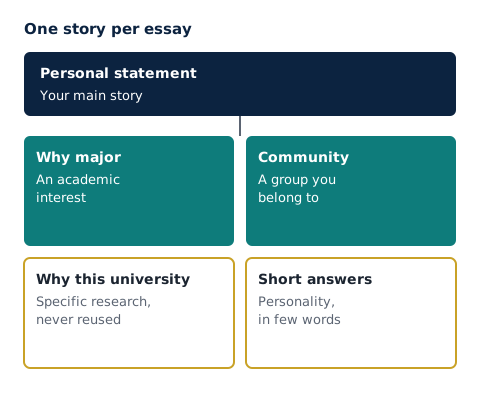
How do I plan them across my list?
In four steps, ideally in August:
- Collect every prompt. Most universities publish their supplements for the coming season by early August. Put them in one document with word limits and deadlines.
- Sort them by type. You will find the same six types again and again.
- List your stories. Write down eight to ten experiences, interests and communities you could draw on, besides your personal statement.
- Map stories to prompts. Each university should see a different side of you in each essay, and nothing should repeat the personal statement.
The map takes an afternoon and saves weeks. It also shows you early which universities will take the most work, which matters when deadlines cluster.
When can I reuse an answer?
When the question truly matches. A "why this major" answer can often be adapted for several universities, as long as you change the parts about each university's courses. A community essay may fit several prompts that ask about the same thing in different words.
A "why this university" essay cannot be reused. An admissions officer can tell when the name has simply been changed, and a wrong university name is an easy way to lose a reader. Read each prompt closely before adapting: small differences in wording often ask for something different.
How do I write a good short answer?
Be specific and be yourself. In 50 or 100 words there is no room for an introduction or a conclusion. Answer the question in the first sentence, then give one concrete detail that only you could give.
Short questions about a favourite book, a word or a perfect day are looking for personality. Answer honestly. A Ghanaian author, a dish your grandmother makes or a song from home can say more about you than the answer you think a university wants. Stanford, for example, asks five short questions of up to 50 words each, alongside three essays of up to 250 words.
Are optional essays really optional?
Technically, yes. In practice, at selective universities most strong applicants answer them, so an empty optional essay can look like a missed chance. Answer it if you have something new to say.
The exception is an essay about circumstances or challenges. If nothing in your life needs explaining, leave it blank rather than inventing hardship. Our guide to writing about hardship explains when to use it.
How do I write about Ghana in a supplement?
Specifically, and as part of your story, not as background. A reader in the US may know little about Ghana, so a sentence of context helps. But the essay should be about you: your school, your town, a problem you noticed and what you did.
Community essays are a natural place for this. A church youth group, a family business, an SHS house or a WhatsApp study group are all communities, and each can show what you would bring to campus.
What about universities outside the Common App?
They ask their own questions, and they count in the same plan. MIT, for example, uses its own application with several short-answer questions instead of the Common App personal statement. Other universities add questions in their own applicant portals after you apply.
Add these to your prompt document as soon as you know about them, and check each university's portal after you submit. A question that appears only in a portal is easy to miss, and an unanswered one can hold up your file. Our guide to US application deadlines lists the dates.
How do I manage the workload?
Start with the universities whose deadlines come first, and write the essays you can adapt before the ones you cannot. A typical order:
- Early deadlines first. Early Action and Early Decision essays are usually due on 1 or 15 November.
- Reusable answers next. Draft one strong "why major" and one community essay you can adapt.
- "Why this university" essays last for each. They need the most research and cannot be reused.
Give each essay at least two drafts. Our guide to when to apply, month by month shows how this fits the season.
What should I do first?
Open a document today and paste in every supplemental prompt from your list, with its word limit and deadline. Count them. Then list eight stories you could tell besides your personal statement, and start matching.
If you would like help planning and drafting your supplements alongside your personal statement, our Personal Statement Studio covers both, with the words always yours.
Questions people ask
What are supplemental essays?
The extra questions a university adds to its section of the Common App, on top of the personal statement. They are usually short, often 50 to 250 words, and each university sets its own.
How many supplemental essays will I write?
It depends entirely on your list. Some universities ask none, and some selective ones ask several. Stanford, for example, asks three short essays of up to 250 words and five short questions of up to 50 words. Count them all in August.
Can I reuse supplemental essays for different universities?
Sometimes. An answer about your intended major or a community you belong to can often be adapted. A "why this university" answer cannot, because it must be specific to each one.
Are optional supplemental essays really optional?
Technically, yes. But at selective universities most strong applicants answer them, so treat an optional essay as a chance to add something new, unless you truly have nothing to say.