Writing a scholarship essay as a Ghanaian student
Start from the scholarship's own criteria, not from a general essay. Most look for some mix of academic strength, leadership, service, financial need and clear goals. Answer the exact question, show each quality through specific things you did and what changed, and connect your plans to what the scholarship exists to do. Keep to the word limit, write in your own voice, and never exaggerate.
How do I write a scholarship essay that wins?
Start from the scholarship's own criteria. Most scholarships say what they look for: academic strength, leadership, service, financial need, a commitment to give back, or some mix of these. Answer the exact question, show each quality through things you have actually done, and connect your plans to what the scholarship exists to achieve.
A scholarship essay is not a general personal statement. It is an answer to one committee's question, read against one set of criteria. Write it for them.
What do scholarship committees look for?
It depends on the scholarship, and the best ones tell you. Some examples:
| Scholarship | What it says it looks for |
|---|---|
| Lester B. Pearson, Toronto | Academic achievement, creativity and leadership |
| Reach Oxford | Academic achievement, financial need and social commitment, with an intention to return home |
| Mastercard Foundation Scholars | Academic strength, financial need, leadership and a commitment to give back |
Look for the criteria in three places: the scholarship's description, its eligibility rules and the questions themselves. A question that asks about "a time you helped others" is telling you that service matters. Where a scholarship explains why it exists, such as supporting students who will return home, your essay should show you share that purpose.
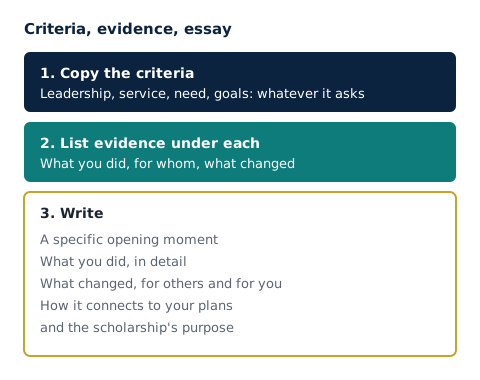
Before you write, copy the criteria onto a page. Under each one, list the evidence you have: what you did, for whom, and what changed. That page is your plan.
How should I structure it?
Simply, around the question. A structure that works for most prompts:
- Open with a specific moment that shows the quality the question asks about, not a quotation or a general statement.
- Show what you did, with detail: the action, the people, the scale.
- Show what changed, for others and for you.
- Connect to your plans and to the scholarship's purpose.
- End plainly, with where you are going next, not a slogan.
Keep paragraphs short and concrete. Committees read many essays; the clear, specific one stands out.
How do I show leadership and service?
Through specific actions and results, not titles. "I was class prefect" says little. "I organised Saturday revision for 30 SHS 1 students, and their mock results in mathematics rose" says a great deal. Leadership includes work at home and in your community, not only school posts.
Choose one or two examples and go deep, rather than listing ten. Our guide to the Common App activities list shows how to describe activities precisely.
How do I write about financial need?
Plainly and briefly, if the scholarship asks. State the facts of your family's situation without exaggeration, and keep the focus on what you have done despite it. Committees want to understand your circumstances, not to be moved to pity. Our guide to writing about hardship shows how to keep the dignity of the people in your story.
How do I write about my goals?
Specifically, realistically and with a link to what you have already done. A committee funding your future wants to see that your plans grow out of your past. "I tutored classmates in mathematics for two years and want to train as a teacher of mathematics, then help design better materials for Ghanaian schools" connects a record to a goal.
You do not need a ten-year plan. It is fine to say what you want to explore and why. What does not work is a goal that appears from nowhere, or one so large it says nothing.
What about short-answer questions?
Treat each one as a small essay with one job. Many scholarship applications add short questions, sometimes of 100 or 150 words, about a book you loved, a problem you would solve or a person who shaped you. Answer the question in the first sentence, give one specific example, and stop.
Short answers are where students often fall back on clichés, because the space is small. Use the space for one vivid, true detail instead.
When should I start, and who should read it?
Start at least a month before the deadline. A strong essay usually takes several drafts, with days between them so you can see it freshly.
Ask one or two trusted readers, such as a teacher who knows you, to check two things: does it answer the question, and does it sound like you? Take their comments, but keep the words your own.
Can I reuse material across scholarships?
Yes, carefully. The stories and evidence are yours, and you can use them in several essays. But each essay must answer its own question and criteria. Rewrite the opening and the ending for each scholarship, and check that every paragraph serves its prompt.
Never submit an essay with another scholarship's name in it. It happens more often than students think, and it is hard to recover from.
How long should it be?
Exactly as long as asked, and never over. Many scholarship portals cut essays off at the limit. If no limit is given, aim for about a page. Write long first if you need to, then cut until every sentence earns its place.
How do I make it sound like me?
Write as you would explain it to a teacher you respect: clearly, in your own words, without borrowed phrases. Read it aloud. If a sentence sounds like a speech or a template, rewrite it. Ask one trusted reader whether it sounds like you, and whether they learned something new.
Never let anyone write it for you, and never exaggerate. Committees often check details with your school, and an essay that does not match your record can cost the scholarship.
What should I do first?
Pick the scholarship you are applying to, copy its criteria onto a page, and list your evidence under each. Then write a first draft that answers its question directly.
If you would like feedback on a scholarship essay, you can book a call with us.
Questions people ask
How is a scholarship essay different from a personal statement?
A personal statement shows a university who you are. A scholarship essay answers a specific question against specific criteria, such as leadership, service or need. It should speak directly to what that scholarship is looking for.
What do scholarship committees look for?
Usually evidence that you match their criteria: academic strength, leadership, service, financial need or a commitment to give back. The best essays show these through specific actions and results.
Can I reuse my personal statement for scholarships?
Parts of it, carefully. You can reuse stories and evidence, but rewrite each essay to answer that scholarship's question and criteria. A general essay pasted into a specific prompt usually reads as off-target.
How long should a scholarship essay be?
Exactly as long as the scholarship asks, and never over. If no limit is given, a page is usually enough. Shorter and specific beats longer and general.