How to study in the UK from Ghana
Apply through UCAS to up to five courses in one subject, by 15 October for Oxford, Cambridge and most medicine courses, or 13 January 2027 for most others. Many universities accept strong WASSCE results; some ask for a foundation year first. Most UK funding for international undergraduates is partial, so plan for fees and living costs, which the student visa requires you to show before you travel.
How do I study in the UK from Ghana?
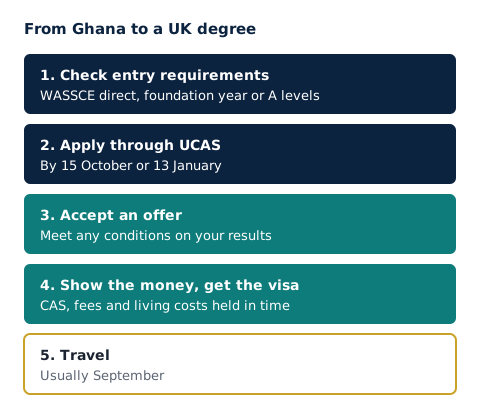
In five stages: check you meet the entry requirements, apply through UCAS, accept an offer, secure the money and the student visa, then travel. The UK route is simpler than the US one in some ways: one application, one personal statement, up to five courses. It is harder in one way that matters to most Ghanaian families: the money.
UK universities give international undergraduates far less need-based aid than the most generous US universities. So the UK suits a family that can pay a large share of the cost, or a student who wins one of the few full scholarships.
Will a UK university accept my results?
Often, with conditions. UK universities set entry requirements by course, and most publish what they accept from Ghanaian students. Three common routes:
| Route | What it means | Who it suits |
|---|---|---|
| WASSCE direct | Set grades in set subjects, for some courses at some universities | Strong WASSCE students applying to universities that accept it |
| Foundation year | A year of preparation before the degree, adding a year of fees | Students whose results or subjects do not meet direct entry |
| A levels or IB | Accepted by all UK universities | Students at schools offering them |
Cardiff, for example, publishes its entry requirements for Ghana. Check every university on your list, because two universities can treat the same WASSCE results differently. Some also accept WASSCE English in place of an English test. Our guide to WASSCE, A levels or the IB compares the qualifications.
How does UCAS work?
One application, up to five courses, one personal statement. You apply for a specific course, such as economics or mechanical engineering, so choose five courses in the same subject. The application includes your results or predicted grades, a reference from your school and the personal statement.
From 2026 entry, the personal statement answers three set questions: why you want to study the course, how your studies have prepared you, and what else has prepared you outside education. The total is 4,000 characters. It is quite different from a US essay. Our guide to how to write a personal statement compares the two.
Do I need IELTS?
Not always. For degree-level study, each university decides how it assesses your English. Some accept a strong WASSCE English grade, and others ask for IELTS or another approved test with a set score. Check the course page for each university, and take a test only if one on your list needs it. Our guide to TOEFL or IELTS compares the tests.
What does the school reference need?
A teacher or head writes one reference for all five courses. It should explain your school and its grading, give predicted grades where you do not yet have results, and speak to your ability in the subject. Brief your referee early: many Ghanaian schools write few UCAS references, and a reference that arrives late holds up the whole application.
When are the deadlines?
Two main ones for 2027 entry, both at 18:00 UK time:
- 15 October 2026Oxford, Cambridge, and most courses in medicine, dentistry and veterinary science.
- 13 January 2027Most other undergraduate courses, for equal consideration.
- After 13 JanuaryApplications are still possible where places remain, but are not guaranteed equal consideration.
Some courses also need an admissions test or an interview, especially at Oxford, Cambridge and in medicine. Check each course page early.
What does it cost, and is there funding?
Tuition plus living costs, for every year of the course. International tuition varies widely by university and subject, and living costs are highest in London. Most degrees in England take three years, and four in Scotland, which can make the total lower than a four-year US degree for a family paying in full.
Funding for Ghanaian undergraduates is limited. A handful of full scholarships exist, such as Oxford's Reach scholarship and UCL's Global Undergraduate Scholarship, and many universities offer partial awards. Our guide to UK undergraduate scholarships lists them.
What do I need for the student visa?
An unconditional offer, a Confirmation of Acceptance for Studies (CAS) from the university, proof of English, and proof of money. The money must cover any unpaid first-year fees plus a set amount for living costs for up to nine months, higher in London. It must normally be held in an account for a set period before you apply. The UK government's student visa page lists the current figures and rules.
You also pay the visa fee and the Immigration Health Surcharge. Prepare the bank documents early, because a Ghanaian bank statement must meet the UK's rules on format and timing.
Can I work during and after the degree?
During term, most undergraduates on a student visa can work part-time, within limits set on the visa. After graduating, the Graduate route lets you stay and work. For applications made on or after 1 January 2027, it lasts 18 months after a bachelor's degree, down from two years.
That shorter window matters for a family weighing the UK as a route to work abroad. Plan on the 18 months, and check the rules again before you graduate.
Should I apply to the UK, the US or both?
It depends on how your family will pay:
- Need substantial aid: the US is usually stronger, because a group of US universities meet full need for internationals. Add a UK full scholarship application if you are a strong candidate.
- Can pay part: compare UK partial awards with US merit and need-based offers, over the full length of each degree.
- Can pay in full: the UK's shorter degrees and simpler application can be good value.
Many students apply to both, which means two essays and two timelines. Our guide to which country gives the best chance compares the options.
What should I do first?
Choose your subject, then check the entry requirements for Ghana at five universities that teach it. Note which accept your results directly and which need a foundation year. At the same time, agree as a family what you can pay each year, in pounds.
If you would like help deciding between the UK and the US, or applying to both, you can book a free call with us.
Questions people ask
What are the requirements to study in the UK from Ghana?
Entry grades set by each course, usually from WASSCE, A levels or the IB; English proof, which some universities accept from WASSCE English; a UCAS application with a personal statement and a reference; and, after an offer, proof of funds for the student visa.
Can I study in the UK with WASSCE?
Often, yes, with set grades in set subjects. Some universities accept WASSCE directly for some courses, while others ask WASSCE students to complete a foundation year first. Check each university's entry requirements for Ghana.
When is the UCAS deadline for 2027 entry?
15 October 2026 for Oxford, Cambridge and most courses in medicine, dentistry and veterinary science. 13 January 2027 for most other courses. Both are at 18:00 UK time.
Can I work in the UK after graduating?
Through the Graduate route, yes. For applications made on or after 1 January 2027, it allows 18 months of work after a bachelor's degree, down from two years.
Is the UK cheaper than the US for Ghanaians?
Degrees are often shorter, usually three years in England. But the UK gives international undergraduates far less need-based aid, so for a family that needs funding, a full-need US university can cost much less.