Personal statement mistakes Ghanaian students make
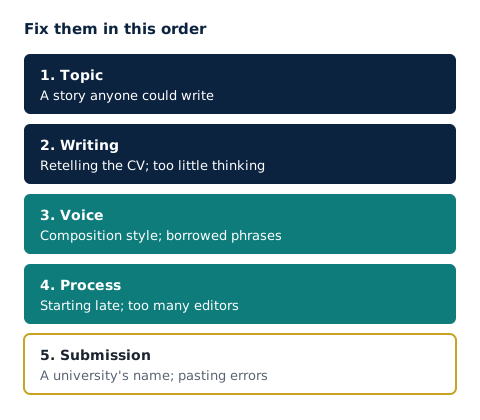
The most common mistakes fall into five groups: a topic that could be anyone's, an essay that retells your CV, a formal composition voice, a rushed or over-edited process, and careless submission. Each has a simple fix: one specific story, most of the space on your thinking, plain words, time for three rounds of revision, and a final check inside the Common App.
What are the most common personal statement mistakes?
They fall into five groups: the topic, the writing, the voice, the process and the submission. Most weak essays we read have one big problem rather than many small ones, and it is usually in the first two groups. A typo can be fixed in a minute. An essay about nothing in particular cannot.
These are the mistakes we see most often from Ghanaian students. Almost all of them come from good habits learned for school exams, applied to a very different kind of writing.
Which mistakes happen at the topic stage?
Three, and they matter most:
- A topic anyone could write. "Hard work pays off", "my passion for medicine", "how I became a leader". If another student at your school could write it, choose something more specific.
- Too big a topic. Your whole life, your country, or ten years of your education in 650 words. Pick one moment, routine or problem.
- A topic chosen to impress. The biggest prize or the most dramatic event is not always the best story. A small, true story about how you think usually tells the reader more.
Our guide to personal statement ideas has three tests for any topic.
Which mistakes happen in the writing?
Three more, all about where the words go:
- Retelling the CV. Prefect, NSMQ, debate club, best student in chemistry. These are already in your activities list and honours. The essay is where the reader learns how you think, not what you did.
- Too much story, too little thinking. Many drafts spend most of the space on what happened and a paragraph on what the writer thought. Reverse that balance.
- A moral at the end. "This taught me that with determination, anything is possible." End with where your thinking led, or return to the opening, but do not preach.
Which mistakes are about voice?
Two, and they are the most Ghanaian of the lot:
- The composition voice. Openings like "Since time immemorial" or "Webster's dictionary defines", long words used to impress, and a formal tone throughout. That style can score in a WASSCE paper. To a US reader it hides the person.
- Sounding like someone else. Phrases borrowed from sample essays online, or a parent's or adviser's sentences. Admissions officers read thousands of essays and notice when a voice does not match the rest of the application.
Write as you would speak to a teacher you respect: clear, specific, in your own words. Explain any Ghanaian term or place in a few words, because your reader may never have been to Ghana.
Which mistakes happen in the process?
Four, all about time and help:
| Mistake | What happens | The fix |
|---|---|---|
| Starting in October | No time to revise, so the first idea goes out | Start in June or July |
| Polishing the first draft | Hours on sentences that later get cut | Revise content, then order, then sentences |
| Too many readers | The essay drifts towards everyone's opinion | Two or three readers at most |
| Letting someone else write it | The voice stops being yours | Ask for questions and feedback, not rewrites |
AI belongs in this group too. The Common App's fraud policy counts submitting the substantive content or output of an artificial intelligence platform as your own work as fraud. Beyond the rule, an essay written by a chatbot tends to sound like no one, which defeats its purpose. Our guide to how to write a personal statement sets out the three rounds of revision.
Which mistakes happen at submission?
Small ones, but they are avoidable and they look careless:
- A university's name in the personal statement. The same essay goes to every university on your Common App, so a name will be wrong for all the others.
- Formatting lost when pasting. Paste your final essay into the Common App box and read it there: check paragraph breaks, quotation marks and any special characters.
- Over the word limit. The box will not accept more than 650 words.
- Spelling and grammar. British spelling is fine, but be consistent. Read the final version aloud, slowly, once more.
How do I check my essay for these mistakes?
Read it once for each group, in order, asking one question each time:
- Topic: could anyone else at my school have written this?
- Writing: is most of the space on what I thought and did?
- Voice: does this sound like me talking, not like a composition?
- Process: have I revised it at least three times, with no more than three readers?
- Submission: have I read it inside the Common App, under 650 words, with no university's name?
Fix any problem you find at the earliest stage first. A new topic beats a better sentence.
Which mistakes matter less than students think?
A few that students worry about more than readers do:
- Using a "boring" prompt. All seven prompts are equal. Choose the one your story fits, or the topic-of-your-choice prompt.
- Writing under 650 words. A clear 550 words beats a padded 650.
- Ghanaian English. Readers expect international students to sound like where they come from. Clarity matters, not an American accent on the page.
Do the same mistakes apply to other essays?
Mostly, yes. Supplements and scholarship essays suffer from the same vague topics and borrowed voices, plus one mistake of their own: reusing the personal statement's story. Each essay should add something the reader has not yet seen. A scholarship essay also has to answer the funder's question directly, which many students skip in favour of a general story. Our guides to supplemental essays and the scholarship essay cover both.
What should I do first?
Take your current draft and highlight every sentence that is already in your activities list or honours. If more than a quarter of the essay is highlighted, the essay is retelling your CV. Choose the one moment in it that shows how you think, and rewrite around that.
If you would like someone to read your drafts against these mistakes and work through the revisions with you, our Personal Statement Studio does that, with the words always yours.
Questions people ask
What is the biggest personal statement mistake?
Writing an essay that could belong to any applicant. If another student at your school could have written it, the reader learns nothing about you. Choose one specific story only you could tell.
Is it a mistake to write about my achievements?
Not if you write about what you thought and did along the way. It is a mistake to list them, because your activities list and honours section already do that.
Can I use AI to write my personal statement?
No. The Common App's fraud policy counts submitting the substantive content or output of an artificial intelligence platform as your own work as fraud. The words, ideas and voice must be yours.
Is going over the word limit a problem?
The Common App will not accept more than 650 words in the personal statement box, so you must cut. Cutting usually makes an essay stronger.
Should I mention the university's name in the personal statement?
No. The same personal statement goes to every university on your Common App, so a university's name in it will be wrong for all the others. Save that for the supplements.