Engineering and computer science scholarships for Ghanaians
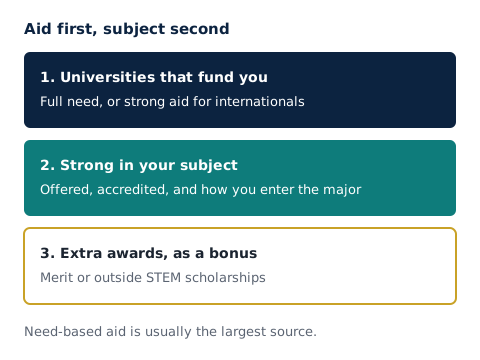
Most funding for a Ghanaian studying engineering or computer science in the US comes from the university's need-based aid, not from subject scholarships. At universities that meet full need, an engineering student gets the same aid as anyone else. So choose universities that fund international students and teach your subject well, check how you are admitted to the major, and treat STEM-specific awards as a bonus.
How do I fund an engineering or computer science degree in the US?
Mostly through the university's need-based aid, not through subject scholarships. At universities that meet the full need of international students, an engineering or computer science student receives aid exactly as any other student does. MIT, for example, meets full need for every admitted student and never includes loans.
Named engineering scholarships for international undergraduates exist, but they are few and usually partial. So the best plan is the same as for any Ghanaian student who needs full funding: choose universities that fund international students, and that teach your subject well.
Where does the money come from?
Three sources, in order of how much they usually provide:
| Source | What it is | For a Ghanaian student |
|---|---|---|
| Need-based aid | The university meets your calculated need | The main source at universities that meet full need |
| Merit scholarships | University awards for strong applicants | Sometimes large; often partial; check eligibility |
| Outside STEM awards | Company or foundation scholarships | Few open to international undergraduates; usually small |
Our guides to universities that meet full need and to US merit scholarships cover the first two.
How am I admitted to engineering or computer science?
It depends on the university. Three common patterns:
- Admission to the university, then choose a major. You declare engineering or computer science later, often in the first or second year.
- Direct admission to an engineering school. You apply to the engineering school itself, often with a separate selection.
- Limited places in popular majors. Some universities cap computer science, so not every admitted student who wants it can enter.
Read each university's admissions pages for how your major works. If places are limited, ask what happens if you do not get in, and whether your aid stays the same in another major.
Does choosing engineering change my aid?
Not at universities that meet full need. Your aid is calculated from your family's finances, not your subject, so an engineering student and a history student from similar families receive similar offers. What can differ is the cost of attendance: some engineering programmes add lab fees or equipment costs. Ask whether these are included in the aid.
At universities that give merit awards, some scholarships are tied to particular schools or majors. If you change major later, ask whether the award stays with you.
What should I check about the programme?
Four things, for each university:
- Does it offer your subject? Many liberal arts colleges teach computer science but not engineering. Swarthmore is one of the few with an accredited engineering degree.
- Is it accredited? In the US, ABET accredits engineering and computing programmes. Accreditation matters most if you want to practise as an engineer.
- How do you enter the major? Directly, later, or by competition.
- What support is there? Research for undergraduates, internships and advising.
Is computer science different from engineering?
In how it is taught and where it sits, often yes. Computer science may sit in a school of engineering or in a school of arts and sciences, and the degree may be a Bachelor of Science or a Bachelor of Arts. Both can lead to careers in software and technology.
The difference matters for admission and for the courses you take. A computer science major inside engineering usually includes more mathematics and engineering courses; one in arts and sciences leaves more room for other subjects. Read the course requirements for each.
Do I need the SAT for engineering?
At many universities that fund international students well, yes, because they require the SAT or ACT of all applicants. For engineering and computer science, the mathematics section matters especially. Our guide to whether you need the SAT lists policies for this cycle.
What about work experience during the degree?
US universities offer engineering and computing students internships, research and co-operative programmes. F-1 students can usually take part through practical training rules, which allow work related to your field under conditions. After graduating, students may apply for a period of optional practical training, and students in STEM fields can qualify for an extension. Your international office explains the current rules.
Are there funded engineering options outside the US?
Yes. KNUST is a Mastercard Foundation partner, and Ghana government bilateral awards often include engineering. Russia, for example, has said its expanded scholarship places for Ghanaians prioritise fields including engineering and artificial intelligence. Our guide to funded places outside the USA lists the routes.
Will it be recognised in Ghana?
Usually, for a degree from an accredited US university, but check if you plan to register as a professional engineer. The Ghana Institution of Engineering sets its own requirements for professional membership. Ask how it treats a US degree, especially if your programme is ABET-accredited.
How do I strengthen an engineering application?
By showing what you have built, solved or explored, not only your grades. Useful evidence includes:
- Strong results in mathematics and the sciences, including elective mathematics and physics.
- Projects: something you built, coded, repaired or designed, with what it did.
- Competitions, such as mathematics or science contests.
- Curiosity in your essays: a problem you could not stop thinking about, and how you tackled it.
A student who has built a small app for their school, repaired a generator or taught themselves to code from a phone shows exactly what engineering readers look for. Our guide to the Common App activities list shows how to describe it.
What should I do first?
List the universities that meet full need for international students. Then check, for each, whether it teaches your subject, how you enter the major and whether the programme is accredited.
If you would like help building a funded list for engineering or computer science, that is part of the Scholarship and Aid Sprint.
Questions people ask
Are there full scholarships for engineering students from Ghana?
Yes, mainly through universities that meet the full need of international students. At those, an engineering or computer science student receives aid in the same way as any other student. Named engineering scholarships for internationals are rarer and usually partial.
Is it harder to get into engineering or computer science?
At some universities, yes. Some admit you directly to an engineering school, and some limit places in popular majors such as computer science. Check how each university admits students to the major you want.
Can I study engineering at a liberal arts college?
At a few. Swarthmore, for example, offers an accredited engineering degree within a liberal arts education. Many liberal arts colleges offer computer science but not engineering.
Should my engineering degree be accredited?
It helps, especially if you want to work as an engineer. In the US, ABET accredits engineering and computing programmes. Check whether your programme is accredited, and whether that matters for your plans in Ghana.