Funded undergraduate places outside the USA for Ghanaians
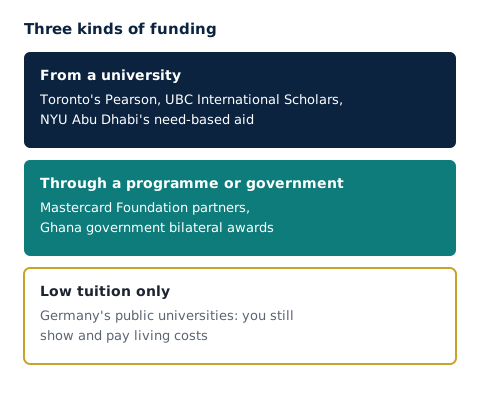
Yes, a Ghanaian student can win a funded first degree outside the US, through a handful of routes. They include Canada's few full awards, Mastercard Foundation partner universities, NYU Abu Dhabi's need-based aid, Japan's MEXT scholarship, and government bilateral awards to countries such as Hungary and Morocco. Germany's public universities charge little or no tuition but rarely fund living costs. Each has its own deadline and conditions.
Can I get a funded first degree outside the USA?
Yes, through a handful of routes, each with its own rules. The main ones are Canada's few full awards, Mastercard Foundation partner universities, NYU Abu Dhabi's need-based aid, Japan's MEXT scholarship and Ghana government bilateral awards. Germany's public universities charge little or no tuition, but rarely pay living costs.
None of these is an easy alternative to the US. Each is competitive, and each asks for something different: a school nomination, a national examination, a language year or proof of living costs. But together they give a Ghanaian student several more chances at a funded degree, often on a different timetable.
What are the main funded routes?
Six, and they work very differently:
| Route | Where you study | How it works |
|---|---|---|
| Canada's full awards | University of Toronto, UBC | Pearson needs a school nomination by early October; UBC's International Scholars program is need-based |
| Mastercard Foundation Scholars | Partner universities, many in Africa | You apply to the partner university; it selects its Scholars |
| NYU Abu Dhabi | Abu Dhabi | Need-based aid for students of any nationality, based on the CSS Profile |
| Japan's MEXT scholarship | Japanese universities | Selection through the Embassy of Japan in Ghana; includes Japanese language study |
| Ghana government bilateral awards | Partner countries, such as Hungary and Morocco | Through the Ghana Scholarships Authority, with national selection |
| Germany's public universities | Germany | Little or no tuition at most; you show funds for living costs; mostly taught in German |
Each route has its own guide or source, linked below. Read the current call for each before you plan around it.
How do Canada's full awards work?
Through two named programmes. The University of Toronto's Lester B. Pearson Scholarship covers tuition, books, fees and residence for four years, but needs your school to nominate you by early October. UBC's International Scholars Program gives need-based awards up to the full cost. Our guide to Canadian scholarships covers both.
How do the Mastercard Foundation and Ghana government routes work?
Through partners. The Mastercard Foundation funds Scholars at partner universities, such as KNUST and Ashesi, which select their own students. Ghana government bilateral awards go through the Ghana Scholarships Authority, which nominates candidates to partner countries such as Hungary and Morocco. Our guides to the Mastercard Foundation Scholars Program and Ghana government scholarships explain each.
What about NYU Abu Dhabi?
It gives need-based aid to admitted students of any nationality, based on the CSS Profile, and considers every admitted student for limited merit support. It is a selective university with an American-style liberal arts education, in the United Arab Emirates. Read its aid page for the current terms, and apply for aid by its deadline, which comes before admission decisions.
What about Japan's MEXT scholarship?
The Japanese government's MEXT scholarship has an undergraduate category, and the Embassy of Japan in Ghana runs the selection. It usually includes a written examination and an interview at the embassy, then a year of Japanese language study before the degree. Applicants must meet an age limit and be willing to study in Japanese. Watch the embassy's website for each year's call, which in recent cycles opened in the spring.
What about the UK?
Full scholarships for international undergraduates in the UK are few. Some universities offer named awards that cover tuition, and a handful cover living costs too, but they are small in number and highly competitive. The best-known UK government scholarships, such as Chevening, are for postgraduate study, not a first degree.
So for most Ghanaian families who need full funding, the UK is a harder route than the US universities that meet full need. Our guide to UK undergraduate scholarships looks at the options in detail.
Will these routes accept my WASSCE?
Usually, but check how. Most universities and programmes outside the US accept WASSCE results for admission, with their own minimum grades. Some add a step:
- A preparation or language year, as with MEXT in Japan, Morocco's French year, or Ashinaga's preparation in Africa.
- A foundation year, which some UK universities require of WASSCE students before the degree.
- Specific subjects, such as elective mathematics for engineering.
Read each route's entry requirements early, so you know whether the programme will take three, four or five years in total.
What about funded study in Africa?
It is a strong option, and often overlooked. Mastercard Foundation partners include universities in Ghana and across Africa, and Ashesi University in Ghana offers financial aid to students who need it. A funded place close to home, with a respected degree, can be a better fit than a distant one, especially for a student who wants to build a career in Ghana.
How do these fit with US applications?
Alongside them, with a calendar. The deadlines are spread through the year: Toronto's nomination in October, UBC in November, Mastercard partners at various points, MEXT in the spring and bilateral awards whenever the Authority publishes a call. Put every date on one calendar with your US deadlines.
Decide in advance which offer you would take if more than one arrives. Some routes, such as bilateral awards and Mastercard, carry commitments to return or give back, and some include a preparation or language year. Our guide to comparing aid offers shows how to set them side by side.
What should I do first?
Pick one or two of these routes that fit your plans and results, and note their deadlines. If you are in your final SHS year and want Toronto's Pearson Scholarship, speak to your headteacher now.
If you would like help choosing which of these routes belong on your list, you can book a call with us.
Questions people ask
Where can a Ghanaian student study abroad on a full scholarship, besides the US?
In Canada through a few full awards, at Mastercard Foundation partner universities, at NYU Abu Dhabi with need-based aid, in Japan through the MEXT scholarship, and in partner countries through Ghana government bilateral awards, such as Hungary and Morocco.
Is the MEXT scholarship open to Ghanaians?
Yes. The Embassy of Japan in Ghana runs the selection for the Japanese government's MEXT scholarship, including an undergraduate category. It includes a year of Japanese language study, and applicants must meet an age limit.
Is university free in Germany for Ghanaians?
Most public universities charge little or no tuition, though some states and universities now charge non-EU students. You still need to show you can pay living costs, and most undergraduate courses are taught in German.
Should I apply outside the US as well as to US universities?
Yes, one or two funded options outside the US are a sensible part of most lists. They keep a funded place possible if no US offer comes, and their deadlines often fall at different times.