Liberal arts colleges vs universities for Ghanaians
A liberal arts college is a small college that teaches only undergraduates, in small classes led by professors. A research university is larger, with graduate schools, research labs and more subjects. Both can fund Ghanaian students well: Amherst and Bowdoin are need-blind for internationals, as are Harvard and MIT. Choose by how you want to learn and what you want to study, not by which name is more familiar at home.
What is the difference between a liberal arts college and a university?
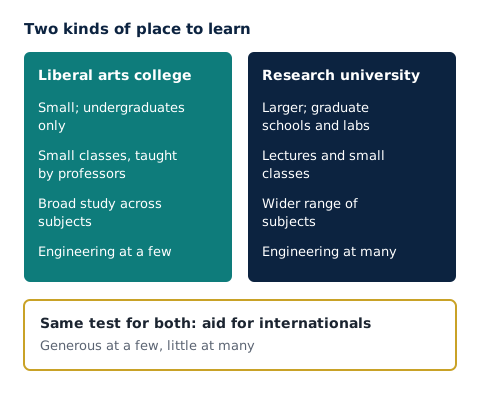
A liberal arts college is small and teaches only undergraduates. A research university is larger, with graduate schools, research labs and a wider range of subjects. At a liberal arts college, professors teach almost all your classes. At a university, you may meet more large lectures and teaching assistants, but also more courses, labs and specialist programmes.
Neither is better in general. Each suits a different kind of student. For a Ghanaian student who needs full funding, both kinds include some of the most generous places in the US.
How do the two compare?
On five things that matter to a student from Ghana:
| Liberal arts college | Research university | |
|---|---|---|
| Size | Usually fewer than 3,000 students | Often 5,000 to many tens of thousands |
| Teaching | Small classes, taught by professors | A mix of large lectures and small classes |
| Subjects | Arts and sciences; engineering at only a few | Wider range, including engineering, business and nursing at many |
| Graduate students | Few or none | Many, in research and some teaching |
| Aid for internationals | Generous at a few, little at many | Generous at a few, little at many |
The last row is the same for both, and it is the one that matters most. Whichever kind you consider, check each one's international aid policy.
What is studying at a liberal arts college like?
Close and broad. Classes are small, often under 25 students, and your professors know you by name. You take courses across the humanities, sciences and social sciences, as well as your major. Discussion and writing carry a lot of weight.
That suits a student who likes to talk ideas through, write a lot and get to know teachers well. It can feel very different from SHS, where large classes and exam preparation are the norm. Many Ghanaian students find the change energising. Some find the small community intense at first.
What is studying at a research university like?
Larger and more varied. You may sit in lectures of a hundred or more in your first year, with smaller sections led by graduate teaching assistants. In return, you get more subjects, specialist programmes, research labs and a bigger campus life.
That suits a student who knows what they want to study in depth, wants access to research early, or likes the energy of a large place. Finding your way takes more initiative: office hours, research projects and advisers are there, but you have to seek them out.
What is life like outside class?
It depends more on the place than on the type, but there is a pattern. Many liberal arts colleges sit in small towns or the countryside, with most students living on campus all four years. Many large universities sit in or near cities, with more off-campus life.
For a student arriving from Accra or Kumasi, both have trade-offs:
- A small-town college gives a close community and fewer distractions, but fewer shops, churches, African food and other Ghanaians nearby.
- A city university gives more of all of those, but a larger, less personal campus and a higher cost of living.
Look at where each place is on a map, how far it is from a major airport, and whether it has an African students' association. Ask the admissions office to connect you with a current international student. A short conversation tells you more than a brochure.
Which kind gives better aid to international students?
Neither, as a group. Both include a few highly generous places and many that give international students little. Among liberal arts colleges, Amherst and Bowdoin are need-blind for international applicants and meet full need, and Williams meets full need for the internationals it admits. Among universities, Harvard, Yale, Princeton, MIT, Dartmouth and Brown are need-blind for internationals.
Our guide to universities that meet full need lists both kinds.
Can I study engineering or medicine at a liberal arts college?
Engineering at a few; medicine at none, at first degree. Swarthmore is one of the few liberal arts colleges with an accredited engineering degree, taught within a liberal arts education. Many others offer no engineering.
Medicine in the US is studied after a first degree, at medical school. So a future doctor can do a first degree at either kind of place, usually in a science, then apply to medical school. Check each college's science facilities and advising for students aiming at medicine.
Will employers in Ghana recognise a liberal arts degree?
A degree from a strong liberal arts college is a full US bachelor's degree, and graduate schools and international employers generally know the leading colleges well. Some employers in Ghana know them less than the big university names.
The practical answer is to be ready to explain your college in a sentence: what it is and why you chose it. Your skills, results and experience will matter more than the name over time.
How do I choose between them?
Ask yourself three questions, and answer honestly:
- How do I learn best? In discussion and small groups, or in a large place where I find my own way?
- What do I want to study? If it is engineering, nursing or business, check which places offer it.
- Do I want to explore before choosing? Liberal arts colleges, and many universities, let you choose your major late.
Most students who need full aid should include both kinds on their list. Then the decision between them comes later, between real offers.
What should I do first?
Add two or three liberal arts colleges that meet full need to your list, if none are there yet. Read about how each one teaches, then compare with the universities you already have.
Our free ebook walks through building a funded list from the start, if you would like the full picture.
Questions people ask
What is a liberal arts college?
A college, usually small and private, that focuses on undergraduates. Professors teach most classes themselves, classes are small, and students study broadly across subjects before and alongside their major.
Is a liberal arts degree respected in Ghana?
A degree from a strong liberal arts college is a full US bachelor's degree. Some employers in Ghana know the names less well than the big universities, so be ready to explain your college briefly. Graduate schools and international employers generally know them well.
Can I study engineering at a liberal arts college?
At a few. Swarthmore, for example, offers an accredited engineering degree within a liberal arts education. Many liberal arts colleges do not offer engineering at all, so check each one before it goes on your list.
Do liberal arts colleges give aid to international students?
Several of the most generous do. Amherst and Bowdoin are need-blind for international applicants and meet full need. Williams meets full need for the internationals it admits. Others give less, so check each one.