How US financial aid works for Ghanaian students
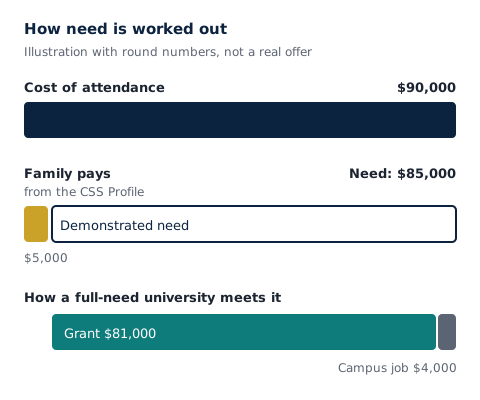
Your aid comes from the university itself, because the FAFSA and US government aid are closed to Ghanaian students. The university takes its full cost for a year and subtracts what it calculates your family can pay. The gap is your demonstrated need, and a full-need university covers it with grants and a campus job.
Where does financial aid come from for a Ghanaian student?
From the university itself. You cannot use the FAFSA, the US government's aid form, or any federal grant or loan. Those are only for US citizens and certain eligible non-citizens, such as permanent residents. A Ghanaian student on an F-1 student visa is not one of them.
The university's aid is mostly grants, which you never repay, and it depends on what your family can afford. A small group of wealthy private universities fund international students from their own endowments. Some of them cover the full cost for a family with a modest income.
So skip the American pages about the FAFSA, Pell Grants, federal loans and state scholarships. None of it applies to you. It also means you cannot fall back on a US government loan if an offer comes up short. The offer you accept has to work without one.
How does a university decide what my family pays?
It takes the full cost of a year and subtracts what it calculates your family can pay. The gap is your demonstrated need. A university that "meets full demonstrated need" covers all of it.
The full cost is the cost of attendance, also called the student budget. It includes what the university bills you for: tuition, housing and food. It also includes costs it does not bill, such as books, personal expenses and, at some universities, travel. Princeton and Yale both publish theirs, and the totals are high. Do not let that headline figure decide anything on its own.
What your family can pay comes from your aid forms. Usually that is the CSS Profile, the aid form most universities that fund internationals use. Sometimes it is a university's own form. The university looks at your parents' income and assets, the number of children in the household and other costs. Then it applies its own formula. You report figures in cedis, and the university converts them.
How is merit aid different from need-based aid?
Merit aid rewards achievement, while need-based aid comes from what your family can pay. Merit aid is usually a fixed sum. Some universities offer competitive merit scholarships to international students, and a few cover the full cost.
The universities most generous to Ghanaian students often give only need-based aid. Merit scholarships are a second route, usually at different universities. Our guide to full-ride scholarships covers them.
Which universities give need-based aid to international students?
A small group gives a great deal, a larger group gives some, and most give little or none. MIT, Harvard, Yale, Princeton and Dartmouth meet full need, and asking for aid plays no part in whether they admit you. Columbia also meets full need, but asking for aid can count against you.
Harvard shows how far the top group goes. From 2025-26, it says students from families earning $100,000 or less pay nothing. It also says international students get aid on exactly the same basis as Americans. For many Ghanaian households, that covers the whole cost.
Many large public universities, including well-known ones, give international undergraduates little or no need-based aid. Check before you assume. Our guides to universities that meet full need and need-blind and need-aware admission list them.
Which forms do I file, and when?
File the CSS Profile for most universities that fund internationals, by the same deadline as your application. Many then ask for your documents through IDOC, the College Board's document upload service. A few accept their own form or a free alternative. Dartmouth, for example, accepts the ISFAA when the CSS Profile fee is a hardship.
Your aid forms are due with your application, not after it. Our guides to the CSS Profile from Ghana, IDOC from Ghana and choosing between the ISFAA and the CSS Profile walk through each form.
- 1 October 2026
The 2027-28 CSS Profile opens. It asks for your parents' 2025 income.
- 1 to 15 November 2026
Early Decision and Early Action deadlines. Many universities want your aid forms by the same date.
- January 2027
Most Regular Decision deadlines. Aid forms follow the same dates unless the university says otherwise.
- Late March to early April 2027
Regular Decision results. If you applied for aid on time, your aid offer usually comes with them.
- By 1 May 2027
The usual date to accept an offer. Compare your aid offers line by line first.
What does an aid package contain?
A grant, a work expectation and sometimes a loan, set against what your family is expected to pay. Each university mixes them differently, and the mix decides what you actually owe.
| Part of the package | What it is | Repaid? |
|---|---|---|
| Grant or scholarship | The university's own money | No |
| Student work, or "self-help" | Money you are expected to earn from a campus job | No, but you have to earn it |
| Loan | Money borrowed, usually from the university or a private lender | Yes |
| Family contribution | What the university expects your parents to pay | Not aid, but on the offer |
Check the work line. On an F-1 visa you can work on campus for up to 20 hours a week during term and full time in vacations. If your package already counts on that income, your campus job pays your bill, not your pocket money.
Check the loan line even more closely, because you cannot get a US federal loan. MIT says its aid never includes loans. Columbia meets need with grants and student work only. If an offer leans on a private loan, question it before you accept.
What does financial aid not cover?
Mostly the costs before you arrive. A full-need offer covers the academic year, and Ghanaian families are often caught out by the bills that come first:
- The I-901 SEVIS fee, $350 for F-1 students, paid before your visa interview in Accra.
- The visa application fee.
- Medical examinations and document fees.
- Your first flight, unless the university counts travel in its cost of attendance.
- Warm clothing for your first winter, which few Ghanaian wardrobes contain.
Read every line of your offer to see which of these it includes. Some universities count travel, and Harvard's expanded aid covers it for families under its income threshold. Many do not. Our guide to the cost of studying in the USA sets out these costs for parents.
Where do I start?
Start with your university list, not the forms. Find ten universities whose international aid pages say they meet full need. Read how each one works out its cost. Only then open the CSS Profile.
The universities publish everything on this page themselves, and a careful family can work through it alone. If you would like the whole process in one place, from building the list to reading the offer, our free ebook walks through it step by step.
Questions people ask
Can Ghanaian students apply for the FAFSA?
No. The FAFSA and its federal grants and loans are for US citizens and certain eligible non-citizens, such as permanent residents. As a Ghanaian student on an F-1 visa, you apply for the university's own aid instead, usually through the CSS Profile.
What does "meets full demonstrated need" mean?
It means the university covers the whole gap between its cost of attendance and what it calculates your family can pay. MIT, Harvard, Yale and Princeton make this promise to international students. They also ignore your ability to pay when they decide whether to admit you.
Will my aid package include loans?
Not at many of the universities most generous to internationals. MIT says its aid never includes loans, and Columbia meets need with grants and student work only. You cannot get a US federal loan, so any loan in your offer is private or from the university. Question it before you accept.
Can I work in the US to cover what aid does not?
Yes, on campus. On an F-1 visa you can work up to 20 hours a week while classes are in session, and full time in vacations. Many aid packages already count on that campus job, so the money is often spoken for before you arrive.
What costs does a full scholarship leave out?
Usually the costs before you arrive: the $350 SEVIS fee, the visa application fee, medical checks and often your first flight. Some universities include travel in the cost of attendance. Read your offer line by line rather than assuming.