How to complete the CSS Profile from Ghana, step by step
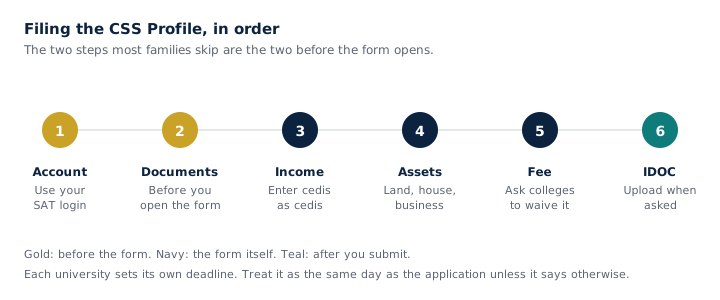
Gather your family's documents first, then fill in the CSS Profile in cedis, answering every question the way your family's money really works. Submit it on the same day as the application it belongs to. The Profile is the form that decides how much need-based aid a US university offers you, so give figures your documents can back up.
What does the CSS Profile decide?
How much aid a university gives you, not whether it admits you. The Common App decides whether a university wants you. The CSS Profile decides whether it will pay for you.
Separate offices read the two forms. A strong application with a careless Profile is how a Ghanaian student ends up admitted to a university the family cannot afford.
The College Board runs the Profile, the same organisation behind the SAT. Most private US universities that fund international students use it. Public universities mostly do not use it, and mostly do not fund international students either. That is a large part of why your school list matters.
When does it open, and when is it due?
It opens on 1 October, roughly a year before you would start. There is no single national deadline. Each university sets its own, and it follows the round you apply in.
If you apply Early Decision, your Profile is due in early November. For Regular Decision, it may not be due until January or later.
Treat the aid deadline as the same day as the application deadline, unless the university says otherwise. Missing it rarely costs you the admission. It costs you the money, which is worse.
- October
Create your College Board account, open the Profile and start gathering documents. Nothing needs to be perfect yet.
- Late October
Fill in the income and asset sections. Have a parent check each figure against the records, not from memory.
- Early November
Submit for any Early Decision or Early Action university, the same day as the application.
- November to January
Submit for the other universities as each deadline comes. Upload whatever IDOC asks for within a week of the request.
How do I set up the College Board account?
Use the account you already have if you sat the SAT. Do not make a second one. Two accounts in the same name are a common way for documents to land on a file the university cannot match to your application.
When you open the Profile, choose the academic year you would start university, not the year you are filling it in. If you file it against the wrong year, the universities you apply to cannot see it.
What documents do I gather before I start?
Your family's income, bank, property and expense records for the year. The form asks for figures nobody remembers. If you start filling it in and then hunt for a bank statement, you end up guessing.
For most Ghanaian families, that means:
- Each parent's most recent tax return, if they file one
- Payslips, or records of what the business took in and paid out
- Bank statements for the accounts the family actually uses
- Records of any land, property or business the family owns
- Receipts for school fees you pay for other children
- Records of money received from a relative abroad, which counts and is often forgotten
Our checklist for Ghanaian parents says where each document comes from. If your parents file no tax return, read the CSS Profile with no tax returns. If they trade, farm, run a business or are paid in cash, read the CSS Profile for self-employed parents. It is the hardest part of the form for many Ghanaian families.
How do I enter the income in cedis?
Type the figures in cedis, and let the form convert them. The Profile accepts your own currency, and the College Board does the conversion. You do not need to convert anything yourself.
Families who convert to dollars first usually use a rate that is months old. The household income then looks wrong in both currencies.
Consistency matters far more than the conversion. Give the same income for each parent that the payslips show, that the tax return shows if there is one, and that you would repeat if an aid officer emailed to ask. Three different answers to the same question cost families aid.
How do I answer the questions about assets?
Report what is actually true, explain anything unusual in the space the form gives you, and keep the documents behind each figure. Your family is not ineligible because its wealth looks different from what the form expects.
The form assumes a family with a mortgaged house and savings in a bank. Many Ghanaian families hold their wealth as land, a partly built house, a vehicle used for work, or stock in a shop.
Our guide to land and property on the CSS Profile covers houses, plots, family land and unfinished buildings. A family business is covered in the guide for self-employed parents.
What does it cost, and can the fee be waived?
You pay a fee for the first university and a smaller fee for each one after. The College Board will not waive it for you, but some universities will. For a list of ten universities, the fee adds up to real money in cedis.
The College Board's automatic fee waivers are for lower-income students in the United States, not for international students. Email each university before you pay to ask whether it waives the fee. Ask early, because a reply can take a week.
Our guide to the CSS Profile fee and waivers lists the current fees, the universities that accept a free form, and how to pay by card from Ghana.
What happens on IDOC after I submit?
Most universities ask you to upload documents through IDOC, the College Board's document upload service. You usually get access within about a week of submitting. The university checks what you upload against what you entered on the Profile.
Upload what each university asks for, in the format it asks for, as soon as the request arrives. An aid file still incomplete in January gets decided last, and sometimes decided without you. Our guide to using IDOC from Ghana walks through scanning, labelling and uploading.
What if a question on the form is unclear?
Email the university's financial aid office and ask. Do not rely on an agent, a forum or a WhatsApp group. Every aid office has an email address, and it answers international students.
A written answer from the office that will decide your aid is worth more than any second-hand advice. Keep it with your records.
If you want someone to sit with your family and go through the form line by line, that is what the Scholarship and Aid Sprint is for.
Questions people ask
When does the CSS Profile open, and when is mine due?
It opens on 1 October, about a year before you would start university. Each university sets its own deadline, and it follows the round you apply in. An Early Decision Profile is due in early November; a Regular Decision one may not be due until January. Unless the university says otherwise, treat the aid deadline as the same day as the application deadline.
Can I enter our income in cedis?
Yes. Enter cedis as cedis, and the College Board converts them. Families who convert to dollars first usually use a rate that is months old, and the income then looks wrong in both currencies.
What if my parents do not have payslips or tax returns?
You can still apply for aid. Filling in the form takes longer, because you build the evidence yourself from bank statements, business records and a certifying letter. Give the figure your documents support, and give the same figure if an aid officer asks later.
Can the CSS Profile fee be waived for international students?
Not by the College Board. Its automatic waivers go to lower-income students in the United States. Some universities waive the fee themselves for international students, so email each one and ask before you pay. Allow a week for an answer.
What happens after I submit?
Most universities then ask for documents through IDOC, the College Board's document upload service. You usually get access within about a week. The university checks what you upload against what you typed, so the two must agree.