ISFAA or CSS Profile? Choosing the aid form from Ghana
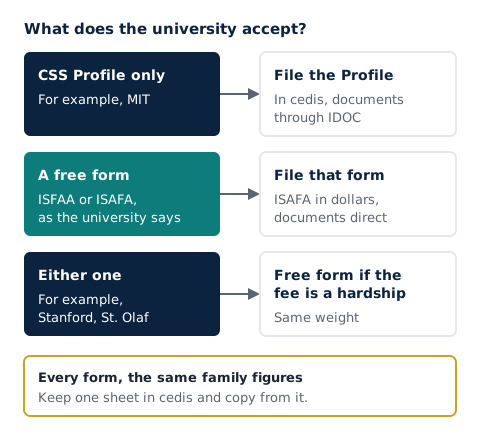
File the form each university asks for. Use the CSS Profile, the College Board's paid aid form, where a university requires it, as MIT does. Use a free form, the ISFAA or the International ACAC's ISAFA, only where the university says it accepts one. There the free form is not second best, but the ISAFA asks for your figures in US dollars, not cedis.
Which aid form should I file, the ISFAA or the CSS Profile?
Whichever each university asks for. Many of the universities that fund international students require the CSS Profile, MIT among them. Some accept a free form instead, the ISFAA or the ISAFA, usually when the Profile fee is a hardship.
You choose university by university, not once for your whole list. If you apply to eight universities, you might file the CSS Profile for five, the ISFAA for two and the ISAFA for one.
What are the three forms?
The CSS Profile, which you pay for, and two free forms, the ISFAA and the ISAFA. Different organisations run them, and their names are easy to confuse.
| CSS Profile | ISFAA | ISAFA | |
|---|---|---|---|
| Full name | CSS Profile | International Student Financial Aid Application | International Student Application for Financial Assistance |
| Run by | College Board | Provided by each university that uses it | Coordinated by the International ACAC |
| Cost | $25 for the first university, $16 for each after | Free | Free |
| Format | Online, one form sent to many universities | A form, returned to the university that provided it | A form, completed online, downloaded or printed |
| Currency | Your own currency | As the form instructs | Converted to US dollars |
| Documents | Usually through IDOC | Sent to the university directly | Sent to the university directly |
The ISFAA and the ISAFA ask much the same questions as the Profile. They want your details, your custodial parents' details, your family's income, property and assets, and your household expenses. They ask which documents you will send to back up the figures. Both end with a signed promise that the information is true.
Which universities accept which form?
It differs by university. MIT wants the CSS Profile, while Stanford, Amherst, Bowdoin, Dartmouth and St. Olaf accept a free form, some only where the fee is a hardship. In detail:
- MIT asks international applicants for the CSS Profile, with parent income documents sent through IDOC, the College Board's document upload service.
- Stanford accepts either the CSS Profile or the free ISAFA, together with its own international student supplement.
- Amherst, Bowdoin and Dartmouth accept the ISFAA from international students instead of the Profile. Dartmouth and Amherst accept it where the Profile fee is a hardship.
- St. Olaf accepts any of the three from international students.
Northwestern also publishes the ISAFA for 2026-27 on its aid site. Read each university's own instructions before you rely on any of this. The conditions on the free forms change, and they matter.
Is the free form second best?
No, not at the universities that accept it. A university that takes the ISFAA or the ISAFA wants to hear from students who cannot pay the Profile fee. It uses the free form to work out your need in the same way. Amherst says the ISFAA carries the same weight as the Profile.
The real risk is sending a free form to a university that does not accept it. You may only find out after the deadline that your aid application was never complete.
How do I handle cedis on each form?
On the CSS Profile, enter cedis as cedis. The Profile accepts your own currency, and the College Board converts it.
On the ISAFA, convert to US dollars before you write anything down. Three rules keep your figures easy to defend:
- Use one rate for the whole form. Take a published rate from the Bank of Ghana or your bank, on one date.
- Write the rate and the date down, on the form if there is space, and in your own records either way.
- Convert the same cedi figures you used on the Profile for other universities. If the rate has moved, the dollar total will differ from the Profile's conversion. The cedi figures underneath should not.
On the ISFAA, follow the instructions on the university's own copy of the form.
When are the free forms due, and how do I send them?
Usually by the same date the CSS Profile would be due: the university's aid deadline for your application round. Choosing the free form does not buy you extra time.
Follow each university's instructions on how to send it, whether by upload, portal or email. A form sent the wrong way can sit unread. The free forms also take longer than families expect, for three reasons:
- They need signatures. A parent signs the promise at the end, so you print, sign and scan the form, or sign it in whatever way the university allows.
- They go to each university separately. Three universities that accept the ISFAA can mean three copies, sometimes each on the university's own version of the form.
- Some come through the applicant portal. Amherst, for example, makes the ISFAA available in its portal after you apply. The form may not exist for you until your application is in.
Start each free form the week your application goes in, and send it a few days early.
If a university accepts neither free form and the Profile fee is a hardship, ask it about a waiver before the deadline. Our page on the CSS Profile fee and waivers lists the universities that consider them.
Do the free forms need documents too?
Usually, yes. Each form asks which documents will back up your income and asset figures. Universities that accept the free forms typically want payslips, bank statements, an employer's letter or a tax return. You send these to the university directly, not through IDOC.
They are the same documents you would gather for the Profile. Our checklist of the documents Ghanaian parents need says where each one comes from.
What should I do first?
Write your list of universities. Next to each one, write the form it accepts from international students: CSS Profile, ISFAA, ISAFA or its own. Then prepare one sheet of your family's figures in cedis. After that, every form is a matter of copying from the sheet.
You can do this alone with each university's aid page. If you would like someone to build the forms with you and check that every figure agrees, that is part of the Scholarship and Aid Sprint.
Questions people ask
What is the difference between the ISFAA and the CSS Profile?
The CSS Profile is a paid online College Board form. You send it to many universities at once, and they collect your documents through IDOC. The ISFAA is a free form that a university provides, and you return it to that university directly. Both ask about your family's income, assets and expenses.
Is the ISAFA the same as the ISFAA?
No. The ISAFA, the International Student Application for Financial Assistance, is a free form coordinated by the International ACAC. Stanford accepts it in place of the CSS Profile, together with its own supplement. It asks for all figures in US dollars.
Can I send the ISFAA to a university that requires the CSS Profile?
Not unless the university says it accepts it. MIT, for example, asks international students for the CSS Profile and for income documents through IDOC. If you send a free form to a university that does not accept it, your aid application stays incomplete.
Do I need to convert cedis to dollars?
Not on the CSS Profile, which takes figures in your own currency. On the ISAFA, yes. Convert at one rate, write down the rate and the date, and use that rate for the whole form.