CSS Profile mistakes Ghanaian families make
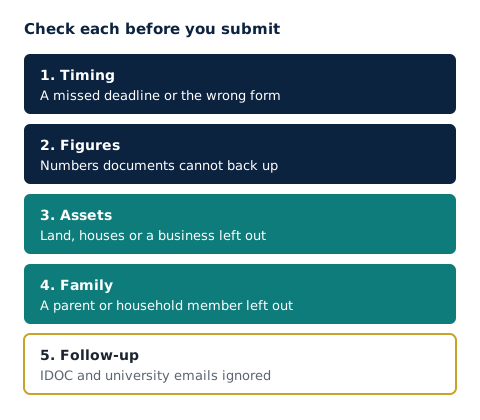
The costly mistakes fall into five groups: missing a university's deadline or form, figures your documents cannot back up, leaving out assets such as land or a business, leaving out a parent or household member, and ignoring IDOC and university emails afterwards. Fix them before you submit. The College Board allows one correction per academic year, so check every figure first.
What are the most common CSS Profile mistakes?
They fall into five groups: timing, figures, assets, family and follow-up. Most are honest. A Ghanaian family's finances rarely fit the form's American assumptions neatly, and the questions are easy to misread. But a mistake on the CSS Profile can delay or reduce your child's aid, so it is worth checking each group before you submit.
The College Board allows one correction per academic year. After that, you must contact each university separately. Getting it right first time matters more than with most forms.
Which mistakes are about timing?
Three, and they cost the most because they cannot always be fixed:
- Missing a university's aid deadline. Each university sets its own, often the same day as the application. Submit the Profile with the application it belongs to.
- Filing the wrong form. Some universities want the CSS Profile, some their own form or the ISFAA, and some both. Check each university's international aid page.
- Not asking for aid at the start. Several universities will not consider an international student for aid later if they did not apply when they applied for admission.
Our guide to the ISFAA and the CSS Profile explains which universities want which.
Which mistakes are about the figures?
Four, all about matching your documents:
- Converting cedis yourself. Enter cedis as cedis and let the form convert them. Your own conversion may use a different rate.
- Guessing instead of checking. Every figure should come from a payslip, a bank statement, a tax document or a written record. Round sensibly, but do not estimate from memory.
- Leaving out informal income. Rent from a room, a side trade, money from relatives abroad. If the form asks, include it. Our guide to the CSS Profile without tax returns covers income without formal records.
- Monthly and yearly mixed up. The form asks for yearly figures. A monthly salary entered as a year makes the family look far poorer, and the documents will show it.
Which mistakes are about assets?
Two, both common in Ghana:
- Leaving out land, houses or a family business. Many Ghanaian families hold their wealth in land or property rather than savings. If the form asks about it, report it honestly with a reasonable value. Our guide to land and property on the CSS Profile shows how.
- Mixing business and household money. For a trader or self-employed parent, the business account and the family's money are often the same. The form asks for them separately. Our guide for self-employed parents explains how to split them.
Which mistakes are about the family?
Two, both about who is counted:
- Leaving out a parent. Many universities want information from both biological parents, even if they are separated or one lives abroad. Some will waive this in specific circumstances, but you must ask. Our guide to separated parents and the CSS Profile covers it.
- Getting the household wrong. Count the people your parents actually support, including relatives who live with you, and say how many are in university. Both affect what the university expects you to pay.
Which mistakes are about the student?
The student has a section of their own, and it is easy to rush. It asks about the student's own income and savings: money from a holiday job, a savings account opened by a relative, or gifts held in the student's name. Report them where the form asks. Universities usually expect a larger share of a student's own savings to go towards costs than of the parents', so accuracy here matters too.
The student should also be the one who answers questions about their own plans and circumstances, with a parent beside them for the figures.
Do the same mistakes apply to the ISFAA?
Mostly, yes. The ISFAA and universities' own aid forms ask similar questions in a simpler format, and the same mistakes happen: converted figures, missing assets, a missing parent. Make sure the figures on every form agree with each other and with your documents. A university that sees two different incomes for the same family will ask why.
Which mistakes happen after submission?
Three, and they are the easiest to avoid:
- Not uploading documents to IDOC. After the Profile, most universities want documents through IDOC. Upload early: processing can take about ten business days. Our guide to IDOC from Ghana walks through it.
- Ignoring university emails. Aid offices often ask follow-up questions. Check the student's email and each applicant portal every few days, and answer within the time they give.
- Using the correction for something small. You get one correction a year. Save it for an error that matters.
What if we have already submitted a mistake?
Act quickly, in this order. First, decide whether it matters: a figure that changes the picture of your family's finances does; a small rounding difference does not. Then use "Correct Your CSS Profile" on the dashboard if you have not used your correction. If you have, or if the deadline has passed, email each university's aid office, explain the error plainly and give the right figure with a document.
Universities see honest corrections often. A clear email that fixes the record is far better than leaving a wrong figure in place.
How do we check the Profile before submitting?
Print or save the summary, then check it with the documents in front of you, in five passes:
- Timing: is every university's deadline and form on our list?
- Figures: does every number match a document, in cedis, yearly?
- Assets: have we included land, property and any business?
- Family: are both parents and the whole household included?
- Follow-up: do we know which universities want IDOC, and by when?
Have a second adult read it too. Fresh eyes catch the monthly-for-yearly slip that the person who typed it cannot see.
What should we do first?
Gather every document before opening the form: payslips, bank statements, any tax records, and a note of land, property and business assets. Then fill in the Profile from the documents, not from memory.
If you would like someone to complete the CSS Profile, ISFAA and IDOC with you and check every figure before you submit, our Scholarship and Aid Sprint does exactly that.
Questions people ask
What happens if I make a mistake on the CSS Profile?
You can correct it once. The College Board allows one correction per academic year, through "Correct Your CSS Profile" on your dashboard. After that, you must contact each university directly, and each handles corrections differently.
Should I convert our income from cedis to dollars myself?
No. Enter cedis as cedis and let the form convert them. Converting yourself risks using a different rate and creating figures that do not match your documents.
Do we have to include land and property in Ghana?
Yes, where the form asks for it. Leaving out land, houses or a family business is one of the most common mistakes, and documents or questions later can bring it to light. Report it honestly with a reasonable value.
Can a mistake on the CSS Profile cost us aid?
It can. Figures that do not match your documents can delay or reduce an award, and false figures can lead a university to withdraw an offer. Most mistakes are honest and fixable if caught early.