CSS Profile when Ghanaian parents file no tax return
You can still apply for aid. Tell the CSS Profile that your parents did not file, have each parent sign a non-filer statement, and send other proof of income, such as payslips, an employer's salary letter and bank statements. Before anyone signs, check with the Ghana Revenue Authority (GRA) that the parent really was not required to file, because the statement asks them to certify it.
Can I get aid if my parents have no tax return?
Yes. You tell the CSS Profile the return does not exist, each parent signs a statement saying so, and you prove the income another way. Having no return does not make you ineligible for aid.
The CSS Profile is the aid form most private US universities use. It and IDOC, the College Board's document upload service, were built for American families, who file a return every April. Universities use that return to check the income you typed in.
Many Ghanaian parents have never filed one. A nurse's tax comes off her salary before she sees it. A carpenter in Suame may pay nothing formal at all. Neither has the document the form keeps asking for.
Which year's income does it ask about?
2025, if you are starting university in autumn 2027. The 2027-28 Profile opened on 1 October 2026. Like every Profile, it looks back to the "prior-prior" year.
Ghana's tax year runs from 1 January to 31 December, so the two line up. Every payslip, bank statement and letter you gather should cover January to December 2025. A letter about this year's salary answers a question nobody asked.
- 1 Jan to 31 Dec 2025
The income year the 2027-28 Profile asks about. Everything you upload should cover these twelve months.
- 30 April 2026
The date by which, according to GRA, individuals were due to file their 2025 return. If a parent filed, that return is your evidence.
- 1 October 2026
The 2027-28 CSS Profile opens. Choose each parent's tax return status here.
- Early November 2026
Early Decision and Early Action Profile deadlines at many universities. Each university sets its own.
- About a week after submitting
IDOC opens for most universities that use it. The non-filer statement and the income documents go up here.
Were my parents required to file a tax return in Ghana?
Check before you assume they were not. According to GRA's public statements, reported widely in the Ghanaian press, an amendment to the Income Tax Act now requires employees to file their own annual return by 30 April. That applies even when PAYE has already been deducted.
For years, a Ghanaian worker on PAYE had no reason to think about a personal return. The employer took the tax each month and paid it to GRA. American guides have no reason to warn you that this has changed.
It matters because the Profile asks whether each parent was required to file. The non-filer statement then asks them to sign that they were not.
Check each parent's position:
- A salaried parent who has never filed may have been required to. Before they sign a statement saying otherwise, check with GRA or an accountant.
- A self-employed parent with no GRA registration is not automatically a non-filer either. Registration and the duty to file are different questions, so check this parent's position too.
A salaried parent who can still file can do it through the GRA Taxpayers' Portal, using their Ghana Card number. GRA now treats it as the Taxpayer Identification Number. If a 2025 return will be filed before your aid deadlines, "Estimated, will file" becomes the honest answer.
We are not tax advisers, and this page is not tax advice. The point is narrower. Your parent should not sign a US university's certification on a guess. A wrong certification is a harder conversation with an aid office than a missing document.
Which tax return status do I choose on the CSS Profile?
Choose "Not filed, and not required to file, a tax return" if your parent did not file and was not required to. That is the College Board's own guidance for international families.
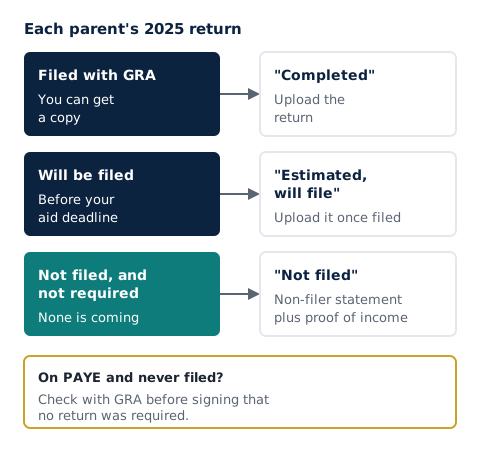
The Profile offers three answers for each parent, and each leads to different paperwork:
| Status on the Profile | What it tells the aid office | What you upload later |
|---|---|---|
| Completed | A return for that year was filed with GRA | The return itself |
| Estimated, will file | A return is coming | The return, once filed |
| Not filed, and not required to file | There is no return and there will not be one | A non-filer statement and proof of income |
Answer separately for each parent. If your mother is a civil servant and your father trades, their answers may differ.
What is a non-filer statement, and who signs it?
A one-page form in which a parent lists every source of income for the year and certifies that they did not file a tax return and were not required to. Each parent fills in and signs their own.
You may meet two kinds:
- The IDOC international parent statement, from the College Board, for universities that collect documents through IDOC.
- A university's own form. Princeton publishes a Non-filer Statement (International) and asks for one per parent, with income in your own currency. Harvard publishes an International Tax Non-Filer Statement.
Read each university's document list. Do not assume one form covers everything.
Report figures in cedis unless a form asks otherwise, and keep the totals the same as on the Profile. If the statement says GH₵48,000 and the Profile says GH₵52,000, the aid office will ask which one is true.
What do I send instead of a tax return?
Documents that prove what the non-filer statement says. Harvard, Princeton and Yale each ask for broadly the same thing: wage statements, salary certificates, or a letter from each employer stating annual income.
For a Ghanaian family, that means a specific folder.
For a parent in government employment:
- Twelve payslips for 2025. Teachers, nurses and other government workers can download these from the Controller and Accountant-General's Department e-payslip service. They need their employee number, Ghana Card and phone number to verify.
- A letter from the head of department or HR, on letterhead, signed and stamped. It should state gross pay for 2025 and the tax and SSNIT deducted.
For a parent employed privately:
- Payslips for 2025, or the employer's year-end summary if one exists.
- The same signed letter on letterhead, stating gross annual pay.
For either:
- An SSNIT statement of account. It shows the contributions your parent's employer reported in their name, which backs up the salary independently. Your parent can request it through the SSNIT portal, the SSNIT app, a branch, or by dialling *711*9#.
- Bank statements for the accounts the salary is paid into.
- A GRA Tax Clearance Certificate, if your parent is a registered taxpayer and can get one through the Taxpayers' Portal.
A self-employed parent needs different evidence: bank and mobile money statements, a record of stock bought and sold, and a certifying letter. Our guide to the CSS Profile when your parents are self-employed covers it in full.
Most documents issued in Ghana are already in English. You are unlikely to need to pay for translation, as many international families do.
What if the employer will not write a letter?
Ask in writing, early, and say what the letter is for. Many HR offices and heads of school already write similar letters for bank loans and visa applications. A request that names the year, the figure needed and a date is easy to act on.
If it really is impossible, because the employer has closed or the work was casual, send what you have and explain the gap. The Profile has space for explanations, and IDOC lets you upload supporting documents. For example:
"My father worked casually on building sites in 2025 and was paid in cash. These are his mobile money statements for the year."
A note like that gives an aid officer something to work with. Silence gives them nothing.
What should I do this week?
Two things, before you open the Profile again. Ask each parent directly whether they filed a 2025 return with GRA. Then request the documents that take longest to arrive, usually the employer's letter and the SSNIT statement, so you have them when IDOC opens.
A careful family can do everything on this page on its own. If you would rather have someone check the status you choose, the non-filer statement and the folder of evidence before you submit, that is part of what the Scholarship and Aid Sprint does.
Questions people ask
What tax return status should I choose on the CSS Profile if my parents never file?
Choose "Not filed, and not required to file, a tax return". That is the College Board's guidance for international families whose parents do not file. Choose "Estimated, will file" only if a return for that year really will be filed with the Ghana Revenue Authority, because the aid office will then expect to see it.
Which year's income does the CSS Profile ask about for students starting in 2027?
2025. The 2027-28 CSS Profile, which opens on 1 October 2026, asks for 2025 income. Ghana's tax year runs from 1 January to 31 December, so your documents should cover January to December 2025.
What is a non-filer statement?
A short signed form. In it, a parent lists every source of income for the year and certifies that they did not file, and were not required to file, a tax return. The College Board's IDOC service has an international version, and some universities, including Princeton and Harvard, publish their own. Each parent signs a separate one.
My father is a teacher on PAYE. Does he count as a non-filer?
Possibly not. His tax comes off his salary every month, but the Ghana Revenue Authority has said publicly that employees must also file an annual return by 30 April. If he has never filed one, he should check his position with GRA before he signs any statement saying he was not required to.
What proves income if there is no tax return?
For a salaried parent: a year of payslips, and a letter from the employer on letterhead stating gross annual pay. A SSNIT statement of account and bank statements back these up. For a self-employed parent: bank and mobile money statements, and a record of what the business bought and sold.