CSS Profile for self-employed parents in Ghana
Work out what the business earned over a full year after its costs, not what it sold. Build the figure from bank and mobile money statements and a record of stock bought and sold. Write down how you worked it out, keep the records, and give the same figures every time anyone asks. You do not need a payslip or a tax return to do this.
What does the CSS Profile ask a self-employed parent?
Three things, in different parts of the form:
- What the business earned over the year, after its costs. Not turnover. What was left.
- What the business is worth, meaning what someone would pay for it today.
- What the household lived on, which for most self-employed families comes from the same pot as the business.
The CSS Profile, the aid form most private US universities use, was designed around an American household. A parent there has a payslip, a W-2 from an employer and a tax return filed every April. They copy the numbers across.
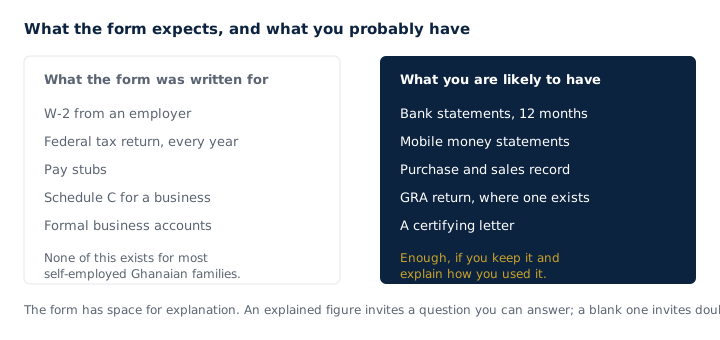
Your mother may sell cloth at Makola. Your father may farm outside Techiman. The family income may come from a trotro and a provisions shop. Then none of those documents exist, but the form asks the same questions. A blank answer or a round guess is the most expensive thing you can put in the box.
How do I separate the business from the household?
On paper, for one full year, before you open the form. In most self-employed Ghanaian households there is one flow of money. The same account buys stock and pays school fees, and a good week at the shop is a better week at home.
The form treats these as two different things, so you separate them first:
- Business income is what the business took in, less what it spent to keep running: stock, transport, rent on the stall, fuel, wages to anyone helping.
- What your parents live on is what they take out of that for the family.
Almost every figure the Profile asks for comes out of this one sheet.
How do I work out the income with no payslips?
Add up twelve months of real records, not one good month. Use these:
- Bank statements for every account the business touches.
- Mobile money statements. For many Ghanaian traders, MoMo is the business account. You can download a statement, and it is ordinary evidence.
- A purchase and sales record, even a notebook: what was bought, and what it sold for.
- Records of rent, fuel, transport and wages. These costs reduce the figure and belong in it.
- A Ghana Revenue Authority return, if one exists. Use it, and keep it.
Then write down your method in a few lines: which months, which accounts, and what you counted as a cost. Keep that note. You will need it twice: once for the Profile, and once when a university's aid office asks a follow-up question.
If your parents have never filed a tax return, our guide to the CSS Profile with no tax returns explains which status to choose and what each parent signs.
How do we value a business nobody has ever valued?
Work out what it could be sold for today, less what it owes. You do not need a professional valuation.
Count what a buyer would actually be buying:
- Stock you hold now
- Equipment, machines and tools
- Vehicles the business owns and uses
- Land and buildings the business owns
Then subtract its debts: supplier credit, a loan against a vehicle, anything owed in the coming year.
A market trading business with no premises and no machinery may be worth very little if sold, even when it supports the family well. Its value sits in the person, not the assets. The family home is not a business asset. The form asks about it separately, and our guide to land and property on the CSS Profile covers it.
Do not assume the CSS Profile works like the FAFSA, the US government's aid form that many American guides describe. The FAFSA ignores the net worth of a small family business. The CSS Profile asks for it whatever its size.
What if one parent has a payslip and the other does not?
Report both parents separately, because the form does. This is the most common Ghanaian household of all. One parent is a teacher, a nurse or a civil servant with a payslip and a payroll number. The other trades, farms or runs a shop.
The salaried parent's section is simple: the payslip is the answer, and a payslip from a government employer is strong evidence. The self-employed parent's section is the work described above.
Families often report the salary as the whole household income, because it is the figure that is easy to prove. Do not leave out the trading income. The bank statements will show money arriving that the form does not explain, and an aid officer notices that kind of gap.
A household with a modest salary and a modest business still has a modest income. That is what need-based aid exists for.
What should we keep, and for how long?
Everything you used, until the aid decision is final. Most universities ask you to upload documents through IDOC, the College Board's document upload service, and check them against what you typed. The two have to agree.
Keep these together in one folder:
- Twelve months of bank and mobile money statements
- The purchase and sales record
- Any GRA return or receipt
- A letter from someone who can confirm the business exists and roughly what it earns: an accountant if the family uses one, otherwise an assembly member, a bank manager or a trade association officer
- Your own note explaining the method
Our guide to using IDOC from Ghana covers scanning and uploading them.
What if we are not sure a figure is right?
Explain it on the form. The Profile has space for an explanation. An aid officer who reads "my parents run a farm, these figures come from twelve months of records, there is no tax return because none is filed" knows exactly what they are looking at.
An unexplained number invites doubt. An explained one invites a question you can answer.
What you must not do is leave it blank or round it to something comfortable. Aid officers read thousands of these. The files that come apart are the ones where the form and the documents tell different stories.
What should we do first?
Gather twelve months of bank and mobile money statements, and start the purchase and sales record. Those two give you the income figure, and everything else follows from them.
A careful family can do this on its own. If you would rather have someone go through a year of records with your family and build the figures line by line, that is what the Scholarship and Aid Sprint does.
Questions people ask
What if my parents' business is not registered?
You still report what it earns. Registration is not what the form asks about. You need a figure for income you can defend, and a record of how you reached it. For most Ghanaian traders, that means bank and mobile money statements and a simple record of stock bought and sold.
Do my parents need a tax return?
Not to complete the Profile. Many Ghanaian families do not have one. If a Ghana Revenue Authority return exists, use it and keep a copy, because a document from a tax authority carries more weight than anything you prepare yourself. If there is none, say so plainly rather than leaving the question blank, and support the figure with the records you have.
Does the family business count against us?
It is counted. The FAFSA, the US government's aid form, ignores the net worth of a small family business. The CSS Profile asks for it whatever the size. Stock, farm land or a vehicle used for work can all appear as assets, so report what the business owes as carefully as what it owns.
How do we value a small shop or a farm?
Report what a buyer would pay for it today, not what it cost to build. Count the stock, the equipment, the vehicles, and the land and buildings the business itself owns. Then subtract what it owes. The family home is not part of the business, and the form asks about it separately.
What if our income is different every month?
That is normal, and the form does not punish it. Use a full year rather than a good month, and write down how you worked out the figure. If an aid officer later asks how you got the number, you show the method, not a guess.