CSS Profile land and property questions for Ghanaians
Report the property your parents own: what it would sell for today and what is still owed on it. For anything owned jointly, report only your family's share. If your parents use family or stool land that they cannot sell or borrow against, do not count it as theirs. Explain it in the Profile's notes instead.
What does the CSS Profile ask about land and property?
It asks what each property would sell for today and how much is still owed on it. The CSS Profile is the aid form used by most private US universities that fund international students.
For the family home, it also asks for the monthly repayment, and the year and price your parents bought it. For other property, such as a second house, a plot or rented rooms, it asks the same, plus how many months of the year it was rented out.
The questions assume an American family: one house bought with a mortgage, a value anyone can look up online, and a deed in the parents' names. A Ghanaian family's property rarely looks like that.
Think of a house built block by block over twelve years. A plot bought with an indenture and never registered. A share in a family house in Kumasi. Land the family farms because the stool allocated it. None of these fit the boxes neatly, and this page shows you how to report each one honestly.
Does family land count as my parents' asset?
Only the part that is really theirs. The College Board's own guidance on co-owned assets says to report only the family's portion of anything owned jointly. It also lets an aid officer leave out assets the family cannot use.
This matters a great deal in Ghana. Stools, skins, clans and families hold customary land, which is estimated to cover most of the country. Much of it is never registered to one person at the Lands Commission.
Your parent may farm it, live on it or build on it with the family's blessing. That does not give them the right to sell it or borrow against it alone.
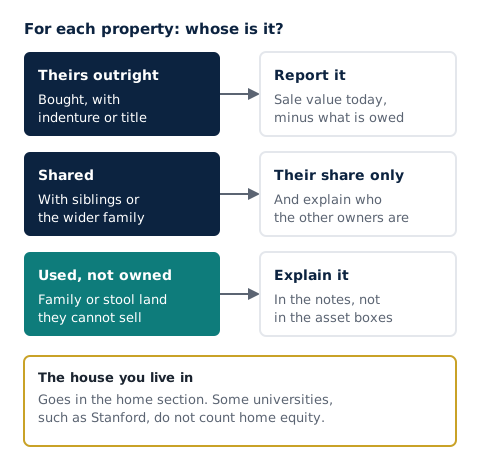
How do we report each kind of property?
By who owns it and what they could do with it. Here are the common Ghanaian cases:
| Property | Report as | What to keep |
|---|---|---|
| A house your parents built or bought and live in | The family home: today's value, what is owed, purchase year and price | Indenture or land certificate, any loan statement |
| A second house, rented rooms or a shop building | Other real estate: value, what is owed, months rented | Tenancy agreements, rent records |
| A plot bought with an indenture | Other real estate: what the plot would sell for today | The indenture, site plan, any registration papers |
| A family house inherited by several siblings | Only your parent's share, with an explanation | Anything showing who the owners are |
| Family or stool land your parents farm or live on but cannot sell alone | Not counted as their asset; explained in the notes | A letter from the family head or chief, if one can be obtained |
Most Ghanaian files go wrong on the last two rows, in both directions. Some families report a whole family house as their own, and so raise the amount the university expects them to pay. Others leave out a plot they bought outright, and the documents later show it.
If your parents' business owns land or buildings, report those as part of the business. Our guide to the CSS Profile for self-employed parents covers how.
Does our home count against us?
At some universities it does not. Stanford announced in 2018 that it would stop counting home equity in its aid calculation. Princeton is widely reported not to count it either. Other universities count it in full, or cap it as a multiple of income.
Second houses, plots and rented property are different. Universities that ignore the family home typically still count other property, because your family could sell or rent it to pay for university.
Check each university's aid page. If it does not say, ask the aid office.
How do we value a house with no market price?
Estimate what it would sell for today, and write down how you got there. The Profile wants a sale value. It does not want the cost of building, or a hope.
You can reach a fair figure in three ways, from least to most effort:
- Comparable sales. Find out what similar houses in the same area have sold for recently, from neighbours, agents or listings.
- Rent. Find out what a similar house in the area rents for. This gives you a sense of what a buyer would pay.
- A formal valuation. The Lands Commission's Land Valuation Division values property for the public, for a fee, through its offices across the country. Most families do not need one for the Profile. It helps settle a dispute if an aid office questions your figure.
Families forget two things that lower the figure. A house far from a town centre, or on land with an unclear title, sells for less. And you subtract what you still owe a bank or lender from the value.
How do we value a house that is still being built?
Value it as it stands today. Across Ghana, families build in stages as money allows, and an unfinished building often sells for less than what has gone into it.
Do not report what it will be worth when finished. Do not add the money already spent to your family's savings either: that money is in the walls, not in the bank.
If the building is unfinished because the family ran out of money, say so in the explanation section. It tells an aid officer something true about your family's finances.
What should we write in the explanation section?
A short, plain account of anything the boxes cannot hold. An aid officer reading a Ghanaian file may not know what stool land is, or why a family house has nine owners. Tell them.
Name the property. Say who owns it, what your parents can and cannot do with it, and what documents exist. For example:
"My father farms two acres of family land at Ejura allocated by the family head. He cannot sell or mortgage it. It is not included in the asset figures above."
That is three sentences, and it answers the question before anyone asks it.
What should we do first?
List every piece of property your family has any link to: the home, any plots, any family house, any land you farm. Next to each one, write who owns it and whether your parents could sell it alone. That list tells you what goes in the boxes and what goes in the notes.
A careful family can do this on its own, with the documents it already holds. If you would rather have someone go through the property with you and decide how to report each piece, that is part of the Scholarship and Aid Sprint.
Questions people ask
Do I report family land on the CSS Profile?
Report only the share your parents own and could use. The College Board's guidance on co-owned assets says to report only the family's portion, and lets aid officers leave out assets the family cannot access. If your parents farm or live on extended-family or stool land but cannot sell it alone, explain it in the notes instead.
How do we value a house in Ghana with no estate agent valuation?
Estimate what it would sell for today, from what similar houses nearby have sold or rented for, and write down how you reached the figure. The Lands Commission's Land Valuation Division values property for the public for a fee, but most families do not need a formal valuation for the Profile.
How do we report a house that is still being built?
Report what it would sell for as it stands today. Do not use what it will be worth when finished, or what you have spent on it so far. An unfinished building often sells for less than it cost.
Does our home count against us on the CSS Profile?
It depends on the university. Stanford announced in 2018 that it would stop counting home equity, and Princeton is also reported not to count it. Other universities count it in full or cap it. Second houses, plots and rented property are usually counted.