How to write the 'why this major' essay
Show where your interest came from, what you have already done about it, and what you want to learn next at this university. Use one specific moment, not a general love of the subject, and name real courses or programmes. You do not need a career plan, and you can still change major later. If you are undecided, say so honestly and write about the questions that interest you.
How do I write a 'why this major' essay?
Show three things: where your interest came from, what you have already done about it, and what you want to learn next at this university. The essay tests whether your interest is real and informed. It does not test whether you have planned your whole career.
The prompt varies. Some universities ask only why you want to study the subject. Others ask why you want to study it there, or ask you to describe the college or school within the university you are applying to. Read it closely and answer every part.
What does the essay need to show?
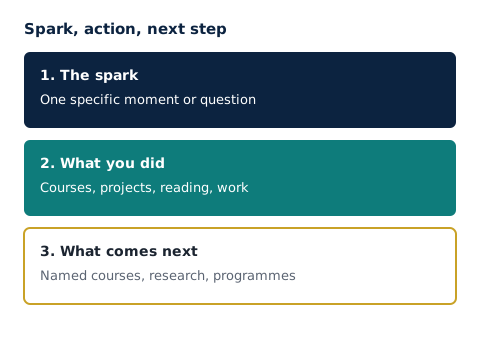
Three parts, in roughly equal measure:
| Part | The question it answers | What works |
|---|---|---|
| The spark | Where did this interest come from? | One specific moment, problem or question |
| What you did | How have you followed it up? | Courses, projects, reading, a job, a competition, a club |
| What comes next | What do you want to learn here? | Named courses, research, programmes or professors |
Most weak essays have only the first part, and describe it in general terms: "I have always been passionate about engineering." Strong ones have all three, with specific details in each.
How do I describe where the interest came from?
With one moment, not a lifetime. "I have loved science since I was a child" tells the reader nothing. A specific scene does: the day the borehole in your town stopped working and you wanted to know why, or the WASSCE chemistry question you could not stop thinking about.
Keep it short. The spark sets up the essay; it is not the essay. A few sentences are usually enough, especially in a 150 or 250-word answer.
What if I have not done much in the subject?
Then show the small things honestly. Ghanaian schools offer fewer electives, labs and clubs than many US schools, and admissions officers read your application in that context. Following an interest can mean a book you read, a free online course, a problem you tried to solve at home, a conversation with someone in the field, or work in a family business.
What matters is that you did something because you were curious, not because it was required. One project explained well is worth more than a list of activities.
How do I link it to the university?
By naming specific courses, programmes, research or professors, and saying why each matters to you. Read the department's website, its course listings and its research pages. Look for things that connect to what you have already done.
One or two specific links, well explained, beat a list of five course names. If the prompt asks only why the subject, keep the university details brief or leave them out. Our guide to the why this college essay explains how to research a university you cannot visit.
What if I am undecided?
Say so, and write about what interests you. Many US universities expect students to explore before choosing. Harvard, for example, does not let students declare a concentration, its word for a major, until their third semester, and encourages them to explore first.
An honest undecided essay names two or three subjects or questions and explains what draws you to each. That shows curiosity, which is what the essay is really looking for. A forced choice you cannot explain reads worse than an honest "I am deciding between these".
Does my choice of major affect admission?
It can. Some universities admit students to a specific college or programme, such as engineering or nursing, and those can be more competitive than the university overall. Others admit everyone to the university and let students choose later. Check how each university on your list admits, because it changes how much your choice matters.
Do not choose a major you do not want because you think it is easier to get into. You may have to study it, and an essay about a subject you do not care about is hard to write well.
Does my major affect my financial aid?
Need-based aid usually does not depend on your major. A university that meets full need calculates your aid from your family's finances, whatever you plan to study. Some merit scholarships, though, are tied to a subject or a specific school within the university, and some engineering or nursing programmes have their own awards.
So check, for each university, whether any scholarship you hope for is linked to a major, and make sure your stated interest matches it. Our guide to engineering and computer science scholarships covers the subject-specific ones.
What about medicine and pre-med?
In the US, medicine is studied after a first degree, not instead of one. "Pre-med" is a set of required courses, not a major, so a student who wants to be a doctor usually majors in biology, chemistry or another subject. Write about that subject. Our guide to studying medicine in the USA explains the route and its cost.
How long should it be?
As long as the prompt allows, usually 100 to 300 words. In a short answer, keep the spark to a sentence or two and give most of the space to what you did and what comes next. In a longer one, add a second example or more detail on the university.
Can I reuse it for several universities?
The first two parts, yes. Where your interest came from and what you did about it stay the same. The third part, what you want to learn there, must change for each university. Our guide to supplemental essays shows how to plan reuse across your list.
What should I do first?
Write one sentence for each of the three parts: the moment the interest started, one thing you did about it, and one thing you want to learn next. If any sentence is general, make it specific before you write the essay.
If you would like help shaping your 'why major' essay and the rest of your supplements, our Personal Statement Studio covers them, with the words always yours.
Questions people ask
What is the 'why this major' essay?
A supplemental essay asking why you want to study your intended subject, and sometimes why at that university. It tests whether your interest is real and informed, not whether you have a career planned.
Can I change my major after writing a 'why major' essay?
At most US universities, yes. Many students change. Harvard, for example, does not let students declare a concentration until their third semester and encourages them to explore first. A few programmes, such as some engineering schools, are harder to move into later.
What if I am undecided about my major?
Say so honestly, and write about two or three subjects or questions that interest you and why. US universities expect many students to be undecided, and an honest, curious answer reads better than a forced choice.
Should I write about wanting to be a doctor?
Write about the subject you want to study, not only the career. In the US, medicine is a graduate degree, and "pre-med" is a set of courses, not a major. Show what draws you to biology, chemistry or whatever you would study first.