How Ghanaian students find universities that will fund them
Check three things before a US university goes on your list. Read its international aid page for a promise to meet full need for international students. Check its Common Data Set for how many international students it funded and how much they got, then ask its aid office about a family like yours. If a university fails all three checks, it is unlikely to fund you, however famous it is.
How do I tell whether a university will fund me?
Run three checks before it goes on your list. Read what its international aid page promises. See what its Common Data Set shows it actually gave international students. Then ask what it would offer a family like yours.
Each check takes minutes, and all three use the university's own words and figures.
If you need a full scholarship, you cannot build your list on fame. Many of the best-known American universities give international undergraduates little or no need-based aid. Their names tell you nothing about that. The three checks do.
What should I look for on its international aid page?
One sentence: that it meets the full demonstrated need of the international students it admits. Find the page written for international students, on the university's financial aid or admissions site.
MIT says it meets the full demonstrated need of international students. Penn says its grant-based aid applies fully to admitted international students. Duke says it meets the full need of the international students it admits with aid. Those are the sentences you are looking for.
Read for three more things while you are there:
- Whether admission is need-blind for international students, meaning the university ignores your aid request when it decides whether to admit you. Our guide to need-blind and need-aware shows how to read that wording.
- Whether you must ask for aid when you apply. At Penn and Columbia, an international student admitted without requesting aid cannot ask later.
- Whether aid continues for four years if your family's circumstances stay the same.
If the page says nothing about international students, or calls its aid "limited" without saying more, treat that as your answer.
What does its Common Data Set show?
How many international students it actually funded, and with how much. The Common Data Set is a standard set of figures many US universities publish every year, usually on their institutional research website. Search for the university's name and "Common Data Set".
You want section H, on financial aid, and in it question H6. H6 covers undergraduates who are nonresident aliens, the category that includes international students. It reports three figures:
- the number who received aid from the university, need-based or merit,
- the average amount awarded,
- the total awarded.
Read those three figures against two others:
- The number of international students enrolled, so you know what share the university funded.
- The cost of attendance, so you know whether the average award covers most of the cost or a small part. Our guide to the cost of studying in the USA explains what that figure includes, and the costs that come before the first term.
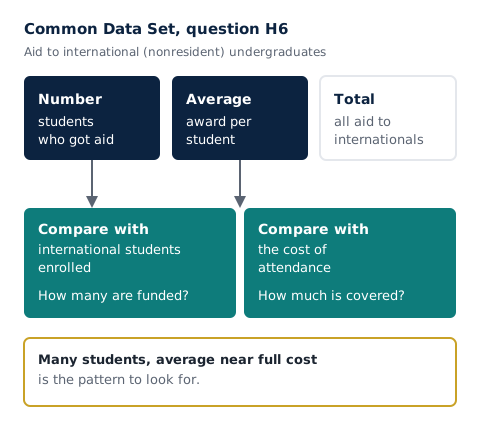
Patterns you will see:
| What H6 shows | What it usually means |
|---|---|
| A large number of students, an average close to the full cost | Generous to internationals. Worth applying for aid |
| A small number of students, an average close to the full cost | Funds a few internationals fully. Competitive, often need-aware |
| A large number of students, a small average | Partial awards, often merit-based. Check whether the gap is one your family can close |
| Very few students, or none | Little or no aid for internationals. Needs a strong reason to stay on the list |
Here is a real example. USC's Common Data Set for 2023-24 reported 950 international undergraduates receiving aid from the university, at an average of $25,384. Whether that is generous depends on the cost of attendance and the number of international students enrolled. Use the current year's Common Data Set for every university you check.
Not every university publishes a Common Data Set, and some leave H6 blank. If you cannot find one, ask the aid office how many international undergraduates it funds each year, and how much a typical award covers. A university confident in its international aid will usually tell you.
What would it offer a family like mine?
Ask. Run the university's net price calculator if the university says it works for international families. If it does not, email the aid office.
Keep the email short. Say you are applying from Ghana. Give your family's yearly income in cedis and roughly what your family owns. Then ask whether a family like yours would typically qualify for full aid if admitted.
Not every office will answer in detail. But an office that replies "we have very limited aid for international students" has told you what you need to know.
How do I find out whether Ghanaian students go there?
Look for an African students' association, or for Ghanaian and West African students in the university's news and events. Either shows the university admits students from your part of the world.
Current students will often answer a polite message about how their aid worked. That is the closest you can get to the view from inside.
Should I apply to universities that do not meet full need?
Keep a few, if you can say why each one is there. Some offer competitive merit scholarships to internationals that cover most of the cost. Some have a programme you particularly want. Some are realistic admissions for your profile when the full-need universities are reaches.
For each one, write down what you expect it to give you and why. If you cannot write that sentence, spend the application fee elsewhere. Our guide to US universities that meet full need is the place to start the rest of your list.
What should I do now?
Run the three checks on every university on your current list. Write the results in one table: the promise on the aid page, the H6 figures, and the answer to your email. Your list may end up shorter, and it will be stronger.
Every check on this page uses figures the universities publish themselves, and you can do it alone. If you would like help building or testing your list, you can book a call with us.
Questions people ask
How do I know if a US university gives aid to international students?
Read its international aid page for a promise to meet the full need of international students. Then look at question H6 of its Common Data Set. H6 reports how many international undergraduates received aid from the university, and the average amount. The university publishes both itself.
What is the Common Data Set?
A standard set of figures that many US universities publish each year, usually on their institutional research website. Section H covers financial aid. Question H6 reports aid given to nonresident aliens, the category that includes international students.
Is a big average award in the Common Data Set enough?
No. Compare it with the cost of attendance and with the number of students funded. A university that gives a few international students large awards is very different from one that gives many students small ones. Both are different from one that gives almost none.
Should I avoid universities that do not meet full need?
Not automatically, but each one needs a reason to be on your list. Good reasons include a strong record of merit scholarships for international students, or a real fit for your subject. Without one, it may admit you with a partial award your family cannot close.