Which country gives Ghanaians the best scholarship chance?
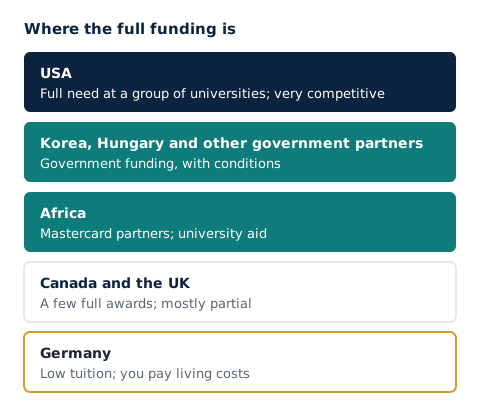
For a full first degree, the USA usually offers the most funding, because a group of its universities meet the full need of the international students they admit. But those places are scarce. Canada and the UK have few full undergraduate awards. Government schemes such as Korea's and Ghana's bilateral awards to countries such as Hungary fund strong applicants who accept their conditions. Most students do best applying to more than one country.
Which country gives me the best chance of a funded degree?
For a full first degree, the USA usually offers the most funding. A group of US universities meet the full need of the international students they admit, which no other country matches at that scale. But those places are scarce: MIT admitted 136 of 6,926 international applicants for its class of 2029.
So the honest answer is that no single country gives a good chance on its own. The best chance comes from a list across two or three countries, each chosen for what it offers students like you.
How do the countries compare?
On what they fund and how hard it is to win:
| Country | What funds a first degree | How it works | The catch |
|---|---|---|---|
| USA | Universities that meet full need | Need-based aid from the university | Very competitive admission |
| Canada | A few full awards, such as Toronto's Pearson and UBC International Scholars | Nomination or need-based application | Very few places; most aid is partial |
| UK | A small number of university awards | University-specific scholarships | Few full awards; Chevening is postgraduate |
| Korea | Global Korea Scholarship | Selection through the Embassy of Korea in Ghana | A year of Korean; under 25; three undergraduate places for Ghana in 2027 |
| Hungary and other bilateral partners | Ghana government bilateral awards | Ghana Scholarships Authority selection | You study in the partner country; a bond to return |
| Germany | Low or no tuition at most public universities | Admission, then you pay living costs | Living costs; mostly taught in German |
| Africa | Mastercard Foundation partners; university aid such as Ashesi's | Apply to the university | Fewer places than demand |
Read each country's current terms before you rely on this table. Our guide to funded places outside the USA explains each route.
Why does the USA lead on funding?
Because a group of its private universities choose to meet the full need of the international students they admit, from their own money. A Ghanaian student admitted to one of them from a family with little income may pay almost nothing. No other country has as many universities making that promise to international undergraduates.
The catch is admission. These are among the most selective universities in the world, and some weigh your aid request when deciding. Our guide to your chances of a full scholarship explains what decides them.
When is another country the better bet?
When it fits your profile and you accept its conditions. For example:
- The Global Korea Scholarship suits a strong student willing to learn Korean and study in Korea.
- A bilateral award suits a student with strong WASSCE results who is happy to study in the partner country and return to serve Ghana.
- A Mastercard partner suits a student with strong results, real need and a record of service, who would thrive close to home.
- Germany suits a family that can pay living costs and a student ready to study in German.
How should I spread my applications?
Across two or three routes, with the deadlines on one calendar. A common, sensible mix for a Ghanaian student who needs full funding is:
- Several US universities that meet full need, the core of the list.
- One or two funded routes outside the US that fit your profile.
- A place at home, through a Ghanaian university or a local scholarship, as a safety net.
Our guide to building a college list for full aid shows how to balance the US part.
What does each country leave for the family to pay?
It varies more than the headline funding suggests. At a US university that meets full need, the aid covers living costs as well as tuition, so the family may pay little beyond travel and personal costs. A government award usually covers tuition and a stipend, but check whether the stipend covers food and housing in that city. In Germany, the family pays living costs in full.
Every route also has costs before arrival: passport, visa, medical checks and a first flight. Ask each programme what it covers, and add the rest to your family's plan. Our guide to costs a scholarship won't cover lists them.
Does the language of teaching matter?
Yes, and it is easy to overlook. Universities in the US, Canada, the UK and Ghana teach in English. The Global Korea Scholarship includes a year of Korean before the degree. In Hungary, Algeria or Germany, check whether your programme is taught in English or in the local language, and whether a language year is included.
A strong student who must learn a new language at the same time as a demanding degree can still succeed. But plan for it honestly, and choose a route whose language you are ready to take on.
When should I decide which countries to apply to?
In the year before your final SHS year. Deadlines start early: Toronto's nomination in October, US early rounds in November, Korea's scheme in September. Decide your mix of countries by the end of August, so no deadline arrives before you are ready for it.
Do I need different results for different countries?
Often, yes. US universities read your whole record, essays and activities. Bilateral awards and many African universities lean heavily on your WASSCE aggregate. Korea's scheme adds selection rounds at the embassy and then the university. A student with strong essays and a broad record may do best in the US; one with outstanding WASSCE results may do best through a bilateral award or a Ghanaian university's scholarship.
Look at where your strengths lie, and weight your applications towards the routes that reward them.
What should I do first?
Write down your strengths: grades, WASSCE prospects, essays, activities, languages. Then pick the two or three routes that reward them most, and note each one's deadline.
If you would like help choosing the right mix of countries for your profile, you can book a call with us.
Questions people ask
Which country gives the most scholarships to Ghanaian students?
For a full undergraduate degree, the USA, through universities that meet the full need of the international students they admit. But admission to those universities is very competitive, so most students should apply to more than one country.
Is it easier to get a scholarship in Canada or the UK than the US?
Usually not for a full undergraduate scholarship. Both have only a few full awards for international undergraduates, such as Toronto's Pearson Scholarship. Partial scholarships are more common.
Is Germany a good option for Ghanaians without money?
Only partly. Most public universities charge little or no tuition, but you must show you can pay living costs, and most first degrees are taught in German. It suits a family that can cover living costs.
What about studying in Africa?
It can be an excellent funded option. Mastercard Foundation partner universities, including in Ghana, select Scholars with strong results and real need, and some universities, such as Ashesi, offer their own financial aid.