Full ride vs full tuition: what Ghanaians need to know
No, they are not the same, and the difference can be $20,000 or more a year. A full-tuition scholarship pays your classes only. A full ride pays tuition plus housing, food and usually fees. Your family pays everything the award leaves out, including flights and visa costs. Before you celebrate any offer, ask what it covers line by line, and what is left for you to pay.
Is a full-tuition scholarship the same as a full ride?
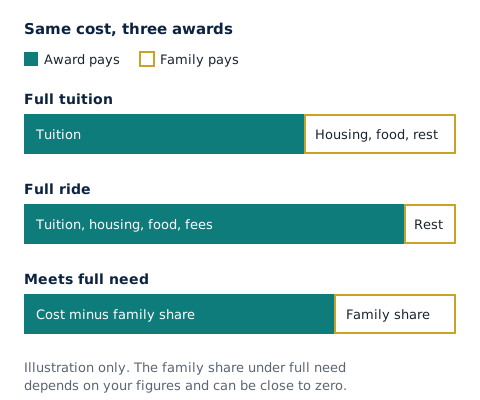
No. A full-tuition scholarship pays for your classes and nothing else. A full ride also pays for your housing and food, and usually the required fees. At a private US university, that gap can be $20,000 or more a year.
So "full scholarship" on its own tells you very little. A Ghanaian family that hears it and stops asking questions can end up with a bill it never planned for.
What does each kind of award cover?
There are four kinds you will meet, and they cover very different things:
| Award | What it pays | What your family still pays |
|---|---|---|
| Partial scholarship | A fixed sum, such as $10,000 a year | Everything above that sum |
| Full tuition | Tuition only | Housing, food, fees, books, insurance, travel |
| Full ride | Tuition, housing, food and usually fees | Usually travel, personal costs and pre-arrival costs |
| Meets full need | The gap between the full cost and your family's calculated contribution | Your family contribution, plus any work expectation |
The fourth row is not a scholarship you apply for separately. It is a promise some universities make to every student they admit. If your family's calculated contribution is very low, the result looks like a full ride. Our guide to universities that meet full need names them.
What is the cost of attendance?
It is the university's own estimate of what one year costs, and it is the number every award is measured against. It has five main parts:
- Tuition and fees. Your classes and the required student fees.
- Housing and food. Usually a room on campus and a meal plan.
- Books and supplies.
- Health insurance. Most universities require it of international students.
- Personal costs and travel. Clothing, phone, and for you, flights home.
Universities publish a separate figure for international students, because travel and insurance cost more. Find it on each university's cost page before you compare offers. Tuition is often only around two-thirds of the total.
How much does a full-tuition award leave to pay?
Work it out from the university's own figures. Take the cost of attendance for international students and subtract the award. What is left is your family's bill for that year.
An illustration, with round figures: if a university's cost of attendance is $90,000 and tuition is $65,000, a full-tuition award leaves $25,000 a year. Over four years, that is $100,000, more than GH₵1 million at recent exchange rates. Some full-tuition awards add need-based aid on top. Vanderbilt says it adds need-based aid for Cornelius Vanderbilt Scholarship recipients whose need is greater than full tuition. Do not assume this. Ask each university.
Do I have to apply separately for these awards?
Sometimes, and the separate deadline is often earlier than the admission deadline. Universities hand out awards in three ways:
- Automatically. Some merit awards go to admitted students with no extra form. You are considered when you apply.
- By separate application. Named scholarships, such as the Robertson Scholars Leadership Program at Duke and UNC-Chapel Hill, have their own application and their own date. Some need a nomination from your school.
- Through the aid forms. Need-based aid, including the full-need promise, comes only if you file the CSS Profile or the university's own form by its aid deadline.
Read each university's scholarship page in September, and put every extra deadline in your calendar beside the admission one. A missed scholarship deadline cannot be fixed after you are admitted.
What does a full ride usually leave out?
Even a full ride rarely covers everything. Three costs often fall outside it:
- Costs before you arrive. The SEVIS fee, the visa fee, your first flight and your medical checks.
- Personal costs. A laptop, a phone, warm clothing for the first winter.
- Summers. Many awards cover the academic year, not June to August, so housing and food over the summer may be yours.
Read the award letter for these three, and ask the aid office about any of them it does not mention. Our guide to the cost of studying in the USA lists the costs that come before the first term.
Which is better for a Ghanaian student?
For most Ghanaian families, the offer that leaves the smallest yearly bill for four years is the better one, whatever it is called. That is usually a university that meets full need, or one of the rare full rides.
A full-tuition merit award can still be excellent. It is excellent when your family can cover the rest, or when the university adds need-based aid on top. It is a trap when it arrives at a university that gives no other aid, and your family cannot find $20,000 or more each year.
Also check how each award is renewed. Merit awards often need a minimum grade point average every year. Vanderbilt's, for example, renews while you keep at least a 3.0. Need-based aid is usually renewed each year when your family files updated figures.
How do I compare two offers?
Put them side by side, one line per cost, and find the bottom line. For each offer, write down:
- The cost of attendance for international students.
- Every grant and scholarship, the money you never repay.
- Any work expectation, the amount you are expected to earn on campus.
- The family's yearly bill: the cost, minus grants, minus work.
- The renewal rules: grade point average, yearly forms, or both.
Then multiply the yearly bill by four. That is the real price of each offer.
What should I do first?
Open the cost of attendance page of every university on your list and write down the international figure. From then on, every award you read about, ask one question: what does my family pay after this?
If you are holding two offers and want a second opinion before you choose, you can book a call with us.
Questions people ask
What is the difference between a full ride and full tuition?
Full tuition pays for your classes only. A full ride pays tuition plus housing and food, and usually the required fees. Neither normally covers your flights, visa fees or the costs before you arrive.
Is meeting full need the same as a full ride?
No, but it can work out the same. A university that meets full need pays the gap between its full cost and what it calculates your family can contribute. If that contribution is near zero, the offer covers almost everything, like a full ride.
How much does a full-tuition scholarship leave to pay?
Everything except tuition: housing, food, fees, books, insurance and travel. At a private US university that is often $20,000 or more a year. Check the university's published cost of attendance for the exact figure.
Can I use a full-tuition scholarship to get a student visa?
Only if your family can show the rest. The university issues the I-20, the form your visa depends on, only after you prove you can pay whatever the award does not cover.