What 'meets full demonstrated need' means for Ghanaians
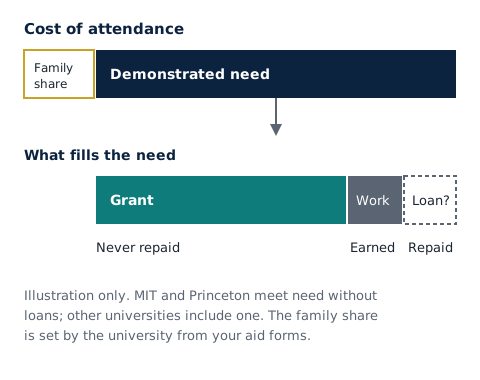
It means the university pays the whole gap between its cost and what it calculates your family can contribute. That gap is your demonstrated need. The university fills it with grants, often a campus job, and at some universities a loan. Your family still pays its calculated contribution, and the university decides that figure, not you. Read what each package is made of, not just the promise.
What does "meets full demonstrated need" mean?
It means the university pays the whole gap between what it costs and what it calculates your family can contribute. That gap is your demonstrated need. A university that meets it in full leaves no unmet need for your family to find.
The promise matters most to a Ghanaian family that cannot pay much. But it has a precise meaning, and three parts of it surprise families: the university calculates your contribution, the package can include work or loans, and outside scholarships can change it.
How is demonstrated need worked out?
With one subtraction: the cost of attendance minus your family's calculated contribution. The cost of attendance is the university's own figure for a year, including tuition, housing, food, books, insurance and travel. The contribution comes from your family's aid forms, usually the CSS Profile.
Here is the arithmetic, with round figures as an illustration:
| Amount | |
|---|---|
| Cost of attendance | $90,000 |
| Family's calculated contribution | $6,000 |
| Demonstrated need | $84,000 |
A university that meets full need fills all $84,000. Your family pays $6,000. If the calculated contribution were zero, the university would fill the whole $90,000.
How the university works out your contribution is a separate question, and the one families most often misread. Our guide to how universities decide what you pay explains it.
What fills the gap?
Up to three kinds of aid, and they are not equal:
- Grants and scholarships. Money you never repay. At the most generous universities, most of the package is grant.
- Work. A campus job, often called work-study, with an expected amount you earn during the year. International students on a student visa can usually work on campus.
- Loans. Money you repay after you graduate. Some universities include a loan in the package; others, such as MIT and Princeton, do not.
Two packages that both "meet full need" can leave very different costs over four years. One made of grants and a small job is worth far more than one with a large loan. Check the parts, not only the total.
What does "full need" not cover?
Three things, at most universities:
- Your family's calculated contribution. The university decides this figure from your aid forms. It may be more than you expected, especially if the family owns land or property.
- Costs outside the cost of attendance. The visa fee, the SEVIS fee and often your first flight fall before the academic year begins.
- Need the university did not see. If your family's figures were wrong or incomplete, the university meets the need it calculated, not your real one.
The third is the one families can control. Fill in the aid forms from real documents, not memory. Our checklist of documents for parents shows what to gather.
How do outside scholarships change a full-need package?
They usually replace part of it rather than adding to it. A university that already meets your full need treats outside money as a resource that reduces that need. What it reduces first depends on the university:
- Harvard uses outside awards first to replace your term-time work expectation, then reduces its own scholarship dollar for dollar.
- Princeton says outside awards reduce its grant, and do not reduce the family contribution.
So an outside award can still help, by replacing a job or a loan. But it rarely puts extra money in your pocket at a full-need university. Ask each aid office for its policy before you count on an outside award.
Does the promise last all four years?
Yes, at most full-need universities, as long as you reapply for aid each year. The university recalculates your need each year from your family's updated figures. If the family's income falls, your aid usually rises. If it rises, your aid may fall.
Keep the documents folder going, and put each year's renewal deadline in your calendar as soon as you arrive. A missed renewal can delay the next year's aid.
Can we ask a university to look at the package again?
Yes. If the package rests on a mistake, or leaves out something that affects what your family can pay, you can ask the aid office to review it. Universities call this an appeal or a request for review.
Good reasons include:
- A figure was wrong on the aid forms, or a document was missed.
- Your family's situation has changed since you filed: a lost job, a death, a business that failed, a large medical bill.
- A cost the forms did not capture, such as supporting grandparents or paying school fees for younger siblings.
Write to the aid office, explain the change plainly, and attach documents. A review can change the calculated contribution, and with it the package. What does not work is asking a full-need university to match another university's offer without a reason in your family's figures. Its promise is to meet the need it calculates, not to bid against others.
How do I check whether a university meets full need?
Read its international aid page, not a list online. Look for three things:
- The words "full demonstrated need" or "100% of demonstrated need", with international students included, not just US citizens.
- What the package is made of: grants only, or grants with work and loans.
- Whether it is need-blind or need-aware for international applicants. That decides whether asking for aid affects admission.
Our guides to universities that meet full need and to need-blind and need-aware cover both questions.
What should I do first?
For each university on your list, note whether it meets full need for international students and whether its packages include loans. Then, when offers arrive, subtract only the grants from the cost of attendance.
If you would like help reading the offers and comparing what each one really costs, that is part of the Scholarship and Aid Sprint.
Questions people ask
What does "meets full demonstrated need" mean?
The university covers the whole difference between its cost of attendance and what it calculates your family can contribute. That difference is your demonstrated need. The promise is to fill all of it, usually with grants and sometimes with work or loans.
Does meeting full need mean I pay nothing?
Not necessarily. Your family still pays the contribution the university calculates. For a family with little income and few assets, that can be close to zero. For others it can be a significant sum.
Does a full-need package include loans?
At some universities. MIT and Princeton, for example, meet need without loans. Others include a loan as part of the package. Check each university's aid page, because a loan is money you repay.
What happens if I win an outside scholarship?
It usually changes your package. Many universities use it first to replace your work expectation, then reduce their own grant. Princeton says outside awards reduce its grant. Ask each aid office how it treats outside money.