UK undergraduate scholarships for Ghanaian students
Yes, but only a few UK scholarships fully fund a Ghanaian undergraduate, and each takes a handful of students a year. Oxford's Reach scholarship, UCL's Global Undergraduate Scholarship and Westminster's Full International Scholarship are the clearest examples. You apply through UCAS first, then for the scholarship once you hold an offer. Most UK awards are partial, so compare what each leaves your family to pay.
Can a Ghanaian student win a full UK undergraduate scholarship?
Yes, but only a few exist, and each takes a handful of students a year. Oxford's Reach Oxford Scholarship, UCL's Global Undergraduate Scholarship and the University of Westminster's Full International Scholarship are the clearest examples. Most other UK awards for international undergraduates are partial.
That makes the UK a harder route to full funding than the US universities that meet full need. It can still belong on your list, especially for a student set on a UK university or a three-year degree.
Which UK scholarships fully fund undergraduates?
Three examples show what exists:
| Scholarship | What it covers | Who it is for | Places |
|---|---|---|---|
| Reach Oxford Scholarship | Course fees, a grant towards living costs, one return flight a year | Students from low-income countries, including Ghana, with an Oxford offer; all subjects except medicine | Around two to three a year |
| UCL Global Undergraduate Scholarship | Full fees and maintenance, or full fees only | International students from lower-income backgrounds applying to UCL | A small number of each |
| Westminster Full International Scholarship | Full fees, accommodation, living costs and flights to London | Students from developing countries with a Westminster offer | A small number |
Read each university's own page for the current terms, income guidelines and deadlines. They change from year to year. Some colleges within Oxford and Cambridge, and some other universities, offer smaller awards of their own; these can help, but rarely cover the full cost on their own.
How do I apply?
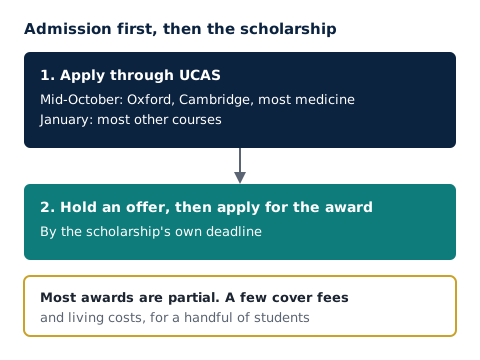
In two steps. First, apply for admission through UCAS, the UK's central application system. Then, once you hold an offer, apply for the university's scholarship by its own deadline. Oxford says it cannot consider a Reach application from a student without an offer.
UCAS deadlines matter:
- Mid-October for Oxford, Cambridge and most medicine, dentistry and veterinary courses.
- January for most other courses.
Scholarship deadlines often fall later, in the spring. Put both on your calendar, because the scholarship cannot open until the admission step is done.
What do these scholarships look for?
Academic strength and financial need, with something more. Each university describes its own criteria:
- Reach Oxford weighs financial need, social commitment and whether you could study for a degree in your own country, and expects scholars to intend to return home after their studies.
- Westminster looks for academic excellence, development potential and financial need.
- UCL aims its Global Undergraduate Scholarship at students from lower income backgrounds, with a published income guideline it treats as a guide rather than a strict cut-off.
So your scholarship application should show your record, explain your family's finances plainly, and say what you intend to do with the degree. Keep it consistent with what you wrote in your UCAS application.
How is the UCAS application different from the Common App?
It is built around one subject. You apply for a specific course, and your personal statement focuses on why you want to study it and what you have done to explore it, rather than on your wider life story. UCAS has recently changed the format of the personal statement, so read its current guidance before you start.
You can apply to up to five courses with one statement, so choose courses in the same subject. A student applying to both the US and the UK writes two quite different essays, and should plan the time for both.
Will a UK university accept my WASSCE?
Often, with conditions. Many UK universities accept WASSCE results for entry, with set grades in set subjects, and some accept WASSCE English in place of IELTS. Others ask WASSCE students to complete a foundation year first, which adds a year of fees.
Check each university's page for Ghanaian applicants. Cardiff, for example, publishes its entry requirements for Ghana. A foundation year can turn a three-year degree into four years, which changes the cost.
What does a UK degree cost if the award is partial?
Tuition and living costs, minus the award. International undergraduate tuition varies widely by university and course, and living costs are higher in London. For the student visa, you must show the first year's unpaid fees and a set amount for living costs, held in a bank account for a period before you apply. The UK government's student visa page lists the current figures.
So a partial award leaves a large sum for most Ghanaian families. Compare it with a funded US offer before you choose. Our guide to comparing aid offers shows how.
Is Chevening an option for a first degree?
No. Chevening, the UK government's best-known scholarship, is for master's study. Ghanaian students often hear of it, but it is not open to undergraduates. Keep it in mind for later: a funded first degree elsewhere now can lead to a Chevening application after a few years of work.
How does the UK compare with the US for a Ghanaian?
On funding, the US usually offers more, because a group of its universities meet full need for international students. On length, the UK is shorter: most degrees take three years in England, four in Scotland. On applications, UCAS lets you apply to up to five courses with one personal statement.
Many students apply to both. Our guide to which country gives the best chance sets the options side by side.
What should I do first?
Decide whether the UK is a serious part of your plan. If it is, check the UCAS deadline for your course, and read the Reach Oxford, UCL and Westminster pages for the next cycle's dates and terms.
If you would like help weighing UK and US applications together, you can book a call with us.
Questions people ask
Can a Ghanaian student get a full scholarship in the UK?
Yes, but very few are offered. Oxford's Reach Oxford Scholarship, UCL's Global Undergraduate Scholarship and the University of Westminster's Full International Scholarship can cover fees and living costs. Each makes only a small number of awards.
Is Chevening for undergraduates?
No. Chevening is a UK government scholarship for master's study. It is not open to students applying for a first degree.
How do I apply for a UK scholarship?
Usually in two steps: apply for admission through UCAS, then apply for the university's scholarship once you hold an offer, by the scholarship's own deadline.
Do I need IELTS for a UK university from Ghana?
Often not for admission, as many universities accept WASSCE English at a set grade. Some courses and visa routes still ask for an approved English test, so check each university's rules for Ghana.