Is WASSCE, A-levels or IB best for US universities?
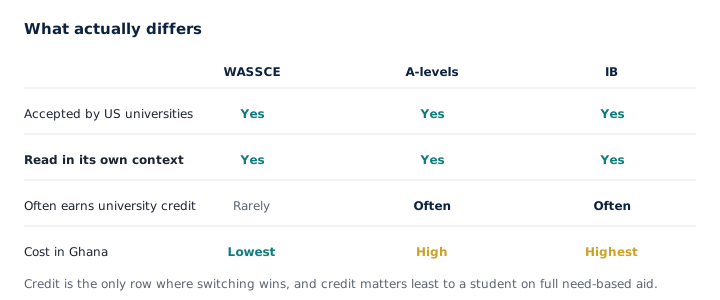
For getting in, WASSCE does the job. US universities accept it, and they read you against the system you studied in, not against IB or A-level students. Switching costs money and often a year. For most Ghanaian students, it changes the outcome far less than the list of universities you apply to.
Do US universities accept WASSCE?
Yes. US universities admit Ghanaian students on WASSCE every year, and their admissions officers read it routinely. You do not need A-levels or IB to apply. Not having them is not what stands between you and an offer.
Many students worry that WASSCE marks them as second tier next to a student with an IB diploma from an international school in Accra. It does not, and the next section explains why. Understand that before anyone spends money on a switch.
How do admissions officers read a WASSCE result?
In context. They do not turn your grades into an American GPA and compare it with a student from Singapore. They ask a narrower question: within this school and this system, how well did you do, and did you stretch yourself?
They have reference material for this. AACRAO, the US association of university registrars, publishes country profiles that explain what each qualification means in its own system. Universities that take many international students also publish their own requirements for Ghana.
Those requirements tend to ask for:
- A spread of strong passes across academic subjects, commonly around seven.
- Mathematics, English, a science, and a humanity or social science among them.
- The demanding electives your school offered.
Which SHS subjects do US universities want to see?
The demanding ones your school actually offers, in a coherent programme. You can act on this one, and it is more specific than it sounds.
An admissions officer who reads Ghanaian files knows the difference between Elective Mathematics and Core. They know which programmes lead to which electives. They can tell when you chose the demanding option and when you took the safer one.
In rough order of how much it is noticed:
- Elective Mathematics, if you are heading anywhere near a quantitative course. Apply for engineering, economics or computer science without it, and the university will ask why.
- Three strong electives in one coherent programme, not a scattered set. Science, General Arts, Business: the programme itself shows your direction.
- English and Core Mathematics, which every university looks at, whatever you plan to study.
- A fourth subject that shows range, where your school allows it.
If you are in SHS 1 or 2, that list is your answer. It matters more than any choice of exam board.
What do A-levels and IB give you that WASSCE does not?
University credit, and more depth in fewer subjects. Neither helps you get in.
Credit. Many US universities give credit for high A-level grades and for Higher Level IB scores of 5 and above. They generally treat WASSCE as completing secondary school, not as first-year university work, so it does not usually earn credit. If you pay your own way, a year of credit saves money. On full need-based aid, it mostly means you finish sooner.
Depth. A-levels go deeper into three subjects. If you already know you want physics or economics, and you want two years of it before university, that is a genuine reason to choose them.
These are real benefits, but they are not admission benefits. They just happen to come bundled into the same decision.
Does my WASSCE English grade decide whether I sit TOEFL or IELTS?
Often, yes. It is the one WASSCE result that changes what you have to do next. Some US universities accept a strong WASSCE English grade as proof of English and waive TOEFL or IELTS. Others set a threshold, and below it they want the test whatever the rest of your results.
Check each university's own page. TOEFL or IELTS costs real money in cedis, and the fee is wasted if the university would have waived it. Check early, too. If you do need the test, sit it before application season.
If your English grade is below a university's threshold, you have three options:
- Sit TOEFL or IELTS. This is the normal route, and the one universities expect.
- Resit English at WAEC's sitting for private candidates. This repairs the grade for every university at once, but takes longer.
- Ask about an alternative. Some universities accept their own interview or another assessment. Email the admissions office before you book anything. The answer is sometimes simpler than the published page suggests.
Do I need my WASSCE results before I apply?
No. Most Ghanaian applicants apply before their results are out. US applications close months before WASSCE results arrive, so you apply on your school's predicted grades and send the results later.
If you are applying before your results, do two things:
- Keep the predictions honest. A prediction far above your mock results causes trouble when the real grades arrive. Offers can be conditional, and universities can reconsider funding.
- Send your results as soon as they are published, to every university still considering you. A strong result that arrives promptly helps a little. One that arrives late, after chasing, hurts a little.
Our guide to applying before your WASSCE results covers what to send and when.
If your results are already out, you are in a stronger position, because the uncertainty is gone. If they are strong, say so plainly in the application. If one weak grade blocks a specific requirement, resit it at WAEC's sitting for private candidates. That is a far cheaper fix than a new qualification. If your results are mixed overall, change your list of universities and strengthen the rest of the file, not the exam board.
So should I switch?
For admission alone, usually not. Take the hardest subjects your school offers and do well in them. Put the money and the year into a list of universities that fund international students.
If you are choosing a programme for other reasons, such as cost, subject depth or a curriculum that suits you, choose on those reasons. US admission is not one of them.
Our ebook, The Funded Application, walks through the parts of the application that do move the outcome.
Questions people ask
Do US universities accept WASSCE?
Yes. US universities admit Ghanaian students on WASSCE every year, and admissions officers are used to reading it. They want a strong spread of passes across academic subjects, not a particular total. That usually includes mathematics, English, a science and a humanity or social science.
Will I be at a disadvantage against IB or A-level students?
Not in the way most students fear. US universities judge you against the curriculum your school offered, so they read you against what was possible at a Ghanaian SHS. A strong WASSCE in the hardest subjects your school offered reads better than a middling IB diploma.
Does my WASSCE English grade matter?
Yes, because it can decide whether you sit TOEFL or IELTS. Some universities accept a strong WASSCE English grade as proof of English and waive the test. Others set a threshold, and below it they want the test anyway. Check each university's own page, because getting it wrong costs money.
Can WASSCE earn me university credit the way A-levels can?
Usually not. Many US universities give credit for high A-level grades or Higher Level IB scores. They generally treat WASSCE as completing secondary school, not as advanced work. That is a reason to pick A-levels if you want credit, but credit is a smaller prize than admission and funding.
Should I switch to A-levels to improve my chances?
Rarely, on admissions grounds alone. It costs money and often a year. It also does not touch what decides most funded Ghanaian applications: whether the universities on your list fund international students. Switch if the curriculum suits you better or a course you want requires it.