How to study in Canada from Ghana
Apply directly to each university, or through OUAC for Ontario, usually between autumn and early in the new year. After an offer, you need a provincial attestation letter from the university and proof that you can pay tuition, travel and living costs: from 1 September 2026, at least CAD 23,448 a year for living costs outside Quebec. Few Canadian awards fully fund internationals, so plan the money first.
How do I study in Canada from Ghana?
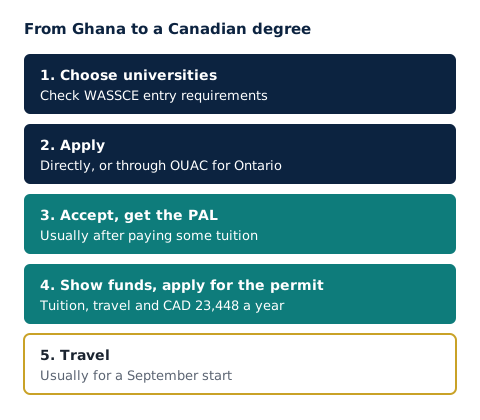
In five stages: choose universities, apply, accept an offer, get the study permit, then travel. Applying is fairly simple: most universities take applications directly, and Ontario's go through a central service called OUAC. The study permit is the harder part, because it needs an attestation letter from your university and proof that your family can pay.
Canada suits a family that can pay a large share of the cost, or a student who wins one of its few full scholarships. Canadian universities give international undergraduates very little need-based aid.
How do I apply to Canadian universities?
Directly, or through OUAC for Ontario. Each university sets its own requirements and deadlines, which mostly fall between December and February for entry the following September. Scholarship deadlines can be much earlier: the University of Toronto's Pearson Scholarship needs a school nomination in early October.
| Step | What it involves |
|---|---|
| Choose universities | Check each one's entry requirements for WASSCE students |
| Apply | Directly to most; through OUAC for Ontario universities |
| Send documents | Transcripts, WASSCE results, English proof if asked |
| Scholarships | Often a separate, earlier application |
Our guide to Canadian scholarships from Ghana covers the scholarship deadlines in detail.
Will Canadian universities accept my WASSCE?
Many do, with set grades in set subjects. Requirements vary by university and programme, and some ask for additional subjects or higher grades for competitive programmes such as engineering or computer science. Check each university's page for Ghanaian or West African applicants, and note whether it accepts WASSCE English as proof of English.
What does it cost?
Tuition, living costs and travel, for every year. International tuition varies widely by university and programme. Living costs depend on the city: Toronto and Vancouver are the most expensive.
The study permit sets a floor. For applications on or after 1 September 2026, a single applicant studying outside Quebec must show at least CAD 23,448 a year for living costs, on top of the first year's tuition and travel. Quebec sets its own figure.
Is there funding?
A little. The University of Toronto's Lester B. Pearson Scholarship and UBC's International Scholars Program fully fund a small number of international students each year. McGill gives some need-based aid to international undergraduates. Mastercard Foundation partner universities in Canada also fund some African students.
Most other awards are partial. Our guide to Canadian scholarships lists them with sources.
What do I need for the study permit?
Four things, in order:
- An offer from a designated learning institution.
- A provincial or territorial attestation letter (PAL or TAL) from the university. In most cases you must accept your offer and pay some or all of your tuition to receive it.
- Proof of financial support for tuition, living costs and travel, without working in Canada.
- The documents the visa office asks for. The office responsible for Ghana publishes an additional document checklist; follow it exactly.
Apply as soon as you have the PAL and documents, because processing takes time. Our guide to the certification of finances explains how to prepare Ghanaian bank documents, which Canada scrutinises in the same way.
Why are study permits refused?
Most often because the officer is not satisfied on the money or the plan. Common problems include funds that appeared suddenly in an account with no clear source, figures that do not cover the full cost, and a study plan that does not explain why this programme, in Canada, makes sense for the student.
So show where the money came from, over time, with documents. Write a clear study plan if the checklist asks for one: what you will study, why there, and what you will do afterwards. A refusal letter states its reasons, so read it closely before reapplying. Our guide to a US visa refused under 214(b) covers similar ground for the US.
Do I need IELTS?
It depends on the university. Some accept a strong WASSCE English grade as proof of English, and others ask for IELTS, TOEFL or another test. Check each university's requirement before booking a test. Our guide to TOEFL or IELTS compares them.
Can I work during and after the degree?
During your studies, most students on a study permit can work part-time within limits set by the government. After graduating, the post-graduation work permit allows eligible graduates to stay and work. Bachelor's degree graduates are exempt from the field of study requirement that applies to many college programmes, which makes a university degree a more flexible route than a college diploma.
The rules change often. Check them again before you graduate.
What about colleges?
Canadian colleges offer diplomas and some degrees, often at lower cost than universities. But many college programmes face the field of study requirement for the work permit, and some have been affected by the cap on study permits. Check whether a programme leads to a degree, and how its graduates qualify for work afterwards, before you choose it.
Should I apply to Canada, the US or both?
It depends on how your family will pay:
- Need substantial aid: the US is usually stronger, because a group of US universities meet full need for internationals. Add Pearson or UBC if you are a strong candidate.
- Can pay part: compare Canadian partial awards with US merit and need-based offers over four years.
- Can pay in full: Canada's lower fees and work routes can be good value.
Many students apply to both. Our guide to which country gives the best chance compares the options, and our guide to studying in the UK covers the third.
What should I do first?
Pick five Canadian universities that teach your subject and check their entry requirements for WASSCE students and their deadlines. At the same time, agree as a family what you can pay each year, in Canadian dollars, and compare it with tuition plus CAD 23,448.
If you would like help deciding between Canada and the US, or applying to both, you can book a free call with us.
Questions people ask
What are the requirements to study in Canada from Ghana?
An offer from a designated learning institution, a provincial or territorial attestation letter from it, proof that you can pay tuition, travel and living costs without working, and a study permit application with the documents the visa office asks for.
How much money do I need to show for a Canadian study permit?
Your first year's tuition and travel, plus living costs. For applications on or after 1 September 2026, a single applicant studying outside Quebec must show at least CAD 23,448 a year for living costs. Quebec sets its own amount.
Can I work in Canada after graduating?
Graduates of eligible programmes can apply for a post-graduation work permit. Bachelor's degree graduates are exempt from the field of study requirement that applies to many college programmes.
Is Canada cheaper than the US for Ghanaian students?
Published fees are often lower than at private US universities, but Canadian universities give international undergraduates very little need-based aid. For a family that needs funding, a full-need US university can cost much less.