Studying medicine in the USA as a Ghanaian student
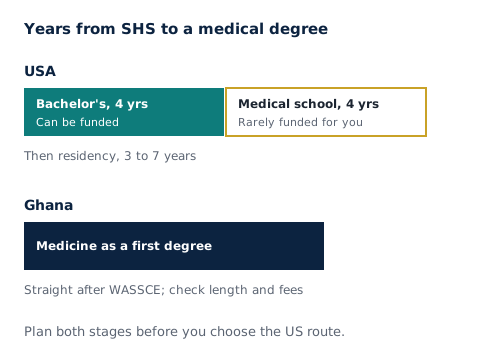
In the US you cannot study medicine straight from SHS. You first take a four-year bachelor's degree, then apply to a four-year medical school, then train further in residency. Undergraduate aid can be generous, but few US medical schools admit international students, and fewer offer them aid. So a funded US first degree is realistic; a funded US medical degree rarely is. Plan the whole path before you choose.
Can a Ghanaian student study medicine in the USA?
Yes, but not straight from SHS, and the medical degree itself is very hard to fund. In the US, you first take a four-year bachelor's degree, then apply to medical school for another four years, then train in residency. A Ghanaian student can win a funded first degree, but few US medical schools admit international students, and fewer still offer them aid.
So the US route to medicine is long, competitive and expensive at its second stage. Know the whole path before you set your heart on it.
How does the US route to medicine work?
In three stages, each with its own admission:
| Stage | Length | What it is |
|---|---|---|
| Bachelor's degree | Usually 4 years | Any major, with the science courses medical schools require |
| Medical school (MD or DO) | Usually 4 years | A graduate degree, with its own admission and the MCAT test |
| Residency | 3 to 7 years | Paid training in a specialty, after medical school |
That makes at least eight years from SHS to a medical degree, before residency. In Ghana and many other countries, medicine is a first degree taken straight after secondary school.
Do US medical schools take international students?
Some do, but only a minority, and they admit few international applicants. The AAMC, which represents US medical schools, publishes specific guidance for international applicants and advises checking each school's policy before applying. Advisers at universities such as Johns Hopkins say the same: acceptance of international students is uncommon, and options are limited.
Some medical schools that accept international students ask for proof that you can pay for all four years, sometimes held in an account in advance. That alone rules out most Ghanaian families.
What about combined BS/MD programmes?
They exist, but they are rarely an option for international students. These programmes admit students from secondary school into both a bachelor's degree and medical school. Most do not accept international applicants, and those that consider them admit very few. Do not build a plan around one.
What are the realistic routes to medicine for a Ghanaian?
Three, each with trade-offs:
- Medicine in Ghana, as a first degree after WASSCE. The most direct and usually the most affordable route to practising in Ghana.
- Medicine as a first degree elsewhere, through a funded route such as a government bilateral award where medicine is offered. Check the conditions, the language and how the degree is recognised in Ghana.
- A funded US bachelor's degree, then medicine. You might apply to US medical schools with a funding plan, or return to study medicine elsewhere, or move into a related field such as public health or research.
Note that Oxford's Reach scholarship, for example, covers all undergraduate courses except medicine. Funded medicine places for international students are scarce almost everywhere.
Is a US pre-medical degree still worth it?
It can be, if you value what it gives you beyond medicine. A US science degree with research experience opens paths into research, public health, biotechnology and graduate study, as well as medicine. Many students who start "pre-med" discover other fields they love.
But be honest with yourself and your family. If being a practising doctor in Ghana is the one goal, the Ghanaian route may get you there sooner and more surely.
What does a US medical school look for?
Strong science grades, the MCAT admission test, and real experience of medicine and research. Applicants usually show:
- The required science courses, such as biology, chemistry, physics and often biochemistry, with strong grades.
- A competitive MCAT score.
- Clinical experience, such as volunteering in a hospital or shadowing doctors.
- Research, especially for research-focused schools.
Some medical schools that accept international applicants prefer or require that the science courses were taken at a US or Canadian university. That is one reason a US first degree is the usual starting point for an international student hoping to enter US medical school.
Could I practise in Ghana with a US medical degree?
Possibly, but check the rules before you commit. Doctors trained abroad usually need to meet the registration requirements of the Medical and Dental Council of Ghana, which may include examinations or supervised practice. Ask the council how it treats a US degree and US residency training.
Remember too that US residency places for international medical graduates are competitive, and a medical degree without residency does not make you a practising doctor in the US.
What related careers can a US science degree lead to?
Many, and some are easier to fund. Public health, biomedical research, global health, health policy and biomedical engineering all start from a science or related first degree. Several of these lead to funded graduate study, such as research doctorates, which are often paid for by the university. A student who loves health but not only clinical medicine has more funded paths than they may realise.
How should this change my university list?
If medicine is your goal, add two kinds of option. Apply to medicine in Ghana, or wherever it is a funded first degree, alongside any US applications. And if you apply to US universities, choose ones that fund you fully and offer strong science and advising, so the first degree is sound whatever comes next.
What should I do first?
Write down where you want to practise medicine, and how you would pay for each stage. If the US medical-school stage has no funding plan, add a medicine-as-a-first-degree option to your list now.
If you would like help planning a route to medicine, you can book a call with us.
Questions people ask
Can I study medicine in the USA straight after WASSCE?
No. In the US, medicine is a graduate degree. You first complete a four-year bachelor's degree, usually with science courses, and then apply to medical school, which takes another four years.
Do US medical schools accept international students?
Some do, but only a minority, and they admit few international applicants. The AAMC, which represents US medical schools, publishes guidance for international applicants and advises checking each school's policy.
Is there financial aid for international medical students in the USA?
Very little. Most US medical schools offer international students little or no need-based aid, and some ask for proof that you can pay for all four years. A few offer limited scholarships.
What is the best route to becoming a doctor from Ghana?
For most students, studying medicine in Ghana, or in a country where medicine is a first degree, is far more affordable. A funded US bachelor's degree in science can still lead to medicine, but the medical degree itself is the hard part to fund.