How to reapply to US universities after a rejection
Yes. You can apply again in the next cycle, and universities do not hold the earlier rejection against you. What matters is whether something real has changed since your first attempt. For most Ghanaian students who needed funding, the thing to change is the list of universities, not the student.
Can you apply again after being rejected?
Yes, in the next cycle, and universities do not hold the earlier rejection against you. They decide one intake at a time.
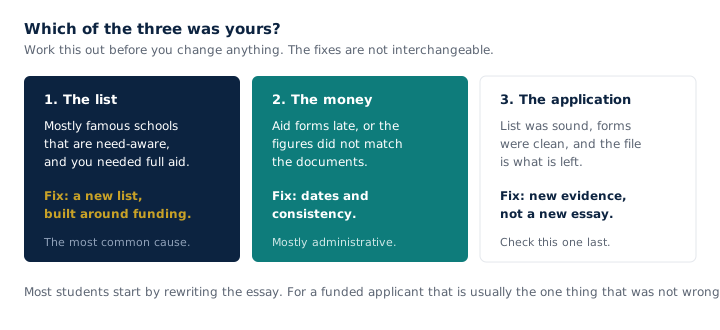
They will not decide differently on the same file, though. So first, find out which of three things went wrong: your list, your aid forms or your application. Each needs a different fix, and only one of them is the application itself.
Was my list of universities the problem?
Probably, if you needed substantial aid and applied mostly to universities everyone at your school has heard of. Two things decide whether a university can fund a Ghanaian student, and its ranking shows you neither.
- Does it meet the full demonstrated need of the internationals it admits? Many do not. Some meet only part of it. For a family that can pay little, that leaves a gap nobody can close.
- Is it need-blind or need-aware for international applicants? A need-blind university ignores your aid request when it decides whether to admit you. A need-aware one takes it into account.
Colby, for example, meets the full demonstrated need of the students it admits, and is need-aware for international applicants. NYU Abu Dhabi says it admits undergraduates need-blind and meets demonstrated need. For the same student, those are very different odds.
A list of eight need-aware universities with single-digit admit rates is not an ambitious plan. It is a plan with one outcome.
Were my aid forms the problem?
Possibly, if you filed them late or your figures did not match. Check the dates first. Aid forms have their own deadlines, usually the same day as the application. A late CSS Profile, the aid form most private universities use, does not usually cost you the admission. It costs you the funding, which ends the same way.
Then check that everything matched. Did the figures on your Profile match the documents you uploaded afterwards? Did an aid office ask a question you left unanswered for weeks? If so, the university may have decided without you.
You can fix this, and the fix is mostly paperwork. Next time, file every aid form by its deadline, keep the figures consistent with your documents, and answer the aid office quickly.
Was my application itself the problem?
Only if your list and your aid forms were both sound. Rule those out first; if they were fine, the file is what is left.
The honest signs:
- A personal statement any student anywhere could have written.
- Teacher references from people who did not know you well.
- A dip in your grades with no explanation.
- Activities listed with no sense of what you actually did.
How do I build my second list?
Start from funding and work backwards. Before a university goes on your list, answer three questions about it:
- Does it fund international students, and how much of their need does it meet?
- Is it need-blind or need-aware for internationals?
- Would I actually go if this were my only offer?
Aim for ten to twelve universities with a real spread:
- Two or three reaches, where admission is a long shot.
- Five or six where your profile sits above the middle.
- Two or three where both admission and funding are realistic.
A famous name with no history of funding Africans is a wasted application fee, and the fees add up in cedis.
What counts as new evidence?
Anything that changes the picture the first reader saw. A university reading your second application looks for one thing: what is different.
Three kinds of exam result count:
- Your WASSCE results, if you applied on predicted grades and the results came out well. The uncertainty that made you a risk is gone.
- A WASSCE resit, if one grade was the problem. WAEC runs a sitting for private candidates, and a repaired grade is concrete evidence. If one grade stands between you and a university's requirement, this is the most direct fix.
- A better SAT score, after three months of structured preparation, not a repeat under the same conditions. A score that moves meaningfully shows growth.
The fourth is a year with something in it, covered next. What does not count: the same file, sent again, a year later.
What should I do with the year?
Something you can describe precisely afterwards. Here is what has worked for Ghanaian reapplicants:
- Teaching. Many SHS take on recent leavers to help with junior classes or exam preparation. It is local work and a year of real responsibility.
- Working in the family business, and running part of it. The stock, the accounts or the staff rota is a real thing to write about. It often interests a reader more than volunteering.
- Building something small. A tutoring group, a repair service, a farm plot, a page that people actually use. Scale does not matter. Starting it and keeping it going does.
- Caring for family. If this is how your year goes, it counts. Be ready to say what you did and what it taught you.
Whatever you choose, you should be able to say what you did, what went wrong and what you learned. A year of waiting answers none of those.
What are my odds the second time?
Better if something real has changed, and no better if nothing has. Students reapply every year and end up funded. The ones who do sent a second application that was a different document.
Suppose you go through the three checks honestly and find a sound list, clean forms and a strong application. Then universities that reject most of the strong people who apply turned you down. That happens, and it is not a verdict on you. The answer is a wider list, not a better essay.
If you want someone to go through last year's application and tell you which of the three it was, that is the most useful hour you can spend before you start again. You can book a call with us.
Questions people ask
Can I apply to a university that already rejected me?
Yes. A rejection applies to that intake, and most universities let you apply again in a later cycle. Some ask on the form whether you have applied before, and the honest answer costs you nothing. Sending the same file again does cost you: if nothing has changed, the reader has no reason to decide differently.
Does taking a gap year hurt my chances?
Not by itself. Universities are used to applicants who are a year out of school. A year spent teaching, working, retaking an exam or building something is ordinary. They want to see that the year made you a stronger candidate. A year with nothing in it is the version that hurts.
Should I start at a Ghanaian university and transfer instead?
Only after you check each university's transfer aid policy. A university transcript is real evidence, but aid for international transfer students is far scarcer than aid for first-year students. Some universities that meet full need for first-years do not do the same for transfers.
Now that I have my WASSCE results, does that change things?
It can change a great deal. The first time, you applied on predicted grades. Now the university can see your real results. If they came out stronger than your predictions, put them at the centre of your second application.
How many universities should I apply to the second time?
More than the first time, and spread differently. Failed Ghanaian applications often rest on a short list of famous need-aware universities. A list built for funding runs to ten or twelve, with a real spread of selectivity, and every one somewhere you would actually go.