Student loans to study in the USA from Ghana
Loan options are narrow. Students on an F-1 visa cannot get US federal student loans. Most US private loans need a US citizen or permanent resident as cosigner. A few lenders lend without one, but mainly to students within two years of graduating. Ghana's Students Loan Trust Fund covers only study in Ghana. For most families, need-based aid is a far better route than borrowing in dollars.
Can a Ghanaian student get a loan to study in the USA?
Sometimes, but the options are narrow and expensive, and for most families they are the wrong place to start. US federal student loans are closed to students on an F-1 visa. Most US private loans need a cosigner who is a US citizen or permanent resident. A few lenders lend without one, but mostly to students near the end of their degree. Ghanaian options mostly fund study in Ghana, not abroad.
Before looking at loans, look at aid. A group of US universities meet the full demonstrated need of international students with grants, which do not have to be repaid. For a family that would otherwise borrow, those universities are usually the better route.
Why can't I get a US federal loan?
Because federal student aid is for US citizens and certain eligible non-citizens. The US Department of Education says students on F-1 visas are not eligible. That closes the cheapest, most flexible loans in the country to international students.
What other loans exist?
Four kinds, each with limits:
| Loan | Who can get it | The catch |
|---|---|---|
| US private loan with a cosigner | Students with a US citizen or permanent resident willing to cosign | The cosigner is fully liable if you do not repay |
| No-cosigner lender | International students at supported schools, usually near graduation | Rarely available for the first years; interest can be high |
| Ghanaian bank loan | Families with income, collateral or both | In cedis, at Ghanaian rates; the dollar cost can rise |
| University loan in an aid package | Students offered one by their university | Part of the aid award; read the terms |
The Students Loan Trust Fund, Ghana's government student loan scheme, lends only to students in accredited programmes at accredited institutions in Ghana. It does not fund study abroad.
What about lenders that need no cosigner?
A few specialist lenders lend to international students without a cosigner or collateral. MPOWER Financing is one of the best known. Its rules require students to be within two years of graduating and to attend a school it supports, among other conditions.
So these loans can help a student who is already in the US and has a gap in the last two years. They rarely solve the problem of paying for the first year, which is when the visa needs proof of funds. Read every lender's terms, and compare the interest rate and repayment period with care.
What is the risk of borrowing in dollars?
Exchange rate risk. A loan in dollars is repaid in dollars. If the cedi weakens during or after the degree, the same dollar repayment costs more cedis each month. A graduate who returns to work in Ghana and earns in cedis carries that risk for the life of the loan.
A loan in cedis from a Ghanaian bank has the opposite problem: the fees are in dollars, so a weaker cedi means the loan covers less of the cost each year. Either way, a family borrowing for a US degree is exposed to the exchange rate.
Do universities include loans in aid packages?
Some do. A university that meets full need may meet part of it with a loan, alongside grants and a campus job. Others meet need entirely with grants. Read every award letter for the word "loan" and work out what is a grant and what must be repaid. Our guide to reading an award letter shows how.
When comparing offers, compare the grants. A package with more loan and less grant costs your family more, even if the total looks the same.
Can a loan count as proof of funds?
Some universities accept an approved loan as part of the evidence they need before issuing the I-20. Ask each university what it accepts, and make sure the loan is confirmed, not merely applied for. At the visa interview, be ready to explain how the whole degree will be paid for, not only the first year. Our guide to the certification of finances covers the documents.
When does a loan make sense?
In three narrow cases:
- A small gap in a good offer. A funded place that leaves a few thousand dollars a year, which a modest loan or family savings can cover.
- The final years of a degree, when a no-cosigner lender may help after an unexpected change in the family's finances.
- A family that can repay comfortably even if the cedi weakens.
In every case, work out the total repayment in cedis, at a weaker exchange rate than today's, before you sign.
What should we ask any lender?
Six questions, answered in writing before you sign:
- What is the interest rate, and is it fixed or variable?
- What fees are charged on top of interest?
- When does repayment start, and for how long?
- What happens if the student cannot work after graduating, or returns to Ghana?
- Does the loan cover every year, or must we reapply each year?
- Who is liable if payments stop: the student, a parent or a cosigner?
Be wary of any lender or agent who promises a loan before seeing your documents, or asks for a fee to "arrange" one.
Where should we look first?
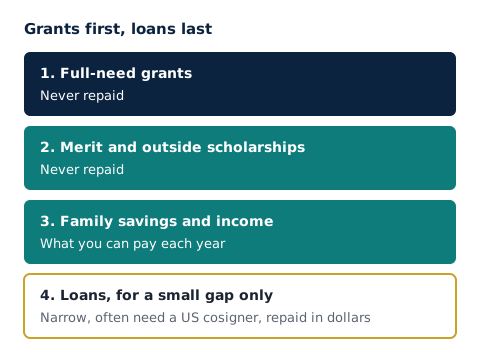
In this order:
- Universities that meet full need for international students. Our guide to universities that meet full need lists them.
- Merit scholarships and outside awards, including Mastercard Foundation and other programmes for African students.
- What the family can pay from savings and income.
- Loans, only for a small, clearly defined gap.
What should we do first?
Before any loan conversation, list how much your family can pay each year in dollars. Then build a university list in which most universities would meet the rest with grants. Only if a gap remains, look at loans.
If you would like help finding the aid that makes a loan unnecessary, our Scholarship and Aid Sprint completes the aid forms with you and builds a scholarship list for every university on your list.
Questions people ask
Can a Ghanaian student get a student loan to study in the USA?
Sometimes, but not easily. Federal loans are closed to F-1 students. Private US loans usually need a US citizen or permanent resident as cosigner. A few lenders lend to international students without one, mostly in the last two years of a degree.
Can I get a loan without a cosigner?
From a few specialist lenders. MPOWER Financing, for example, lends without a cosigner, but requires students to be within two years of graduating and to attend a school it supports. That rarely helps with the first year.
Can the Students Loan Trust Fund pay for study abroad?
No. The SLTF lends to Ghanaian students admitted to accredited tertiary programmes in accredited institutions in Ghana. It does not fund study abroad.
Can a loan count as proof of funds for the I-20 and visa?
Some universities accept an approved loan as part of the proof of funds. Ask the university what evidence it accepts before relying on one, and make sure the loan covers every year, not only the first.