How to read a US financial aid award letter
Find four numbers: the cost of attendance, the grants and scholarships, any work or loans, and the family contribution. Grants are money you never repay. Work is money you earn on campus. Loans are repaid. What your family actually pays is the cost minus the grants, with any loan added back as a future cost. Check the terms for renewal before you accept.
How do I read a financial aid award letter?
Find four numbers: the cost of attendance, the grants and scholarships, any work or loans, and the family contribution. Then work out one more: what your family actually pays. That last number is the only one that matters for your decision, and few letters print it plainly.
Award letters look different at every university. Some fit on one page; others run to several, with their own names for each kind of aid. Read past the format, and find the same four numbers in each.
What are the parts of an award letter?
Most letters have five parts:
| Part | What it means |
|---|---|
| Cost of attendance | The university's estimate of a year's costs: tuition, fees, housing, food, books, insurance, personal costs and travel |
| Grants and scholarships | Money you never repay, from the university or outside |
| Work | An amount you are expected to earn from a campus job |
| Loans | Money you borrow and repay, usually after graduating |
| Family contribution | What the university expects your family, and sometimes you, to pay |
Some letters split the cost into direct costs, which the university bills, such as tuition and housing, and indirect costs, which you pay yourself, such as books, travel and personal spending. Both count.
How do I work out what we will actually pay?
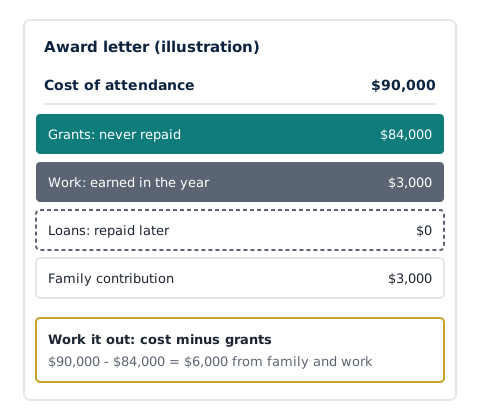
Subtract the grants and scholarships from the cost of attendance. What remains is covered by your family contribution, any work and any loan.
An illustration, with round figures: a cost of attendance of $90,000, grants of $84,000, work of $3,000 and a family contribution of $3,000. Your family pays $3,000, and you earn $3,000 on campus. If the same letter had a $5,000 loan instead of part of the grant, that $5,000 would be repaid later, with interest.
Then multiply by four. A difference of $2,000 a year between two letters is $8,000 over a degree, before any change in the exchange rate. Seen that way, small lines on a letter become real decisions for a Ghanaian family.
Write this out for each letter, in a simple table. Our guide to comparing aid offers shows how to set two or more side by side.
What does work-study mean?
An amount you are expected to earn from a campus job during the year. It is not paid upfront or taken off your bill. You find a campus job, work a set number of hours a week, and receive wages, which usually go towards books and personal costs.
International students on an F-1 visa can generally work on campus during term, within limits. The university's student employment office helps you find a job when you arrive.
Are loans common for international students?
Less common at the universities that fund international students best. MIT, for example, says its aid never includes loans. Others include a loan in the package. A loan offered to an international student may come from the university itself, since US government loans are generally not open to international students.
If a letter includes a loan, find out its interest rate, when repayment starts and whether you can decline it. Our guide to what "meets full demonstrated need" means explains how loans fit into a package.
What does a family contribution of zero mean?
That the university expects nothing from your family for the year's cost of attendance. Grants, and perhaps a campus job, cover the rest. For many Ghanaian families with modest incomes, this is what a full-need offer looks like.
It does not mean the year is free of every cost. Expenses before arrival, such as the visa and SEVIS fees and sometimes the first flight, fall outside the academic year. Personal spending beyond the university's estimate is yours too. Check what the cost of attendance includes, and plan for the rest.
What if the letter is not what we expected?
Compare it with your expectations line by line, then ask. If the family contribution is far above a net price calculator's estimate, look for the reason first: a property counted, a business valued, or a document the office did not receive.
If the letter rests on a mistake, or misses a circumstance that affects what your family can pay, you can ask the aid office to review it. Do that before the acceptance deadline, with documents. Our guide to appealing an aid offer explains how.
What if the letter says documents are missing?
Send them at once. Some letters are estimates until the aid office receives every document it asked for, such as a tax statement or a business record. An estimate can change when the documents arrive, and a missing document can delay the final offer past your deadline. Check the portal, send what is missing, and ask the office to confirm the offer is final.
What else should I look for in the letter?
Three things that affect later years:
- Renewal rules. Most need-based aid is recalculated each year when you file updated forms. Merit awards may require a minimum grade point average.
- Outside scholarships. Whether an outside award reduces the university's grant. Princeton, for example, says outside awards reduce its grant.
- Deadlines. When you must accept the aid, and any documents still missing.
Vassar, like many universities, publishes a guide to reading its own aid offer. Look for one on each university's aid website.
What should I do first?
Take each award letter and copy out five numbers: cost, grants, work, loans and the family contribution. Subtract the grants from the cost. If anything is unclear, email the aid office before the acceptance deadline.
If you would like help reading your offers and working out what each one really costs, that is part of the Scholarship and Aid Sprint.
Questions people ask
How do I read a financial aid award letter?
Find the cost of attendance, then each type of aid: grants and scholarships, work, and loans. Subtract only the grants from the cost to see what remains, and note any loan as money you will repay later.
What is the difference between a grant and a loan?
A grant or scholarship is money you never repay. A loan must be repaid, usually after you graduate. Many universities that meet full need for international students give grants rather than loans, but check each letter.
What is work-study in an award letter?
An amount you are expected to earn from a campus job during the year. It is not paid upfront; you earn it in wages as you work, and it usually goes towards personal costs and books.
Is the award the same every year?
Usually not exactly. Need-based aid is recalculated each year from your family's updated figures, and merit awards may depend on your grades. The letter or the aid office will explain the renewal rules.