Admitted to a US university without aid: what now?
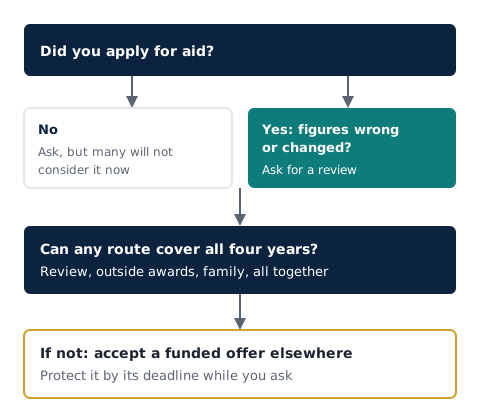
First find out why. If you did not apply for aid, many universities will not consider you now: Columbia and Penn say so for international students. If you applied and the aid is too low, you can ask for a review with documents. Outside scholarships rarely close a large gap. If no route covers the cost for four years, accept a funded offer elsewhere, however hard it feels.
What do I do if I am admitted with no aid?
Find out why, then decide calmly. There are three usual reasons: you did not apply for aid, the university gives international students little aid, or it calculated that your family can pay most of the cost. Each has a different answer. If none of them leads to an affordable four years, the right choice is a funded offer elsewhere.
An admission letter is exciting, and walking away from it hurts. But a place your family cannot pay for is not a place you can keep.
Why did this happen?
One of three reasons, and the aid office can tell you which:
| Reason | What it means | What you can do |
|---|---|---|
| You did not apply for aid | No aid was ever considered | Ask, but many universities will not consider it now |
| The university gives internationals little aid | It admits some international students without funding them | Little; look at your other offers |
| Your calculated contribution is high | The aid office read your forms as able to pay most of the cost | Ask for a review if the figures are wrong or have changed |
Email the aid office, give your application number, and ask plainly which applies. A short, polite question gets a clear answer.
Can I ask for aid now?
At many universities, not if you are an international student who did not ask for it when you applied. Columbia and Penn both say that an international student admitted without requesting aid cannot request it later. Vassar says international students who want aid at any point must apply when they apply for admission.
A few universities may consider a late request in special circumstances, such as a sudden change in your family's situation. Ask, and explain the circumstance with documents, but do not count on a yes. Our guide to whether asking for aid hurts explains why asking at the start matters.
Can we appeal a high family contribution?
Yes, if the figures behind it are wrong or have changed. A business valued twice, income misread, a lost job or a death in the family are all reasons the aid office can act on. Send a short letter with documents, well before the reply deadline. Our guide to appealing an aid offer shows how.
If the figures are right, an appeal is unlikely to change much. The office has calculated what it believes your family can pay, and it will not usually bargain.
Can outside scholarships fill the gap?
Rarely, if the gap is large. Most outside scholarships are small or one-off, and many are not open to international students at US universities. A gap of $50,000 or more a year, for four years, is beyond almost any of them.
The large, reliable funding for Ghanaian undergraduates in the US comes from the universities themselves. That is why a list built around universities that meet full need matters so much.
Can we borrow the money?
It is rarely a good answer. US government student loans are generally not open to international students. Private lenders that do lend to them often require a US co-signer, charge high interest, or limit the amount. A four-year loan for a full US cost would leave a graduate with debt larger than many salaries in Ghana could repay.
Borrowing in Ghana against land or a house puts the family's security at risk for a degree that funded universities would have paid for. If a loan seems the only way, stop and compare it with your funded offers first.
How do we decline the place?
Politely, in writing, and as soon as you decide. Thank the university, say you are unable to attend because the cost is beyond your family's means, and withdraw through the applicant portal. There is no need to explain more.
Universities understand. Declining frees the place for another student, and it leaves a good impression if you ever apply there again, for a transfer or for graduate study.
How do we cope with the disappointment?
Name it, then move on together. It is hard to turn down a famous name, especially after months of work and family hopes. Let your child feel it, and remind everyone that the admission itself is a real achievement.
Then turn to the funded options with the same energy. The university your child attends matters far less, in the end, than what they do there.
What about deferring and reapplying for aid?
Check the rules before you rely on this. Many universities do not allow a student admitted without aid to apply for it after a deferral. Reapplying with a new application, and asking for aid that time, may be possible, but it starts the whole process again with no guarantee.
What should I choose instead?
Your best funded offer, if you have one. Compare what each offer leaves your family to pay each year, for four years, and choose the one that fits. Our guide to comparing aid offers shows how.
If you have no funded offer this year, look at funded options outside the US, a place at a university in Ghana, or a stronger list next year. None of these is a failure. Each is a way to reach a degree your family can afford.
What should I do first?
Email the aid office today and ask why your offer has no aid, or less than you need. While you wait, accept your best funded offer elsewhere by its deadline, so you do not lose it.
If you would like help reading the situation and deciding, that is part of the Scholarship and Aid Sprint.
Questions people ask
Can I apply for aid after being admitted?
At many universities, no, if you are an international student who did not apply for aid at the start. Columbia and Penn both say this. A few universities may consider a late request in special circumstances, so ask, but do not count on it.
Why was I admitted with no aid when I applied for it?
Some universities give international students little or no need-based aid, even when they admit them. Others calculated a family contribution close to the full cost from your forms. The aid office can tell you which.
Can outside scholarships cover the gap?
Rarely, if the gap is large. Most outside awards are small or one-off, and a gap of $50,000 or more a year for four years is beyond almost any of them. The large funded routes are universities that meet full need.
Should I defer and reapply for aid next year?
Check the university's rules first. Many do not allow a student admitted without aid to apply for it after deferring. Reapplying through a new application may be possible, but it starts the process again.