Ashinaga Africa Initiative: a guide for Ghanaians
Yes, a Ghanaian student who has lost one or both parents can apply, if they are near the top of their class and cannot pay for university abroad. Ashinaga pays for an undergraduate degree abroad, in Japan, the UK, the USA or elsewhere in Europe, after a year of preparation in Africa. In return, Scholars commit to come back and work for the development of sub-Saharan Africa.
Can a Ghanaian student apply to the Ashinaga Africa Initiative?
Yes, if you have lost one or both parents, rank near the top of your class, and could not study abroad without support. Ghana is among the eligible countries. Ashinaga, a Japanese foundation, pays for a first degree abroad for a small number of such students each year.
It is one of very few scholarships that funds a full undergraduate degree abroad and is built around students who have lost a parent. If that is you, it belongs on your list.
Who is it for?
Students who meet four conditions at once. Recent calls have asked that you:
- Have lost one or both parents.
- Rank near the top of your class. Recent calls asked for students regularly in the top 10% over their last two or three years of secondary school.
- Finished secondary school recently, with national exam results within the last two years.
- Cannot pay for university abroad without outside support.
You must also be able to study in English, French or Portuguese, take part in a full year of preparation before university, and commit to returning to sub-Saharan Africa. Each call sets an age limit and its own detailed rules, so read the current call in full.
What does Ashinaga pay for?
The whole degree, and the preparation before it. Ashinaga says its support covers tuition, accommodation, travel and other necessary fees for an undergraduate degree abroad. It also covers every cost of the preparation programs in Africa.
Few scholarships cover this much. Fewer still pay for a year of support before university, so that you arrive ready.
What it does not do is choose your university for you, or guarantee a place at any particular one. Scholars still apply for admission, with Ashinaga's guidance, and the universities decide. Go in expecting to work on those applications as hard as on the Ashinaga one.
How does the preparation year work?
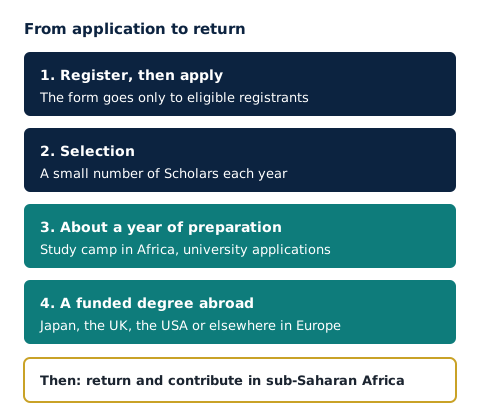
Selected Scholars spend about a year in preparation programs before they start university. Ashinaga runs them at study camps in Africa, in Uganda or Senegal.
During that year, Scholars work on three things:
- Academic preparation, for study at a university abroad.
- University applications, with Ashinaga's help, to universities in Japan, the UK, the USA or elsewhere in Europe.
- Leadership and personal development, built around each Scholar's kokorozashi, a Japanese word for a heartfelt mission in life.
So an Ashinaga Scholar usually starts university a year later than a student who applies straight from SHS. Plan for that year: it is part of the program, not a delay.
How do I apply?
Register first, then apply. Ashinaga asks every applicant to register to confirm eligibility. Only students it deems eligible receive the application form by email. So the first step is to register as soon as a call opens, then watch your email.
Each call has its own deadline, and dates change. The call for the 2027 cohort closed in August 2026. Read Ashinaga's "Apply to the AAI" page for the next one, and gather three things in advance:
- Your results, including your WASSCE certificate.
- Proof of your loss, such as a parent's death certificate.
- Evidence of your class ranking from your school.
Many Ghanaian schools do not publish a class rank. If yours does not, ask your headteacher for a signed letter on school letterhead. It should state where you stood in your year group, and in which subjects, over your last two or three years. Attach your termly reports so the letter can be checked.
What is the commitment to return?
A promise to come back and contribute. Ashinaga Scholars commit to return to their home country, or elsewhere in sub-Saharan Africa, after graduating, and to work for the region's development.
Take this seriously before you apply. Ashinaga selects Scholars partly on how they mean to contribute. Your kokorozashi is not an essay slogan. It is what you plan to do with the degree. Write about it plainly, and connect it to your own life and community.
What if I do not meet Ashinaga's conditions?
You still have funded routes, and losing a parent still matters in each of them. If your results are too old, your ranking falls short or you missed the call, look at three other routes:
- US universities that meet full need. The aid forms ask about the parent or parents you live with. If you have lost a parent, your family's calculated contribution reflects one income, not two. Our guide to universities that meet full need names them.
- Mastercard Foundation partner universities, which select students with strong results and real financial need. Our guide to the Mastercard Foundation Scholars Program explains how to apply.
- Ghana government scholarships, including local awards with places for needy students. Our guide to Ghana government scholarships covers them.
In every one of these, explain your loss plainly where the application allows it. Readers want to understand your circumstances, not to be impressed by them.
Should I apply to Ashinaga and US universities in the same year?
You can, but think about the order. Ashinaga's year of preparation means you apply to universities abroad through the program, a year after selection. If you are also applying directly to US universities that meet full need, you need to know which you would choose if both say yes.
Many students apply to both. A direct US offer may start a year sooner. Ashinaga gives you a year of preparation and a network of Scholars. Talk through the choice with your family before results arrive. Our guide to scholarships for Ghanaian students sets Ashinaga beside the other routes.
What should I do first?
Read Ashinaga's "Apply to the AAI" page and note when the next call is expected. Ask your school now for a letter confirming your class ranking, and put your documents in one folder.
If you would like help weighing Ashinaga against a direct US application, you can book a call with us.
Questions people ask
Who can apply to the Ashinaga Africa Initiative?
Students from sub-Saharan Africa, including Ghana, who have lost one or both parents, rank near the top of their class, finished secondary school recently, and could not study abroad without support. Each call sets its own age and results rules.
What does Ashinaga pay for?
An undergraduate degree abroad, with tuition, accommodation, travel and other necessary fees. It also pays for the preparation programs before university.
Where do Ashinaga Scholars study?
At universities in Japan, the UK, the USA or elsewhere in Europe. Scholars apply to universities during the preparation year, with Ashinaga's help.
Do I have to return to Africa after Ashinaga?
Yes, that is the heart of the program. Scholars commit to return to their home country or elsewhere in sub-Saharan Africa and contribute to its development after graduating.
When is the Ashinaga deadline?
It changes each cycle. The call for the 2027 cohort closed in August 2026. Check Ashinaga's "Apply to the AAI" page for the next call, and register early, because the application form goes only to eligible registrants.