What is an I-20? A guide for Ghanaian students
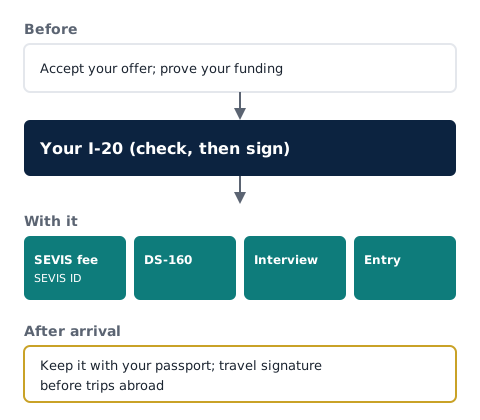
The I-20 is the form your US university issues to show you are admitted and can pay for your studies. Its full name is the Certificate of Eligibility for Nonimmigrant Student Status. You need it to pay the SEVIS fee, apply for your F-1 visa and enter the US. The university issues it after you accept your offer and prove your funding. Check every detail, sign it, and keep it with your passport.
What is an I-20?
The form your US university issues to show you are admitted and can pay for your studies. Its full name is the Certificate of Eligibility for Nonimmigrant Student Status. A designated school official at your university creates it in SEVIS, the US government's database of international students, and sends it to you.
Everything that follows depends on it. You need the I-20 to pay the SEVIS fee, to apply for your F-1 visa at the US Embassy in Accra, and to enter the United States. You keep it throughout your studies.
Is the I-20 the same as a visa?
No. They do different jobs. The F-1 visa is the stamp in your passport that lets you travel to the US and ask to enter. The I-20 shows that you are eligible for student status at a particular university. You need both to enter, and once inside the US, it is the I-20 and your enrolment that keep you in status.
That is why a visa can expire while you are still studying lawfully. What matters inside the US is that your I-20 is valid and you follow its rules. You need a valid visa again only if you leave and want to return.
How do I get one?
Your university issues it after two things happen: you accept your offer, and you prove you can pay for the first year. Proof usually means a certification of finances with bank documents, or an aid letter that covers the cost. Our guide to the certification of finances explains it.
Send the documents as soon as you accept. The international office then creates your record and sends the I-20, often electronically. If weeks pass with no I-20, write to them and ask what is missing.
What does the I-20 show?
Five things, mainly:
| Section | What it shows |
|---|---|
| Your details | Name, date of birth, country of birth and citizenship |
| Your SEVIS ID | A number beginning with N, unique to you |
| Your programme | The university, the course, and the start and end dates |
| Your finances | Estimated costs for a year and how they will be paid |
| Signatures | The school official's and, once you sign it, yours |
The SEVIS ID is the number you use to pay the SEVIS fee and to fill in the DS-160 visa form. Keep it handy.
What should I check when it arrives?
Every detail, before you pay anything else. Look for:
- Your name exactly as on your passport, in the same order and spelling.
- Your date of birth and country of birth.
- Your programme and the correct university.
- The start date, which should match your orientation or term.
- The financial figures, which should match your aid letter and documents.
If anything is wrong, ask the international office to correct it and issue a new I-20. A mismatch between your I-20 and your passport can cause problems at the visa interview or at the border.
What do I do with it next?
Three steps, in order:
- Sign it, in the student signature section.
- Pay the SEVIS fee, using the SEVIS ID and school code on the I-20.
- Complete the DS-160 and book your visa interview, bringing the I-20 to the interview.
Our guide to the SEVIS fee and DS-160 walks through both forms.
How do I keep it valid while I study?
Keep it safe, keep it current, and tell your university about changes. In practice:
- Keep the printed, signed I-20 with your passport. You show it when you enter the US.
- Get a travel signature before trips abroad. If you leave the US during your studies, a school official signs the travel section, and the signature must be within a year of your return.
- Report changes: a new address, a change of major, or a programme that will take longer than the end date shows.
What if my I-20 arrives late?
Ask early, and ask what is missing. Delays usually come from a missing document, a funding figure that does not add up, or a busy international office in May. Check your new student portal, send anything outstanding, and email the office with your full name and student ID.
A late I-20 squeezes everything after it: the SEVIS fee, the DS-160 and the visa appointment. If your start date is near and the visa wait in Accra is long, tell the university. It may be able to adjust your start or advise you on the timing.
When can I enter the US with it?
Usually up to 30 days before the programme start date on your I-20. Plan your flight with that in mind, and aim to arrive in time for international student orientation. Carry the I-20 and your aid letter in your hand luggage, because the border officer may ask to see them.
What if I change universities or my dates change?
Tell your international office early. A delayed start, a deferral or a transfer each needs an updated I-20. The office can issue a new one with the right dates, and in a transfer the new university issues its own.
Should I keep copies?
Yes. Scan the signed I-20 as a clear PDF, and keep it with scans of your passport, visa and aid letter, both on your phone and with a parent in Ghana. If the original is lost or damaged, your international office can reissue it, but a copy speeds everything up. Keep every version you receive, in date order, because each one records a stage of your studies.
What should I do first?
As soon as you accept an offer, send your financial documents to the university. When the I-20 arrives, check every line against your passport and aid letter, then sign it.
If you have a question about your I-20, send us a message on WhatsApp.
Questions people ask
What is an I-20 for?
It shows the US government that a certified school has admitted you and that your studies are funded. You use it to pay the SEVIS fee, apply for the F-1 visa and enter the United States, and you keep it throughout your studies.
How do I get an I-20?
Your university issues it after you accept your offer and send proof of funding, usually a certification of finances with bank documents or your aid letter. The university's international office sends it to you, often electronically.
What should I check on my I-20?
Your name exactly as on your passport, your date of birth, your programme, the start and end dates, and the funding figures. Ask the university to correct any error before you pay the SEVIS fee or apply for the visa.
Do I need my I-20 after I arrive?
Yes. Keep it with your passport throughout your studies. If you travel outside the US, you usually need a travel signature from your university, valid for up to a year, to return.