Education agents vs advisers: a guide for Ghanaian parents
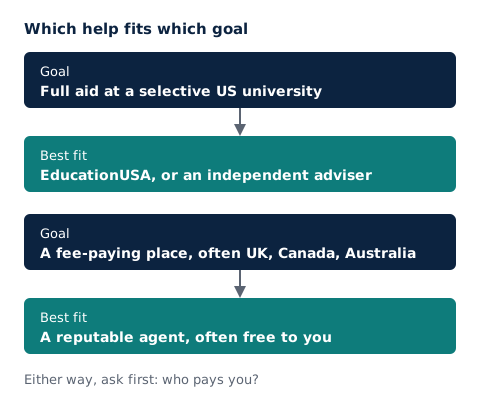
An education agent is usually paid by the universities it sends students to, so its advice tends to lead to its partner institutions. An independent adviser is paid by your family and can recommend anywhere. For a family paying fees at a university that recruits through agents, an agent can be useful. For a family seeking full aid at selective US universities, an adviser or free help such as EducationUSA usually fits better.
What is the difference between an agent and an adviser?
Who pays them. An education agent is usually paid by the universities it sends students to, as a commission for each student who enrols. An independent adviser is paid by your family, as a fee. That one difference shapes whose interests the advice serves.
Neither is good or bad in itself. Each suits a different goal. The mistake is choosing one without knowing which you have, or using the wrong kind for the goal you have.
How do agents earn their money?
Mostly from commissions. A university or college that recruits through agents pays them for each student who enrols, often a share of the student's first-year tuition. Some agents also charge families a service fee.
This is common and legal. NACAC, the US association of college admission counsellors, has allowed its member institutions to use commissioned agents for students outside the United States, with guidance on ethics and contracts. Many universities in the UK, Canada and Australia rely on agents to recruit.
The catch is simple: an agent's list of universities is usually its list of partners. If a university does not pay the agent, the agent has little reason to suggest it.
How do advisers earn their money?
From the families they work with, as an agreed fee for a stated service. An independent adviser can, in principle, recommend any university, because no university pays them. They should tell you plainly that they take no commissions, and put their fee and services in writing.
Free advisers exist too. EducationUSA, the US State Department's network, gives free advice in Accra and Kumasi. Your school's counsellor, if it has one, is another free source.
| Commission agent | Independent adviser | EducationUSA | |
|---|---|---|---|
| Paid by | Partner universities | Your family | US government |
| Cost to your family | Often little or nothing | A stated fee | Free |
| Which universities | Mostly partners | Any | Any US university |
| Best for | Fee-paying places at partner institutions | Full-aid strategy and a tailored list | Reliable information and group guidance |
Which kind suits a family seeking full aid?
An adviser or free help, usually. The selective US universities that meet full need for international students fill their classes from large numbers of direct applicants, and a student applies to them through the Common App or their own portal. They may not be on an agent's commission list at all.
So an agent focused on its partners may never suggest the universities most likely to fund your child fully. A family seeking full aid needs help built around aid policies: which universities meet full need, how to file the aid forms and how to compare offers.
When is an agent a good choice?
When your family can pay fees and is applying to universities that recruit through agents. In that case an agent's service may cost you little or nothing, and a good one saves time with forms, documents and visas.
Choose one that is open about its partners, honest about costs, and does not promise admission or a visa. Our guide to choosing a study abroad consultant lists the questions to ask and the warning signs.
What about the school's own counsellor?
Use them first, if your school has one. A school counsellor is paid by the school, costs your family nothing, and has a role no agent or adviser can fill: they write the counsellor recommendation and send your school's documents. Many Ghanaian schools have no college counsellor, and then the headteacher or an assistant head usually takes that role.
Even where a school counsellor knows little about US aid, they matter. Keep them informed, whatever other help you use, so the school's part of the application arrives on time.
Does using an agent change how a university sees my child?
It should not, if the application is honest. Universities judge the student's record, essays and recommendations, not who helped with the forms. Some application forms ask whether an agent or paid adviser helped; answer truthfully.
What does harm an application is an agent who writes the essays, fills in the forms as if they were the student, or changes figures on the aid forms. Those are not services; they are risks to your child's place. Our guide to choosing a study abroad consultant lists what a good one should and should not do.
Can we use both?
Yes, for different goals. A family might apply to selective US universities for full aid on its own or with an adviser, and use an agent for a fee-paying backup in another country. Keep each one's role clear, and make sure neither controls your child's accounts or documents.
How do we check who we are dealing with?
Ask three questions, and expect straight answers:
- Who pays you? Commission from universities, a fee from us, or both?
- Which universities are your partners? A list, in writing.
- Would you recommend a university that does not pay you? And can you show one you have?
Ask for the answers in writing, with the fee and the services, before you pay anything or hand over any document. Keep copies, and keep your child's passport and original certificates at home; an agent or adviser needs only copies.
An honest agent or adviser answers all three without discomfort. One who avoids them has answered anyway.
What should we do first?
Decide your goal: a full-aid place, a fee-paying place, or both. Then ask anyone you are considering the three questions above. Visit EducationUSA first; it is free and has no partners to favour.
If you would like to put the same questions to us, you can book a call.
Questions people ask
How are education agents in Ghana paid?
Mostly by commission from the universities and colleges they recruit for, often a share of the student's first-year tuition. Some also charge families a fee. Ask any agent who pays them and how much.
Is it wrong for an agent to be paid by universities?
No. It is a common, legal arrangement for recruiting international students, and the US college counselling association NACAC allows its members to use commissioned agents abroad with safeguards. The issue is only that the agent's advice may favour its partners.
Do I need an agent to apply to US universities?
No. Selective US universities accept applications directly through the Common App or their own portals, and EducationUSA gives free advice in Accra and Kumasi.
When is an agent a good choice?
When your family can pay fees and is applying to universities that recruit through agents, such as many in the UK, Canada and Australia. The agent's service may be free to you and can save time with paperwork.